
Month: September 2025

  • Agile & Adaptive Consulting: Real-Time Advisory for Transformation in Volatile Markets

    Agile & Adaptive Consulting: Real-Time Advisory for Transformation in Volatile Markets

    Transformation is no longer a one-time, multi-year roadmap executed in a predictable environment. Today, organizations operate in a landscape of constant disruption—geopolitical shifts, economic uncertainty, rapid technological innovation, and evolving customer expectations. In such a volatile environment, traditional consulting models, built on static strategies and lengthy implementation timelines, often fall short.

    Agile & adaptive consulting redefines the role of advisors. It emphasizes real-time insights, iterative planning, and co-creation of solutions with clients. This model ensures that transformation not only launches successfully but also remains resilient and relevant as conditions change.


    What It Is

    Agile & adaptive consulting draws inspiration from agile methodologies in software development, applying them to the broader domain of business transformation. It is characterized by:

    • Iterative Planning: Strategies are no longer designed once and followed blindly. Instead, they evolve in short cycles, with constant reassessments. This allows organizations to respond to market signals, new technologies, and customer behavior in real time rather than sticking to outdated plans.
    • Co-Creation: Instead of traditional consulting, where external experts deliver static recommendations, adaptive consulting promotes joint solution-building. Consultants collaborate with client teams, bringing external expertise while ensuring deep alignment with organizational culture and goals.
    • Flexibility: Engagements are structured to pivot as conditions change. For example, if a transformation initiative is affected by regulatory updates or supply chain shifts, adaptive consulting adjusts the roadmap without derailing the entire program.
    • Continuous Feedback: Adaptive consulting incorporates feedback loops at every stage, measuring results, learning from successes and failures, and applying those lessons to the next cycle.

    This approach ensures that transformation is never derailed by unforeseen disruptions—it adapts, survives, and thrives.


    Why It Matters

    1. Navigating Volatility

    Markets today are shaped by sudden disruptions—supply chain breakdowns, geopolitical tensions, or abrupt changes in customer expectations. A static 2–3 year transformation plan cannot account for such unpredictability. Agile consulting enables organizations to pivot immediately, introducing adjustments that keep momentum alive even in turbulence.

    2. Accelerating Speed to Value

    Traditional consulting engagements often delay value delivery, with businesses waiting months to see results. Agile consulting prioritizes incremental delivery, where measurable impact is visible within weeks. This not only demonstrates progress to stakeholders but also builds confidence in the transformation journey.

    3. Embedding Resilience

    Resilience is about preparing for disruptions before they occur. Adaptive consulting embeds resilience into business models by designing strategies that remain valid across multiple scenarios. Companies can survive market downturns or sudden shifts because they’ve already prepared for uncertainty.

    4. Strengthening Client Ownership

    Transformation fails when employees feel excluded or disconnected from initiatives. Adaptive consulting ensures employees are involved in co-creation, strengthening ownership. This reduces resistance, boosts morale, and accelerates adoption because employees believe in what they helped build.

    5. Maximizing ROI

    Static transformation initiatives risk pouring money into outdated solutions. Agile consulting maximizes ROI by constantly recalibrating initiatives. Investments are focused on areas with immediate and measurable impact, ensuring resources aren’t wasted.


    How to Address It

    1. Short-Cycle Engagements

    Breaking transformation programs into sprints ensures progress is measurable and manageable. Instead of waiting a year for impact, companies see results in short cycles of 6–8 weeks. Each sprint delivers tangible improvements—such as a redesigned customer journey pilot or a streamlined process—allowing for rapid validation and course correction.


    2. Real-Time Data Utilization

    Real-time data is the foundation of adaptive consulting. By leveraging analytics, dashboards, and performance metrics, consultants make informed decisions on the go. Instead of relying on outdated quarterly reports, leaders have live insights into operations, customer sentiment, and financial performance. This enables them to fine-tune strategies with precision.


    3. Co-Creation & Embedded Teams

    Adaptive consulting is not about telling clients what to do—it’s about working with them. Consultants integrate with internal teams, sitting alongside them, sharing knowledge, and embedding tools and practices. This ensures faster adoption of changes and leaves organizations with stronger internal capabilities long after the engagement ends.


    4. Scenario-Based Planning

    No plan survives first contact with reality. Scenario-based planning equips organizations with multiple pathways—optimistic, conservative, and disruptive. For instance, if market demand suddenly drops, the organization has already prepared a pivot strategy. This proactive approach reduces panic and enables rapid response.


    5. Continuous Learning Loops

    Each cycle of agile consulting ends with a structured reflection. Teams analyze what worked, what didn’t, and what can be improved. These insights are immediately applied to the next cycle. This creates a culture of continuous improvement, where the organization becomes smarter and more resilient with every sprint.


    How Cataligent Helps

    Cataligent brings a structured yet flexible approach to agile & adaptive consulting, ensuring clients achieve transformation that survives volatility:

    • Agile Transformation Frameworks: Proven methodologies adapted to different industries and functions, ensuring iterative, adaptive delivery.
    • Real-Time Dashboards: Performance dashboards that track progress in real time, empowering leaders with actionable insights.
    • Embedded Consulting Teams: Cataligent’s experts work directly with client teams, co-creating solutions and transferring critical skills.
    • Scenario Planning Expertise: Advanced tools and frameworks to simulate multiple possible futures, ensuring organizations are ready for the unexpected.
    • Learning-Centric Culture Building: Beyond immediate transformation, Cataligent helps organizations build cultures that embrace learning, reflection, and adaptation as core strengths.

    Closing Thought

    In uncertain markets, rigidity is a liability. Agile & adaptive consulting empowers organizations to thrive amidst volatility, delivering transformation that is not only fast but also flexible. It shifts consulting from a static exercise into a dynamic partnership that evolves with every challenge and opportunity.

    Cataligent enables this evolution. By embedding agile practices, co-creating solutions, and ensuring transformation resilience, it equips organizations to navigate complexity with confidence. In a world where change is the only constant, Cataligent ensures transformation is never derailed—it adapts, strengthens, and endures.
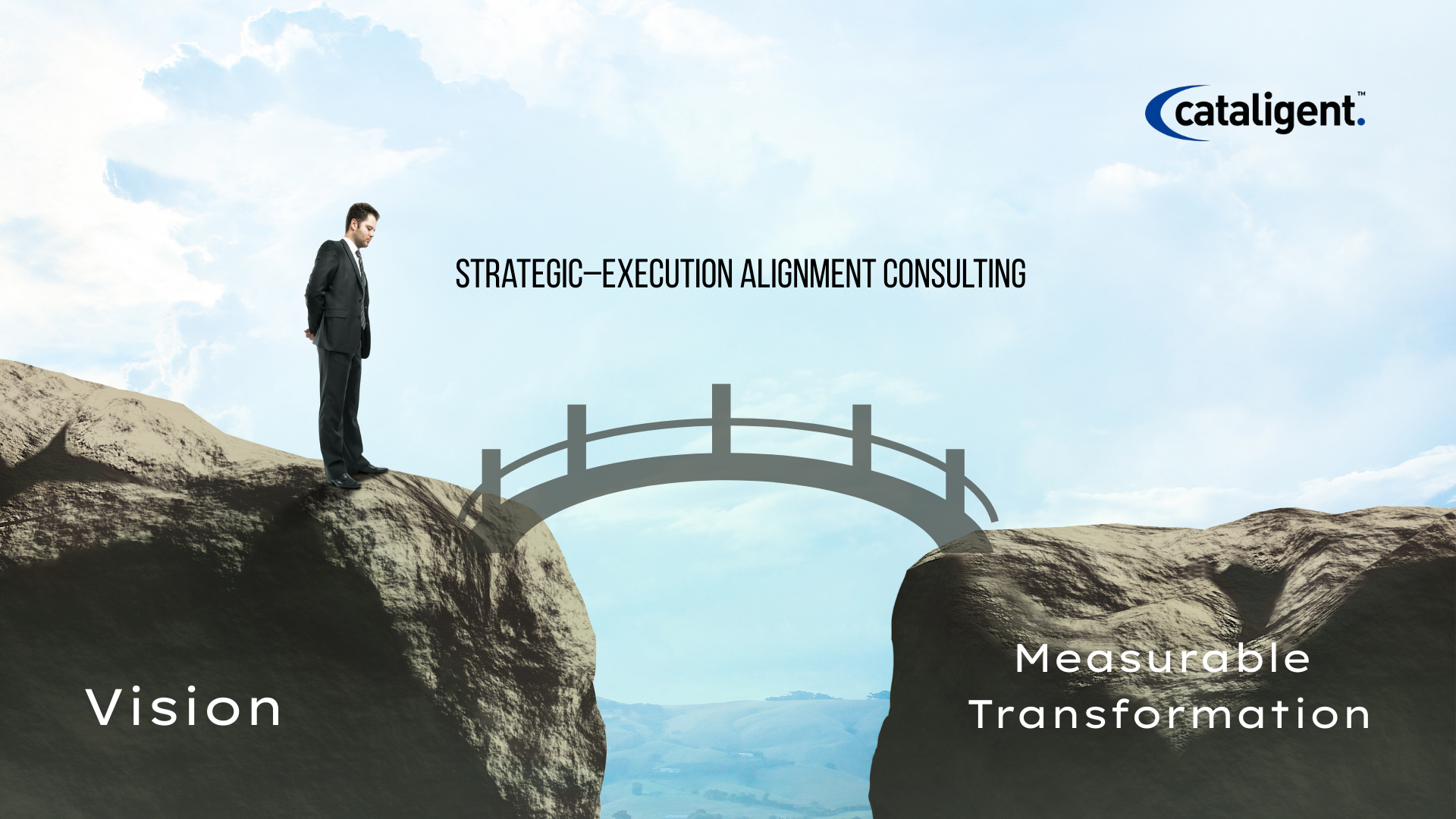

  • Strategic–Execution Alignment Consulting: Closing the Gap Between Vision and Measurable Transformation

    Strategic–Execution Alignment Consulting: Closing the Gap Between Vision and Measurable Transformation

    Many organizations excel at setting bold strategies. Vision statements, roadmaps, and board-level ambitions often point toward transformation that is ambitious, forward-thinking, and competitive. Yet, when these strategies travel downstream into execution, they often lose momentum, clarity, and alignment. The result? Strategic initiatives that look inspiring on paper but fail to materialize into measurable transformation outcomes.

    Strategic–execution alignment consulting addresses this persistent gap. It ensures that strategy doesn’t remain aspirational but becomes operational—translated into initiatives, metrics, and outcomes that drive genuine business transformation.


    What It Is

    Strategic–execution alignment consulting focuses on designing frameworks, operating models, and governance mechanisms that directly connect top-level vision with day-to-day execution. It ensures:

    • Clear Line of Sight: Every project and initiative can be traced back to a strategic objective.
    • Measurable Outcomes: Success is defined not just in activity but in results—whether customer growth, cost optimization, or operational agility.
    • Execution Discipline: Processes, teams, and accountability structures ensure strategy doesn’t dissolve into disconnected projects.
    • Continuous Realignment: Feedback loops allow organizations to adapt as markets, technologies, or priorities evolve.

    Why It Matters

    1. Bridging the Strategy–Execution Divide

    Research consistently shows that most organizations fail to realize the majority of their strategic goals. Without consulting that bridges the divide, transformation becomes a cycle of unfulfilled ambition.

    2. Unlocking Transformation ROI

    A well-articulated strategy without execution alignment leads to wasted resources. By directly linking vision to measurable initiatives, organizations ensure transformation investments yield tangible ROI.

    3. Reducing Fragmentation

    Without alignment, departments and teams often pursue disconnected priorities. Consulting ensures initiatives are interlinked, preventing duplication and aligning resources toward enterprise-level outcomes.

    4. Accelerating Decision-Making

    When strategy is connected to execution, leaders have clearer visibility into what’s working, what’s lagging, and where adjustments are needed. This accelerates decision-making and keeps transformation on track.

    5. Building Organizational Confidence

    Employees often feel disconnected from high-level strategies. Clear alignment ensures teams see how their work contributes to transformation, fostering engagement, ownership, and motivation.


    How to Address It

    1. Strategy Decomposition

    Break down high-level strategies into measurable objectives and actionable initiatives. Frameworks like OKRs (Objectives and Key Results) ensure every activity ties back to a larger goal.

    Example: A vision of “customer-centric growth” is decomposed into measurable KPIs such as Net Promoter Score improvements, digital adoption rates, or reduced churn.


    2. Governance Structures

    Establish governance forums that review not just projects but their alignment to strategy. This ensures that projects don’t drift into siloed execution without contributing to transformation goals.

    Example: A governance board reviews whether a digital upgrade initiative directly supports strategic objectives like operational agility or customer satisfaction.


    3. Portfolio Management Discipline

    Move from managing individual projects to managing transformation as a portfolio. Portfolio management ensures resources, budgets, and timelines are allocated where they drive maximum strategic value.


    4. Feedback Loops & Realignment

    Embed mechanisms for continuous feedback—surveys, data dashboards, and performance reviews—to realign execution with strategy as external conditions shift.

    Example: If regulatory changes impact compliance initiatives, realignment ensures transformation timelines are adjusted without losing sight of long-term strategy.


    5. Accountability & Leadership Alignment

    Executives and managers must model alignment, holding themselves accountable for both strategic clarity and operational discipline. Consulting helps define clear ownership for every level of execution.


    How Cataligent Helps

    Cataligent specializes in ensuring strategies don’t end as presentations but become transformation realities:

    • Strategy-to-Execution Frameworks: Proven methodologies that translate vision into measurable initiatives, KPIs, and deliverables.
    • Portfolio & Governance Models: Tools that manage transformation holistically, avoiding duplication and ensuring alignment.
    • Outcome-Based Metrics: Dashboards that measure results, not just activities, to track transformation ROI.
    • Adaptive Realignment Processes: Mechanisms that allow strategy and execution to stay in sync despite market volatility.
    • Leadership Coaching: Empowering leaders to bridge strategy and execution through clarity, accountability, and visible ownership.

    Closing Thought

    Transformation ambitions collapse when strategy and execution live in separate worlds. Consulting that unites them creates not only clarity but also measurable outcomes that prove the value of transformation. Strategic–execution alignment turns vision into momentum, ambition into progress, and plans into results.

    Cataligent enables organizations to close this divide. By embedding frameworks, governance, and continuous feedback, it ensures transformation is not just envisioned—it is delivered, sustained, and scaled.

  • Capability-Building Consulting: Driving Sustainable Transformation Beyond External Dependency

    Capability-Building Consulting: Driving Sustainable Transformation Beyond External Dependency

    Transformation often begins with external expertise—consultants brought in to diagnose, strategize, and guide change. Yet, a frequent challenge arises once consultants exit: organizations find themselves unable to sustain the momentum. Too often, transformation is tied to the presence of consultants rather than embedded into the fabric of the business. This dependency creates cycles of reliance, driving up costs and limiting internal ownership.

    Capability-building consulting changes this paradigm. Instead of positioning consultants as long-term crutches, it focuses on empowering organizations to internalize skills, frameworks, and tools that allow them to continue transformation independently. It redefines consulting not as a vendor service, but as a catalyst for lasting organizational self-sufficiency.


    What It Is

    Capability-building consulting shifts the objective from delivering solutions to embedding the ability to create, adapt, and sustain solutions within the client organization. It emphasizes:

    • Knowledge Transfer: Consultants don’t just deliver playbooks; they ensure internal teams can replicate, evolve, and innovate using them.
    • Skill Development: Employees are trained, coached, and mentored to take ownership of transformation initiatives.
    • Framework Adoption: Proven methodologies are embedded into everyday workflows, making them second nature to employees.
    • Cultural Shift: Consulting is aligned with creating a culture of problem-solving, innovation, and adaptability.

    Why It Matters

    1. Breaking the Cycle of Dependency

    Many organizations repeatedly hire external consultants for the same challenges. Without capability-building, each new transformation feels like starting over. By equipping teams with the right tools, consulting evolves into a one-time catalyst for lasting progress.

    2. Cost Efficiency & ROI

    Sustainable consulting creates exponential value. The upfront investment pays dividends as organizations reduce repeated reliance on external advisors. The ROI isn’t just financial—it’s also cultural, as teams gain confidence and autonomy.

    3. Agility in Transformation

    Markets, regulations, and technologies shift rapidly. Organizations that depend on consultants for every pivot lose valuable time. Capability-building ensures businesses can adapt strategies on their own, maintaining transformation momentum in volatile environments.

    4. Employee Engagement & Ownership

    When employees are trusted and trained to lead transformation, engagement rises. They stop viewing change as something “done to them” and start owning it as something they drive.

    5. Resilient Competitive Advantage

    Competitors may buy consulting expertise, but only organizations that internalize and scale capabilities achieve resilience. This makes transformation outcomes durable, outlasting consultant contracts.


    How to Address It

    1. Co-Creation over Outsourcing

    Instead of handing over entire initiatives to consultants, organizations must demand co-creation. This involves working side by side, ensuring employees learn through active participation.

    Example: A consulting team redesigns a supply chain process with internal managers and frontline staff, not for them, so the knowledge remains embedded.

    2. Structured Knowledge Transfer

    Consulting deliverables must go beyond documents. Structured workshops, on-the-job coaching, and interactive training sessions ensure frameworks are absorbed and can be reapplied.

    Example: Rather than just handing over a digital transformation roadmap, consultants hold simulation-based workshops where internal teams practice scenario planning.

    3. Capability Maturity Models

    Organizations should measure their consulting engagements by the maturity levels of internal capabilities, not just deliverables. Maturity assessments show whether employees have gained the confidence and competence to sustain change.

    4. Leadership Development

    Consultants must extend their focus from processes to people. Coaching leaders to champion transformation, foster accountability, and drive continuous improvement is key to sustaining momentum.

    5. Embedding Tools & Frameworks

    From agile methodologies to risk management frameworks, consultants should leave behind scalable, easy-to-use tools. These must integrate seamlessly into daily operations so employees rely on them instinctively.


    How Cataligent Helps

    Cataligent’s Business consulting services are designed with sustainability at their core. Instead of creating dependency, Cataligent enables organizations to own their transformation:

    • Capability Transfer Programs: Hands-on coaching, knowledge-sharing workshops, and toolkits ensure employees master skills to sustain change independently.
    • Transformation Playbooks: Customized frameworks, tailored to each organization, are embedded into workflows to drive repeatable success.
    • Leadership Coaching: Cataligent works directly with leadership teams to strengthen their ability to champion transformation and embed accountability.
    • Change Enablement Culture: By aligning consulting with cultural change, Cataligent ensures transformation becomes a part of how organizations think and operate daily.
    • Resiliency by Design: Consulting engagements are structured to prepare businesses for future shifts, ensuring they can adapt long after consultants step away.

    Closing Thought

    Business consulting shouldn’t be about creating perpetual reliance on external expertise. True consulting empowers organizations to stand on their own, innovate on their own, and transform on their own. Capability-building consulting reframes transformation as a long-term investment in internal strength, resilience, and agility.

    Cataligent stands at the forefront of this shift. By embedding skills, frameworks, and cultural resilience, it ensures transformation doesn’t fade when consultants leave—it accelerates. With Cataligent, consulting becomes not a crutch, but a catalyst for enduring, self-sustaining business transformation.

  • Strategic Risk Aggregation & Early Warning Systems Across Initiatives: Safeguarding Transformation at Scale

    Strategic Risk Aggregation & Early Warning Systems Across Initiatives: Safeguarding Transformation at Scale

    Business transformation is rarely a single, linear journey. Instead, it unfolds through a constellation of programs—digital adoption, compliance upgrades, cost optimization, operating model redesigns, and cultural shifts—all moving simultaneously. Each program is carefully tracked within its own scope, with managers diligently maintaining risk registers. Yet, what remains dangerously overlooked is how risks aggregate across initiatives, creating vulnerabilities far greater than the sum of their parts. Without a system to capture and act on these interconnected risks, organizations often find themselves reacting to crises rather than steering transformation deliberately.

    This is where strategic risk aggregation and early warning systems emerge as non-negotiable pillars of large-scale transformation success.


    What It Is

    Most transformation frameworks emphasize risk management within individual projects. A technology rollout might flag integration delays. A compliance initiative might warn of looming regulatory changes. A workforce modernization program may highlight shortages in skilled resources. Each of these risks is logged and tracked—but in isolation.

    Strategic risk aggregation takes a step back and examines risks across the enterprise portfolio. It consolidates individual risk registers to identify overlaps, interdependencies, and systemic vulnerabilities that could escalate transformation derailments if left unchecked. Instead of treating each risk as a standalone event, it recognizes the complex, interconnected web of challenges across initiatives.

    Early warning systems build on this by equipping organizations to detect, monitor, and respond to emerging risks before they become crises. By leveraging real-time data, predictive analytics, and defined governance structures, early warning systems transform risk management from a reactive exercise into a proactive shield.


    Why It Matters

    Ignoring risk aggregation is like monitoring cracks in individual walls of a building without noticing that the foundation itself is shifting. The consequences are often severe and multidimensional:

    1. Cascading Failures

    When one initiative stumbles, its dependencies drag others down. A delayed core platform rollout, for example, automatically hinders data analytics programs, customer experience upgrades, and compliance reporting dependent on that platform. Without visibility into these connections, leaders underestimate the scale of impact until it’s too late.

    2. Resource Burnout

    Resources—especially niche talent pools like data engineers, cybersecurity experts, or compliance officers—are often shared across multiple initiatives. Project-level tracking may understate workload, but when aggregated, it becomes clear that the same small group is stretched thin across critical programs. Burnout, attrition, and declining quality inevitably follow.

    3. Strategic Misalignment

    Project-level reporting often paints a picture of success in silos. A single initiative may appear on track, while its delays or overspending quietly create budget and timeline pressure across the broader transformation portfolio. Leaders relying on fragmented reporting end up making strategic decisions with blind spots that undermine enterprise goals.

    4. Missed Early Interventions

    Most organizations rely on static risk registers updated periodically—usually after risks have already materialized. This reactive approach turns leaders into firefighters. Without predictive early warning signals, opportunities to mitigate risks in their infancy are lost, leading to higher costs, longer delays, and reputational damage.


    How to Address It

    Shifting from fragmented project risk management to enterprise-wide risk intelligence requires both process and cultural change. Here are the essential practices:

    1. Cross-Program Risk Mapping

    The first step is consolidating risk registers from every initiative into a single enterprise-wide repository. By doing so, leaders can identify overlaps such as multiple programs relying on the same technology vendor, or several initiatives hinging on one infrastructure upgrade. This mapping uncovers vulnerabilities that would otherwise remain invisible.

    Example: If three transformation initiatives depend on a data migration scheduled for Q3, a single delay could paralyze all three. Cross-program risk mapping highlights this exposure upfront.


    2. Dependency Tracking

    Risks rarely exist in isolation—they often cascade through dependencies. Organizations need tools to track not only risks but also the web of dependencies across initiatives. This includes technological linkages, shared budgets, and overlapping talent pools.

    Example: A compliance program that requires accurate customer data cannot succeed if a parallel data quality initiative falters. Dependency mapping ensures leaders can anticipate these domino effects and mitigate them early.


    3. Early Warning Triggers

    Traditional risk management waits for issues to surface. Early warning systems flip this model by defining leading indicators of risk escalation. Examples include:

    • A widening gap between planned vs. actual delivery timelines.
    • Frequent changes in resource allocation.
    • Escalating employee attrition rates in critical functions.
    • Unexplained spikes in budget variance.

    By tracking these indicators in real time, organizations can intervene before risks become crises.


    4. Decision Governance Forums

    Aggregated risks are useless without forums to act on them. Cross-functional governance boards provide a platform for leaders to review risks holistically, prioritize interventions, and make strategic trade-offs. These forums ensure risks are elevated beyond project managers and addressed at the executive level.

    Example: A governance board may decide to delay one initiative to preserve resources for a more critical program. Without such forums, initiatives continue in silos, amplifying systemic risks.


    5. Dynamic Re-Forecasting

    Transformation roadmaps must evolve alongside emerging risks. Static plans quickly become outdated in volatile business environments. Dynamic re-forecasting ensures that as risks shift, so do resource allocations, timelines, and budgets. This keeps the transformation both resilient and adaptive.

    Example: If a vendor delays delivery of a digital platform, dynamic re-forecasting allows leaders to re-sequence other initiatives, minimizing disruption and keeping momentum alive.


    How Cataligent Helps

    Cataligent’s Business transformation services bring a structured, technology-enabled approach to strategic risk aggregation and early warning:

    • Integrated Risk Management Frameworks: Cataligent unifies project-level risks into consolidated dashboards, offering leaders a panoramic view of vulnerabilities and interdependencies.
    • Dependency & Capacity Mapping: Using specialized tools, Cataligent identifies cross-initiative dependencies and resource constraints, spotlighting areas where risks may multiply.
    • Real-Time Performance Dashboards: By tracking delivery metrics and key risk indicators in real time, Cataligent provides leaders with actionable early warning signals.
    • Governance Structures: Cataligent embeds cross-functional governance forums, ensuring aggregated risks reach the right decision-makers with the authority to act.
    • Dynamic Adaptability: Cataligent’s re-forecasting capabilities help organizations continuously align transformation roadmaps with the evolving risk landscape.

    Closing Thought

    Business transformation fails not because organizations lack ambition, but because risks multiply in the shadows of disconnected initiatives. By adopting strategic risk aggregation and embedding early warning systems, businesses move from firefighting to foresight, from reactive corrections to proactive steering.

    Cataligent empowers organizations to see the bigger picture, detect risks before they escalate, and make confident, informed trade-offs. The result is not just transformation that survives, but transformation that thrives—resilient, aligned, and built for sustained success.

  • Hidden Costs & Drag from Legacy Processes & Shadow Work: The Unseen Barriers to Business Transformation

    Hidden Costs & Drag from Legacy Processes & Shadow Work: The Unseen Barriers to Business Transformation

    Transformation programs often promise efficiency gains, cost savings, and streamlined operations. Yet, beneath the visible metrics lies a persistent set of hidden costs—those generated by outdated legacy processes and the informal “shadow work” employees perform to keep operations running. These unseen barriers quietly erode ROI, delay adoption, and mask the true impact of transformation efforts.


    What It Is

    Legacy processes are outdated workflows, policies, or approvals that remain embedded in the system even after new processes are introduced. They are often remnants of old systems or compliance requirements that no one formally retired, but which employees continue to follow out of habit or fear of repercussions. These processes add unnecessary steps, consume resources, and slow down decision-making.

    Shadow work refers to unofficial, improvised activities employees take on to fill gaps between formal systems and real-world needs. This might include parallel Excel spreadsheets for reporting, handwritten logs to track approvals, manual reconciliations, and even employees creating their own unofficial tools or templates. These are not documented in official process maps but exist in practice because the formal system does not meet immediate needs.

    Individually, these practices may appear harmless. Collectively, they represent significant organizational drag. They consume energy, reduce transparency, and create risks that undermine the effectiveness of transformation programs.


    Why It Matters

    Ignoring legacy processes and shadow work creates structural inefficiencies that compound over time. Their impact spreads across performance, culture, compliance, and overall transformation outcomes.

    1. Lost Productivity

    Employees spend hours working around inefficient workflows. Consider a finance team that must download data from one system, manually reformat it, and re-upload it into another. Or a sales team that duplicates entries across CRM and billing systems. While each task may take only a few minutes, multiplied across hundreds of employees, the losses run into thousands of hours every month. This time is invisible in most performance metrics, yet it directly reduces the speed and agility of transformation efforts.

    2. Compliance Risks

    Shadow work often falls outside the scope of official governance structures. A parallel spreadsheet used for financial reconciliations may not follow compliance protocols, leaving audit trails incomplete. Similarly, approvals given over informal channels may not be recorded. These gaps expose organizations to regulatory non-compliance, reputational damage, and costly penalties. Hidden systems can also weaken cybersecurity posture if employees bypass official tools for convenience.

    3. Distorted ROI

    Transformation initiatives are often justified by projected cost savings or efficiency gains. However, when hidden rework persists, the savings are offset by invisible effort. For example, a new ERP implementation may promise automated reconciliations, but if employees still perform manual checks due to mistrust of the system, the ROI figures are misleading. Leaders may believe transformation has delivered its intended value, when in reality, the ground reality is far less efficient.

    4. Employee Frustration

    When employees are forced to rely on workarounds, they lose confidence in leadership’s ability to deliver meaningful change. They view transformation as “cosmetic”—fancy new systems that don’t actually make their lives easier. This frustration erodes morale and fuels resistance to future initiatives. In the long term, it contributes to higher attrition rates, especially among high-performing employees who grow tired of inefficiency.


    How to Address It

    The solution lies in conducting a deliberate Process Debt Audit—an initiative designed to uncover and eliminate invisible inefficiencies. Each step ensures that legacy processes and shadow work are surfaced, quantified, and systematically resolved.

    1. Workflow Mapping

    The first step is to document processes as they are actually executed, not just how they are supposed to work. This requires shadowing employees, interviewing teams, and observing real-world workflows. For example, official process maps may state that invoices move directly from approval to payment. In reality, employees may export data into spreadsheets, perform manual checks, and send emails for confirmations. Mapping these differences reveals bottlenecks and duplication points.

    2. Shadow System Discovery

    Organizations must proactively identify the tools and methods employees use outside official systems. This includes unauthorized spreadsheets, homegrown databases, or even messaging platforms used for approvals. These workarounds are not inherently negative—they often indicate where official systems fall short. By surfacing them, leaders can understand unmet needs and design solutions that remove the necessity for shadow work.

    3. Quantifying the Drag

    The hidden costs of legacy processes and shadow work must be translated into tangible metrics. Leaders should measure how much time employees spend on duplications, how often shadow systems are used, and what risks they introduce. For instance, if a customer support team spends 10% of its time reconciling data between systems, that equates to thousands of hours annually. Converting these inefficiencies into financial terms creates urgency for change.

    4. Streamlining and Automating

    Once inefficiencies are visible, outdated workflows can be retired, and repetitive tasks automated. This might involve consolidating reporting systems, eliminating redundant approvals, or integrating platforms for seamless data transfer. Automation tools such as RPA (Robotic Process Automation) can replace manual reconciliation tasks, freeing employees to focus on higher-value work. Streamlining processes not only reduces hidden costs but also enhances employee satisfaction.

    5. Embedding Governance

    Process debt tends to resurface unless governance is built into the operating model. This means assigning process ownership, implementing monitoring mechanisms, and setting clear accountability for compliance. Regular audits, combined with performance dashboards, ensure that shadow work does not creep back in. Employees must also be empowered to flag inefficiencies early, turning governance into a continuous improvement practice rather than a one-off exercise.


    How Cataligent Helps

    Cataligents business transformation services are built to address precisely these unseen barriers.

    • Portfolio Management Tools: Cataligent provides visibility across initiatives, enabling leaders to detect duplications and redundancies that contribute to process debt.
    • Cost Optimization Frameworks: By quantifying hidden costs, Cataligent helps organizations make decisions based on real-world data rather than optimistic assumptions. Leaders gain a true picture of transformation ROI.
    • Process Rationalization Programs: Cataligent specializes in identifying and eliminating legacy processes that no longer serve strategic objectives. By embedding process rationalization into transformation roadmaps, organizations can ensure efficiency gains are both real and sustainable.
    • Performance Dashboards: With real-time insights into productivity, adoption, and resource utilization, Cataligent equips leaders to detect where shadow work persists. This enables proactive interventions before inefficiencies accumulate.

    Together, these services ensure that organizations don’t just launch transformation programs—they realize their full value by addressing the hidden costs that undermine progress.


    Closing Thought

    True transformation requires more than deploying new systems or redesigning org charts. It requires a willingness to confront the invisible obstacles that quietly drain resources and undermine progress. Legacy processes and shadow work may be hidden from official reports, but they are deeply felt by employees and customers alike. They slow down operations, distort ROI, and erode trust in leadership.

    By shining a light on these hidden inefficiencies and embedding governance to prevent their return, organizations can unlock genuine productivity gains and create a culture of operational excellence. With Cataligent’s expertise in process optimization, cost management, and portfolio governance, businesses can move past surface-level improvements and achieve sustainable, measurable transformation outcomes.

  • Integrated Change-Fatigue & Capability Uplift Planning: The Silent Determinant of Business Transformation

    Integrated Change-Fatigue & Capability Uplift Planning: The Silent Determinant of Business Transformation

    Transformation programs succeed not just because of strategy or technology, but because people can absorb and adapt to change effectively. Yet, a silent factor often derails progress—change fatigue. Paired with overlooked capability gaps, it creates an invisible wall between ambitious plans and realized outcomes.


    What It Is

    Change fatigue occurs when employees face multiple overlapping initiatives with little consideration of their capacity to absorb change. Instead of excitement, transformation begins to feel like an unrelenting series of disruptions. It is the psychological wear and tear that happens when employees are bombarded with new systems, processes, and expectations without sufficient time to adapt.

    Meanwhile, capability uplift is more than just scheduling generic training programs. It means giving employees the specific, practical skills they need to thrive in the new environment—whether it’s mastering digital platforms, interpreting analytics, or adapting to new compliance rules. Without deliberate capability planning, even the most innovative transformation roadmap stalls.


    Why It Matters

    Unchecked, these two forces silently chip away at transformation effectiveness:

    • Productivity Decline: When employees are asked to implement multiple initiatives at once, their attention fractures. This leads to slower adoption of new processes, higher error rates, and a constant game of catch-up. Productivity losses quickly compound across the enterprise.
    • Cultural Resistance: Employees who feel overloaded or underprepared often respond with disengagement. The initial enthusiasm for change is replaced by skepticism, with many viewing new initiatives as “yet another disruption.” This resistance embeds itself into the culture, making future transformation programs harder to land.
    • Underutilized Investments: Large sums are often spent on technology upgrades and process redesigns. However, without employees equipped to use them confidently, these investments sit underleveraged. A new platform may have advanced features, but if frontline teams lack skills, it becomes little more than a costly replacement of the old.

    Organizations that ignore these realities end up with transformation programs that look promising in reports but fail to deliver measurable outcomes on the ground.


    How to Address It

    The antidote is a structured Change-Capacity and Capability Audit supported by continuous monitoring. Each step in this approach ensures that change is delivered in a sustainable, people-centered way:

    1. Map Change Load: Leaders must calculate how many changes are impacting each function, team, and role. By creating a heatmap of change intensity, it becomes clear where fatigue is most likely to occur. For example, if finance is simultaneously adopting a new reporting tool, restructuring workflows, and handling compliance changes, leaders can stagger initiatives to avoid overload.
    2. Skill Readiness Assessment: Transformation requires specific capabilities, not just generic adaptability. Identifying skill gaps—like data literacy for decision-making, or advanced digital collaboration skills for remote teams—helps organizations design interventions that are relevant and impactful. This ensures employees can apply new skills directly to their daily work.
    3. Staggered Rollouts: Delivering multiple initiatives all at once is a recipe for fatigue. Instead, projects should be sequenced strategically, prioritizing initiatives that unlock immediate value and create confidence. A phased approach builds momentum and prevents teams from feeling swamped.
    4. Targeted Capability Building: Generic training often fails to stick because it doesn’t connect to role-specific needs. Targeted capability uplift means building tailored learning paths, offering on-the-job coaching, and embedding learning directly into workflows. For instance, rather than a broad digital skills workshop, sales teams could receive training focused on leveraging analytics to improve customer engagement.
    5. Adaptive Monitoring: Change isn’t a one-off event. Leaders need to continuously monitor adoption rates, fatigue indicators (like rising absenteeism or errors), and employee feedback. With real-time insights, organizations can recalibrate by slowing down initiatives, adding support, or sequencing differently.

    This systematic approach shifts transformation from an exhausting push to a series of achievable shifts that build organizational confidence and momentum.


    How Cataligent Helps

    Cataligent’s business transformation services integrate robust Change Management and OKR tracking into every initiative. Through these, organizations can:

    • Quantify Readiness: Cataligent’s frameworks help identify fatigue risks before they escalate by analyzing workload distribution and organizational capacity.
    • Align Change Delivery: By sequencing initiatives with precision, Cataligent reduces the risk of overloading critical teams.
    • Target Capability Uplift: Tailored skill-building pathways are developed that align directly with transformation goals, ensuring employees gain the tools they need to excel.
    • Monitor and Adapt: With real-time dashboards, leaders can track adoption, detect resistance signals, and measure the impact of capability programs, allowing for course correction on the fly.

    By embedding these practices, Cataligent enables businesses to transform fatigue into resilience and ensure that every capability uplift directly accelerates business performance.


    Closing Thought

    Business transformation is not only about systems or structures—it is about people navigating continuous waves of change. When organizations respect change capacity and invest in precise capability building, transformation ceases to be a burden and becomes an opportunity for growth. Cataligent’s expertise ensures that employees are not just passengers in the process, but empowered drivers of sustainable transformation.