
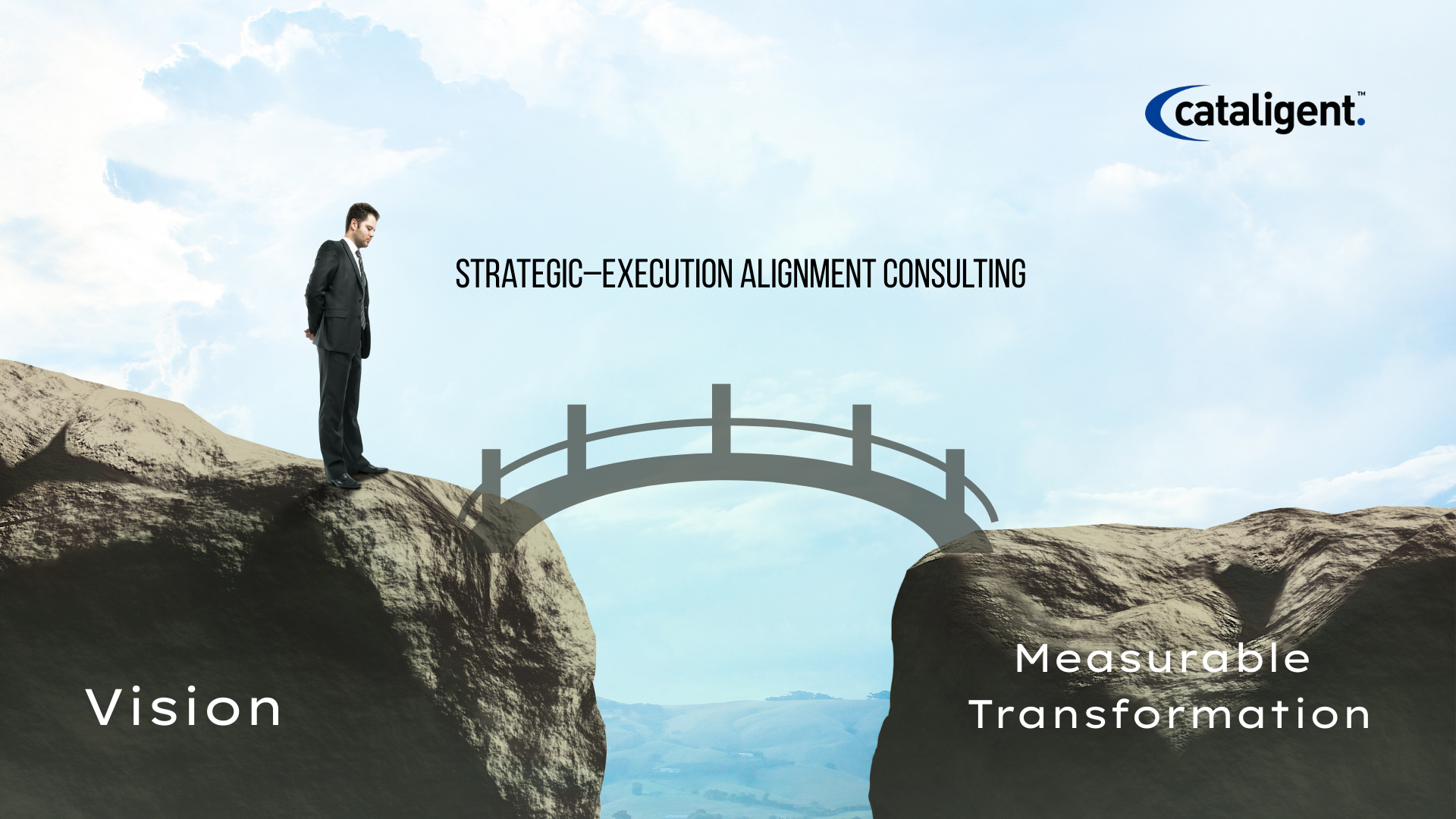
Strategic–Execution Alignment Consulting: Closing the Gap Between Vision and Measurable Transformation
Many consulting engagements lose value after the strategy workshop because the vision is clear but the execution system is weak. Strategic execution alignment consulting matters when board priorities, transformation roadmaps, client workstreams, owners, milestones, risks, dependencies, approvals, value tracking, and steering committee reporting must move together. Without that control, an enterprise can approve a strong strategy and still fail to show measurable transformation progress.
The core issue is not whether the recommendation is intelligent. The issue is whether the consulting recommendation becomes an owned initiative with a sponsor, a measure owner, a baseline, a target, decision rights, implementation evidence, risk escalation, and closure criteria. A consulting recommendation creates direction. An initiative creates potential. Governed execution turns consulting advice into measurable progress.
What Is Strategic Execution Alignment Consulting?
Strategic execution alignment consulting is the discipline of connecting strategic priorities to the operating work required to deliver them. It translates a vision into portfolios, programs, projects, measure packages, measures, workstreams, milestones, decisions, and reports that leaders can govern. For consulting firms, it makes the engagement methodology repeatable. For enterprise leaders, it turns the consulting output into an execution model that can be reviewed, challenged, approved, and measured.
This is different from producing a strategy deck. A deck can define choices, but it does not prove that a workstream owner accepted responsibility, a sponsor removed a dependency, finance validated a benefit, or the steering committee approved the next stage gate. Strategic execution alignment consulting closes that gap by creating a controlled path from recommendation to ownership, from ownership to implementation, and from implementation to closure evidence.
Why Strategic Execution Alignment Matters for Consulting Engagements
Weak alignment creates a predictable pattern. The consulting firm defines priorities, the client approves the roadmap, and each function begins working in its own tracker. The PMO updates one file, finance maintains another, owners send status by email, and the engagement manager rebuilds the client status pack before each steering committee. Leadership sees activity, but it cannot tell whether the strategy is moving toward measurable value.
Strong alignment gives every recommendation a governance path. Each initiative has an accountable owner, sponsor, controller where financial value is involved, milestone plan, dependency map, approval workflow, evidence requirement, and reporting cadence. This gives consulting principals, transformation leaders, CFO teams, and PMO leaders one shared view of whether the work is progressing and whether the expected value is still credible.
| Engagement element | Where delivery breaks down | Governance requirement | What to track |
|---|---|---|---|
| Strategy workshop output | Ideas remain in slides and are not converted into initiatives | Assign measure owner, sponsor, business unit, and target outcome | Initiative creation, owner acceptance, sponsor approval |
| Client workstream | Each function reports progress in a different format | Use common workstream status logic and reporting cadence | Milestones, risks, dependencies, decisions needed |
| Financial potential | Target value is stated but not validated over time | Define baseline, target value, forecast value, actual value, and controller review | Potential Status, forecast variance, closure evidence |
| Steering committee | Decisions are discussed but not closed | Record decision rights, approval owner, and ageing | Decision ageing, approval ageing, blocked initiatives |
| Implementation roadmap | Milestones are complete but business adoption is weak | Separate implementation progress from value progress | Implementation Status, Potential Status, evidence of adoption |
Convert Strategic Priorities Into Owned Initiatives
Consulting teams should not hand over a roadmap as a loose list of recommendations. Each priority should become a governed initiative with a clear description, owner, sponsor, affected function, legal entity where relevant, baseline, expected outcome, and acceptance criteria. That translation is where the consulting engagement moves from advisory output to accountable execution.
For example, a margin improvement recommendation may become separate initiatives for supplier renegotiation, product mix change, sales discount governance, and channel performance improvement. Each one needs its own owner, stage gate, milestone evidence, value logic, and risk profile. Grouping these into one line item hides delivery risk and weakens executive reporting.
Define Decision Rights Before Execution Starts
Strategic execution alignment fails when decision rights are unclear. A business unit head may own the initiative, finance may validate the value, procurement may control supplier data, and the steering committee may approve go or no go movement. If these rights are not mapped, the program becomes slow and political.
A consulting firm can improve client credibility by defining who proposes, who approves, who validates, who reports, and who closes each initiative. This is especially important in transformation consulting and restructuring consulting, where value claims need stronger evidence than standard project progress notes.
Separate Milestone Progress From Value Progress
A program can look green on milestones while the expected value is deteriorating. The implementation team may complete a process change, but forecast savings may fall because adoption is low, the baseline changed, or a dependency blocked the benefit. Strategic execution alignment consulting must therefore separate execution progress from value progress.
That separation is why Implementation Status and Potential Status matter. Implementation Status shows whether the work is moving against plan. Potential Status shows whether the expected value, saving, EBITDA effect, or business benefit is still likely to be achieved and confirmed.
Keep Steering Committee Reporting Connected to Source Evidence
Many consulting engagements spend too much time rebuilding reports. Analysts collect updates from owners, reconcile spreadsheets, paste charts into PowerPoint, and adjust the narrative before each steering committee. This effort creates version risk and reduces time available for actual delivery management.
Better engagement governance keeps the steering committee report connected to the initiative system. The client status pack should show current milestones, decision needs, risk escalation, dependency blockage, value movement, and closure evidence without manual consolidation each week. This improves transparency for enterprise leaders and reduces reporting drag for consulting teams.
Metrics That Matter
The right metrics for strategic execution alignment show whether the strategy is moving through a controlled delivery path. These metrics should measure not only activity, but also ownership, decision speed, value confidence, evidence quality, and reporting accuracy.
| Metric | Why it matters | How to validate it |
|---|---|---|
| Initiatives with named owners and sponsors | Shows whether recommendations have accountable delivery roles | Review ownership fields and sponsor approval records |
| Implementation Status | Shows whether execution is progressing against plan | Check milestone evidence, overdue tasks, and stage gate movement |
| Potential Status | Shows whether expected value is still credible | Compare baseline, target value, forecast value, actual value, and finance comments |
| Decision ageing | Shows whether leadership decisions are slowing execution | Track open decisions by owner, age, and steering committee date |
| Dependency blockage | Shows whether one workstream is delaying another | Review dependency logs, blocked milestones, and escalation history |
| Manual reporting effort | Shows the cost of fragmented execution management | Measure hours spent preparing status packs and reconciling data |
Common Mistakes to Avoid
Stopping at the recommendation deck. A strategy deck creates direction, but it does not prove that initiatives have owners, sponsors, milestones, risks, dependencies, evidence, or closure conditions.
Treating all workstreams as equal. A low risk communications workstream and a high value cost saving initiative need different governance, approval, and evidence requirements.
Reporting only milestone completion. Completed milestones do not confirm that value has been delivered, adopted, or validated against a baseline.
Leaving decision rights informal. When nobody knows who can approve a stage gate, accept a risk, or validate a benefit, the engagement loses pace and accountability.
Building every client status pack manually. Manual slide based reporting increases version risk and takes consulting teams away from risk management, dependency resolution, and client delivery.
How Cataligent Helps Through CAT4
Cataligent helps consulting firms and enterprise clients connect strategic recommendations to governed execution through CAT4, its no code strategy execution platform. For consulting led business transformation, CAT4 gives teams one place to structure portfolios, programs, projects, measure packages, measures, owners, sponsors, milestones, approvals, risks, dependencies, Implementation Status, Potential Status, and executive reporting.
Through CAT4, Cataligent supports a repeatable consulting delivery model. A consulting firm can configure its methodology, stage gate logic, KPI structure, workstream reporting, and client governance model so the same execution discipline can travel across mandates. Enterprise PMOs can use the same platform for multi project management, internal decision rights, and internal organization accountability.
Where financial value is involved, CAT4 supports baseline, target value, forecast value, actual value, and controller backed closure. This is useful for transformation and cost saving programs where leadership needs more than a green project status. Cataligent brings configuration guidance and client delivery support so CAT4 reflects the engagement logic rather than forcing the client into a generic task tracker.
Cataligent has 25 years in continuous operation since 2000, with 250 plus large enterprise installations and 40,000 plus users worldwide. The relevant point for consulting leaders is not the number alone. It is that CAT4 is designed for governed transformation execution, not casual task follow up.
What Cataligent Does Not Claim
Cataligent does not claim that CAT4 creates consulting recommendations automatically. CAT4 does not replace consulting expertise, leadership judgment, finance systems, ERP systems, BI platforms, project management tools, or every planning tool.
CAT4 does not guarantee ROI, compliance, transformation success, savings, EBITDA improvement, client acceptance, or business outcomes. CAT4 supports governed execution, value tracking, approvals, reporting, and controller backed closure where financial value is involved.
Conclusion
Strategic execution alignment consulting closes the gap between an approved vision and measurable transformation progress. It gives consulting firms and enterprise leaders a governed path from recommendation to initiative, from initiative to evidence, and from evidence to executive reporting.
Talk to Cataligent about connecting consulting recommendations to governed execution through CAT4 so your client workstreams can move from strategy to measurable progress with clearer ownership, stronger reporting, and better value control.
FAQs
Why is a strategy deck not enough for strategic execution alignment?
A strategy deck defines direction, but it does not govern owners, sponsors, approvals, dependencies, evidence, or closure. Execution alignment requires a controlled system that tracks whether each recommendation is moving through accountable delivery.
How can consulting firms improve strategic execution alignment for clients?
They can convert recommendations into owned initiatives with stage gates, risks, dependencies, value logic, and steering committee reporting. They should also separate Implementation Status from Potential Status so clients can see both activity and value confidence.
How does CAT4 support strategic execution alignment consulting?
CAT4 helps structure portfolios, programs, projects, measures, approvals, milestones, risks, dependencies, reports, and closure evidence in one governed platform. Cataligent supports consulting firms and enterprise teams in configuring CAT4 around the engagement methodology and execution model.