
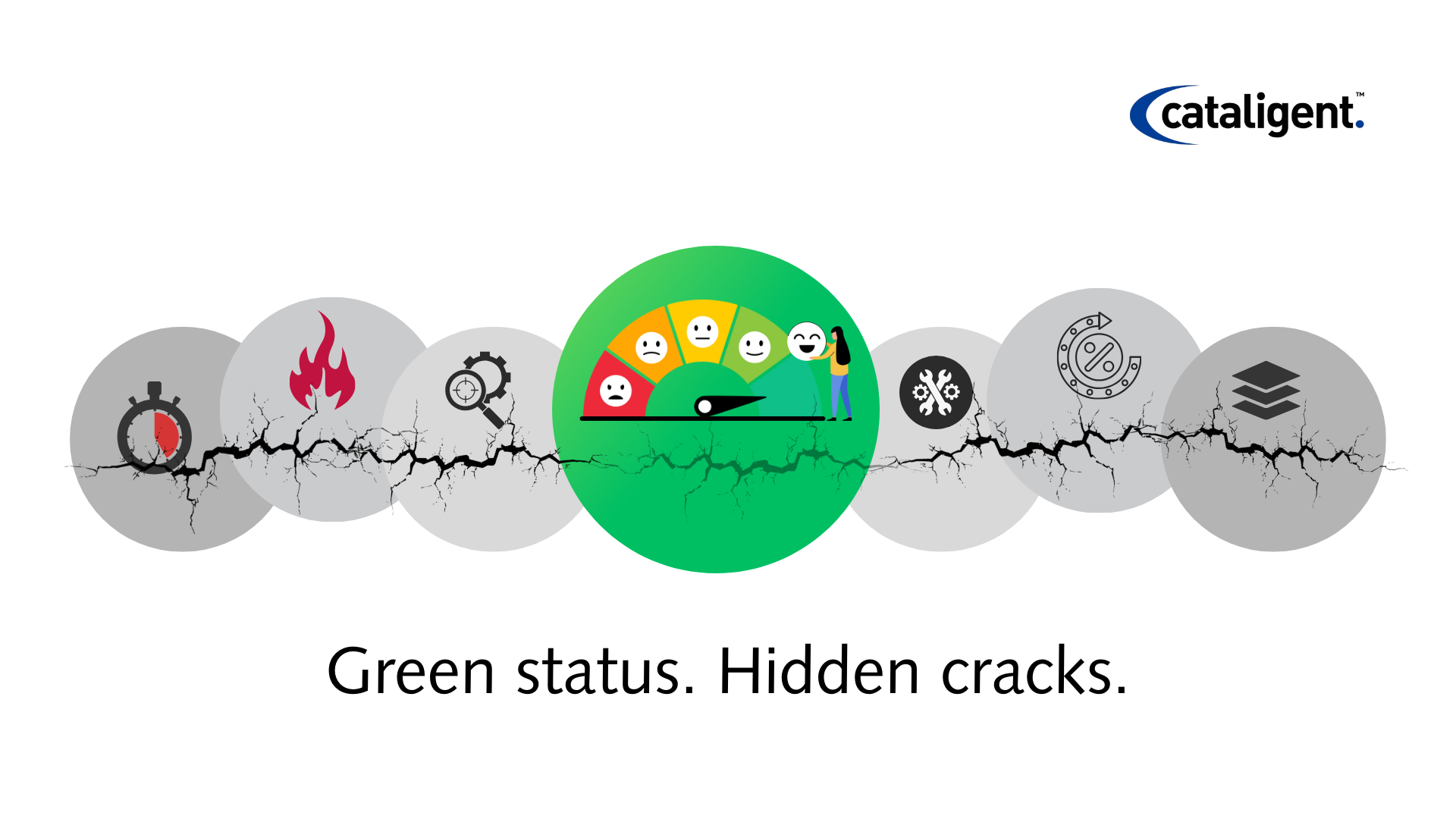
Common Project Management Failure Patterns (And Why We Keep Falling for Them)
Project management failure patterns are not mysterious. Most leaders have seen them before: unclear ownership, optimistic schedules, weak dependency control, late financial surprises, and reporting that turns problems green until the steering committee meeting. The real issue is that organizations keep treating these patterns as people problems when they are often governance system problems.
Failure pattern 1: activity is mistaken for progress
Busy teams can create the impression of control. Status calls happen, tasks move, decks are updated, and trackers are circulated. Yet none of this proves that strategic objectives, savings targets, approvals, or adoption are moving in the right direction.
In many programmes, project status is based on whether tasks were completed, not whether value is being delivered. A workstream can meet milestones while the forecast benefit drops, the owner changes, or the business process fails to adopt. This is why dashboard color alone is a poor substitute for governed execution.
- A milestone is reported complete without evidence.
- A KPI owner has no authority to act on the gap.
- A savings target is forecast but not validated by finance.
- A dependency between workstreams is known but not escalated.
- A decision is needed but hidden inside a status narrative.
Failure pattern 2: governance is added after the damage is done
Programme governance often arrives late. Leaders create steering committees, approval templates, and reporting rules after the first delays appear. By that point, the portfolio already contains inconsistent business cases, mixed definitions of status, and unclear responsibility boundaries.
Strong multi project management needs governance from the start. Project intake, prioritization, resource allocation, financial baseline, gate approval, risk review, and closure should be part of one operating model. When each project invents its own method, the portfolio cannot be trusted.
Failure pattern 3: reporting is built for updates, not decisions
Many reports describe what happened but do not help leaders decide what should happen next. A steering committee pack may include traffic lights, comments, and slides, but still fail to show decision rights, approvals pending, value movement, and escalation triggers.
Decision ready reporting should show the issue, owner, impact, options, required decision, due date, and consequence of delay. Without that discipline, the PMO becomes a reporting office instead of a control function.
How Cataligent Helps Through CAT4
Cataligent helps consulting firms and enterprise clients replace recurring project management failure patterns with governed execution through CAT4. CAT4 connects value tracking, approval workflows, execution control, and reporting in one platform, so teams are not managing strategy in one place and evidence in another.
For business transformation, CAT4 supports the full hierarchy from Organization to Measure. Leaders can see planned versus actual progress, financial effects, risks, dependencies, Implementation Status, Potential Status, and DoI stage movement. This helps expose the difference between work that is busy and work that is valuable.
Cataligent brings the operating experience around configuration, consulting alignment, programme setup, and governance design. CAT4 provides the system layer. Together they help leaders reduce repeat failure patterns and build a portfolio model that can be used across engagements, workstreams, and reporting cycles.
FAQs
Q. Why do project management failure patterns keep repeating?
They repeat because many organizations fix symptoms rather than the control model. Without clear ownership, stage gates, value tracking, and decision rights, the same problems return under new project names.
Q. Are dashboards enough to prevent project failure?
Dashboards help only when the data behind them is governed and decision ready. A dashboard that reports late, subjective, or disconnected updates can make weak control look organized.
Q. How does Cataligent help reduce project management failure patterns?
Cataligent helps clients design a governed execution model through CAT4. The platform connects approvals, value tracking, status reporting, dependencies, and closure so leaders can act earlier and with better context.