

Moving from Reacting to Disasters to Predicting Them with Pre-Mortems
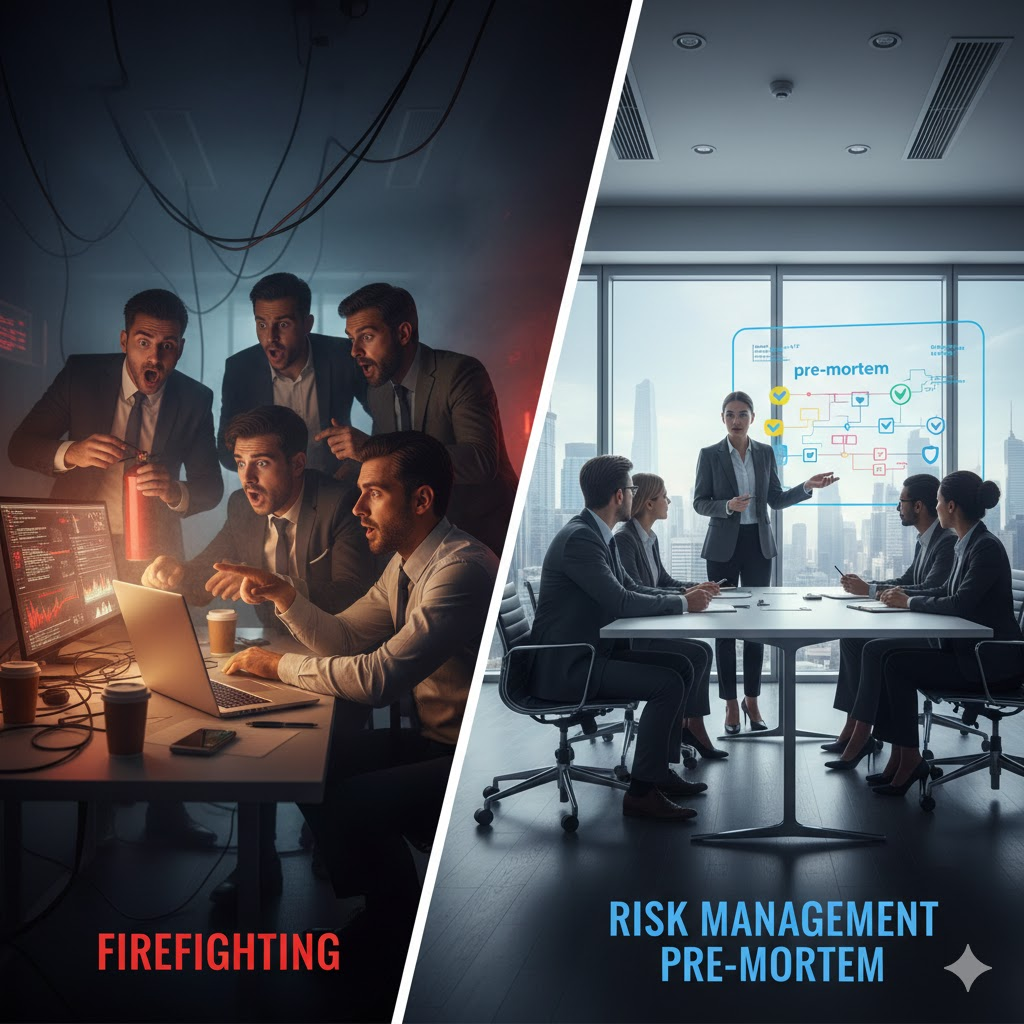
Most organizations say they care about risk management.
What they actually practice is firefighting.
Real risk management isn’t about heroic recovery.
It’s about preventing the fire in the first place.
- Firefighting Feels Productive (But It’s Not)
It rewards urgency, visibility, and action. The people who rush in during a crisis look decisive and committed. In the moment, reacting feels like leadership.
But over time, firefighting creates serious problems:
- Chronic stress and burnout
- Repeated failures with different names
- Shallow “lessons learned” that never stick
- A culture that confuses speed with effectiveness
Most damaging of all, firefighting trains teams to wait for failure instead of anticipating it.
- The Proactive Power of Pre-mortems
Instead of waiting for a project to fail (and then conducting a post-mortem to analyze why), imagine looking into a crystal ball to see how it could fail before it even starts. This is the power of a Pre-mortem, a powerful risk management technique that shifts your team from reactive “firefighters” to proactive “fire preventers.”
A pre-mortem is a hypothetical exercise where a project team imagines, before the project begins, that it has failed spectacularly. They then work backward to explain why, uncovering potential risks that might otherwise remain hidden.
- What Real Risk Management Looks Like
True risk management happens before things go wrong.
It asks:
- Where are we most likely to fail?
- What assumptions are we making that could be wrong?
- What early signals would tell us we’re in trouble?
This isn’t pessimism.
It’s preparedness.
And that’s exactly what pre-mortems are designed to do.
- What Is a Pre-Mortem?
A pre-mortem flips traditional planning on its head.
Instead of asking, “How could this succeed?” you ask:
“It’s six months from now. This project failed.
What went wrong?”
By assuming failure upfront, teams bypass optimism bias and surface risks that would otherwise stay hidden.
Don’t wait for your projects to catch fire. Equip your team with the PMP-aligned strategy of the pre-mortem to identify and extinguish potential risks before they ever ignite. Shift from being a reactive firefighter to a proactive project architect.
.
| Feature | Traditional Risk Assessment | Pre-mortem |
|---|---|---|
| Focus | Identifying known or probable risks | Uncovering unknown or overlooked risks |
| Approach | Analytical, data-driven | Intuitive, imaginative, storytelling |
| Benefit | Quantifies risk, creates registers | Fosters psychological safety, unearths blind spots |
| Output | Risk register with probabilities | Specific, actionable prevention strategies |
How to Run an Effective Pre-Mortem
Pre-mortems don’t need to be complex. They need to be intentional.
1. Set the Scenario
Tell the group:
“Imagine this project has failed spectacularly.
It’s over. We didn’t meet our goals.”
Make the failure hypothetical and shared—this lowers emotional risk.
2. Generate Failure Reasons Individually First
Have participants write down:
- What caused the failure?
- What warning signs were missed?
- What assumptions proved wrong?
3. Share, Cluster, and Prioritize Risks
Collect the responses and group them into themes:
- Technical risks
- People and resourcing issues
- Decision-making bottlenecks
- External dependencies
Then ask:
Which of these are both likely and high-impact?
4. Turn Risks into Actions
This is where most teams stop—and where the value really is.
For each major risk:
- What can we do now to reduce it?
- What early signal would warn us?
- Who owns monitoring it?
A risk without an owner is just a worry.

When to Use Pre-Mortems
Pre-mortems are especially valuable when:
- Launching new initiatives
- Making irreversible decisions
- Working with high uncertainty
- Projects have cross-functional dependencies
If the cost of failure is high, a pre-mortem is cheap insurance.
From Heroics to Foresight
Firefighting will always be necessary sometimes.
But when it becomes the norm, it’s a warning sign.
The strongest organizations don’t rely on heroics.
They rely on foresight.
Pre-mortems won’t eliminate risk—but they will make failure rarer, smaller, and less surprising.
And in today’s environment, the ability to predict problems before they explode isn’t just good risk management, It’s a competitive advantage.
How Cataligent helps you move from firefighting to real risk management (with pre-mortems)
Pre-mortems are only as good as what happens after the workshop. The common failure mode is: great insights → sticky notes → nothing operational changes.
This is where Cataligent’s CAT4 can help, by turning pre-mortem outputs into owned, trackable, and visible risk prevention work across projects and portfolios.
1) Capture pre-mortem risks where execution lives
- Log failure modes as structured risks/issues/actions (not buried in slides).
- Link each risk to the initiative/project, workstream, owner, and due date so it can’t “fade out” after kickoff.
CAT4 is positioned as a strategy-execution platform built to support transformation programs with centralized planning and execution.
2) Assign ownership and make follow-through unavoidable
- Convert each high-impact risk into prevention actions with clear owners (“a risk without an owner is just a worry”).
- Track completion and escalation consistently across teams, not ad hoc in meetings.
CAT4 supports multi-project / portfolio-style management and structured reporting for program oversight.
3) Monitor early warning signals (not just end results)
- Define leading indicators (missed milestones, resourcing gaps, dependency slippage, budget drift).
- Use recurring status reporting to spot signals early, before they become crises.
CAT4 is described as supporting real-time insights/status reporting across progress, cost, risk, and deliverables.
4) Make risk visibility portfolio-wide
- When you’re running multiple initiatives, the biggest threats are often cross-functional: shared resources, dependencies, decision bottlenecks.
- CAT4 helps centralize oversight so leadership can see emerging risk patterns across programs, not just inside one project.
Pre-mortems find the risks. CAT4 makes sure they don’t come back.
Convert failure scenarios into prevention actions with owners, signals, and leadership-ready visibility.
See how: https://www.cataligent.in/
Conclusion
If your “risk management” only shows up after something breaks, it is not risk management. It is firefighting.
Firefighting looks impressive. Urgent calls, late nights, heroic saves. But over time, it creates burnout, repeated surprises, and the same failures with new names.
Real risk management happens before the crisis. One simple shift makes that possible: the pre-mortem.
A pre-mortem flips the question from “How will this succeed?” to:
“It’s six months from now. This project failed. What went wrong?”
That single reframing reduces optimism bias, makes it safer for people to speak honestly, and surfaces risks no dashboard will catch. Post-mortems explain failure. Pre-mortems prevent it by spotting risks early, assigning ownership upfront, and replacing heroics with foresight.
Before your next big initiative, ask:
If this fails, what will we wish we had talked about sooner?