
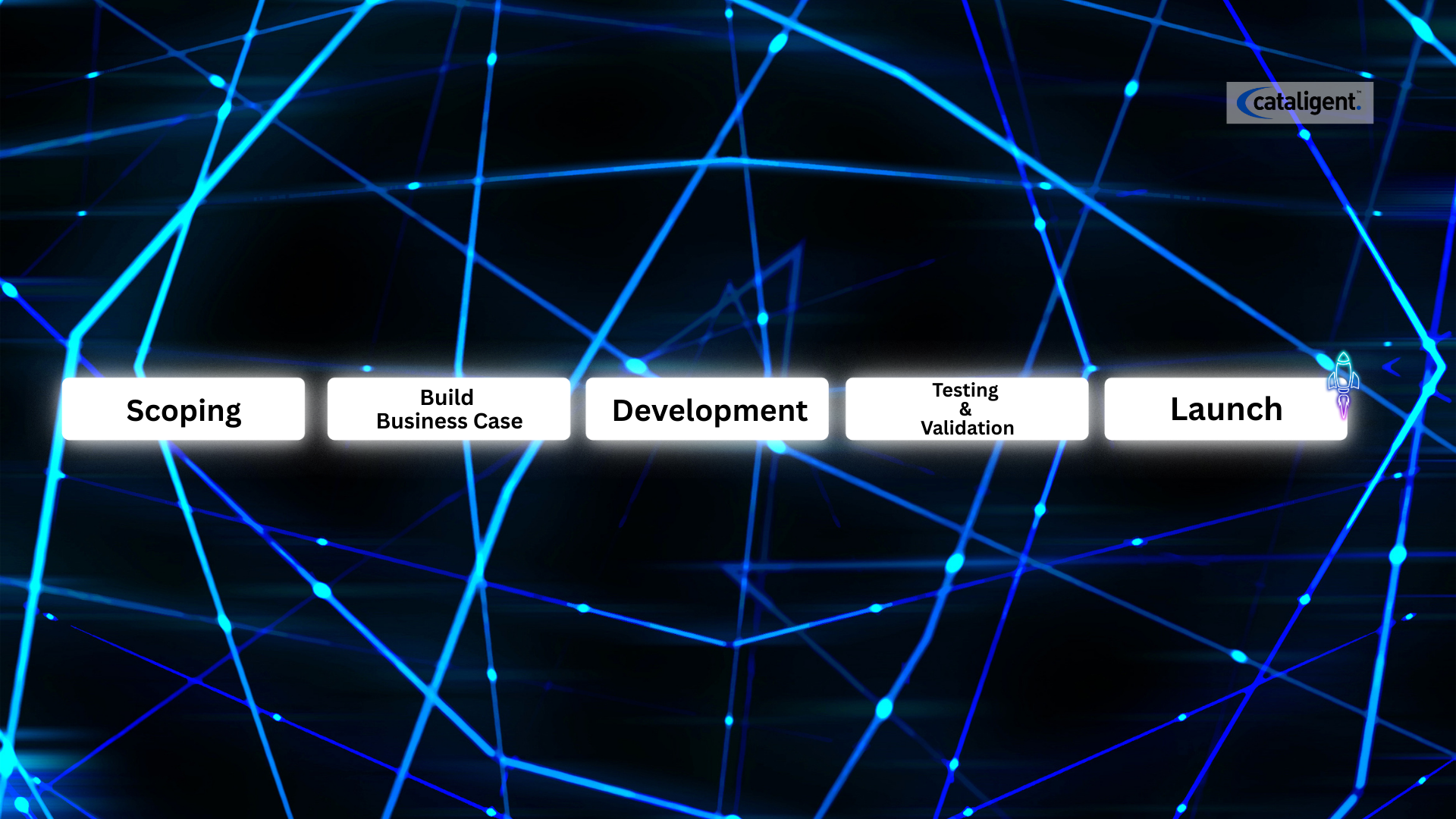
Phase-Gate Protocols: Driving Project Management Excellence and Business Transformation
Phase gate protocols are valuable only when they improve decisions. Too often, they become a checklist that confirms activity without proving readiness, value, or accountability. A project moves through gates because a meeting happened, a slide was approved, or a task was marked complete, while the deeper execution questions remain unresolved.
Project management excellence requires more than gate names. It requires clear entry criteria, decision rights, evidence requirements, status reporting, financial validation, and closure discipline. In business transformation, this matters because programmes often cross functions, workstreams, systems, finance, and operations.
Cataligent helps consulting firms and enterprise clients strengthen phase gate governance through CAT4, its no code strategy execution platform. CAT4 supports phase gate methodology, Degree of Implementation, approval workflows, value tracking, Implementation Status, Potential Status, reporting, and controller backed closure.
Why phase gate protocols fail in practice
A phase gate model can look strong on paper and weak in execution. The common failure is treating a gate as a date rather than a decision. A team reaches the scheduled review, presents progress, receives general approval, and moves forward without clear evidence that the measure is ready for the next stage.
This creates several risks. Scope may be unclear. Financial value may be untested. Dependencies may be unresolved. The owner may not have authority. The controller may not agree with the value case. The sponsor may approve the project without seeing implementation risk. Later, the programme wonders why delivery slowed or value disappeared.
Strong business transformation governance prevents this by making each gate a real control point. The gate should decide whether the measure moves forward, goes on hold, or is cancelled.
CAT4’s Degree of Implementation gives gates business meaning
CAT4 uses the Degree of Implementation, or DoI, framework to measure how deeply a measure has progressed. The stages are Defined, Identified, Detailed, Decided, Implemented, and Closed. Each stage reflects a different level of maturity, not just a different project phase label.
This matters because many programmes confuse progress with activity. A measure can have tasks underway but still lack financial detail. It can have a sponsor but no controller confirmation. It can have milestones but no clear closure criteria. DoI helps expose those gaps before they become leadership surprises.
At each DoI transition, a measure can move forward, be put on hold, or be cancelled. This gives the PMO and steering committee a practical way to govern the portfolio. They are not forced to keep every measure alive simply because it was once approved.
Phase gates should connect execution and value
Business transformation programmes often fail because execution and value are managed separately. The project team tracks milestones. Finance tracks benefits. Leadership receives a status pack. The issue is that no single governance model proves that execution progress and value potential are moving together.
CAT4 addresses this through the dual status view. Implementation Status shows whether execution is progressing against plan. Potential Status shows whether the expected value is still likely to be delivered. This distinction is important for cost saving programs, EBITDA improvement, operating model change, and other value driven programmes.
A measure can pass a delivery gate but lose value because assumptions changed. A procurement initiative may finish negotiations but achieve lower savings than planned. A process change may be implemented but adoption may remain weak. A technology project may go live while the expected operating benefit is delayed. Phase gate protocols should reveal these realities.
Approvals should be traceable, not remembered
Gate decisions need a record. Who approved the measure? What evidence was reviewed? What conditions were attached? Was the measure put on hold? Was a cancellation reason recorded? Which documents support the decision? What changed after approval?
If these answers sit in emails, meeting notes, or personal files, governance is fragile. CAT4 supports approval workflows, event triggered alerts, history management, archiving, and audit logs. Stakeholders can act through email workflows, and the decision record remains connected to the relevant measure.
This is valuable for PMO teams and consulting firms because steering committee governance depends on trust. The client should not have to rely on memory when asking why a measure moved forward or why value was accepted.
How Cataligent Helps Through CAT4
Cataligent helps organizations design phase gate protocols that support real business decisions. Through CAT4, Cataligent can configure gates, measure fields, approval workflows, status reporting, financial tracking, and closure rules around the client’s operating model or the consulting firm’s methodology.
The platform supports Organization, Portfolio, Program, Project, Measure Package, and Measure hierarchy. This allows gate decisions to roll up from individual measures to programme and portfolio level. It also supports planned versus actual tracking, risk and dependency management, document storage, scheduled reports, and dashboards.
For consulting firms, CAT4 helps make the firm’s delivery method repeatable across client mandates. For enterprise teams, it helps the transformation office govern measures with clearer accountability and less manual reporting effort.
For 25 years CAT4 has been trusted, with 250+ large enterprise installations and 40,000+ users. Those proof points matter when an organization wants phase gate governance to support complex enterprise change rather than only a local project process.
Phase gate protocols for portfolio control
Phase gates are also useful for portfolio management. They help leaders control project intake, investment approval, implementation readiness, change requests, and closure. A portfolio without gates can become crowded with work that has unclear value or weak ownership.
In multi project management, gate protocols help leadership see which measures are Defined, which are ready for decision, which are implemented, and which are closed. This supports resource allocation, dependency planning, and steering committee decision making.
The key is to use gates as management controls. A gate should require evidence, identify accountable roles, record decisions, and connect to value tracking. If it does not change what leaders know or decide, it is only ceremony.
Make closure the strongest gate
The most important gate is often the final one. Many programmes close work when tasks finish, but that does not prove value. CAT4’s DoI 5 requires controller backed final approval confirming achieved EBITDA potential where that value applies. This creates a stronger definition of completion.
Formal closure protects the portfolio. It prevents unverified success from entering leadership reporting. It also gives consulting firms and enterprise clients a clearer evidence base for what was delivered.
If your phase gate model has become a checklist, Cataligent can help redesign it around decisions, value, accountability, and evidence. CAT4 can then support that model in daily execution and executive reporting.
FAQs
Q: What makes a phase gate protocol effective?
An effective protocol has clear entry criteria, decision rights, evidence requirements, approval records, and closure rules. It should help leaders decide whether work moves forward, goes on hold, or stops.
Q: How is CAT4’s DoI model different from a normal phase gate model?
DoI measures how deeply a measure has progressed from Defined to Closed and connects that progress to governance. It also supports hold and cancel decisions, dual status reporting, and controller backed closure.
Q: Why do phase gates matter in business transformation?
Transformation work crosses functions, finance, operations, technology, and leadership, so weak gates can hide risk. Strong gates keep ownership, approvals, dependencies, value, and closure evidence visible.