
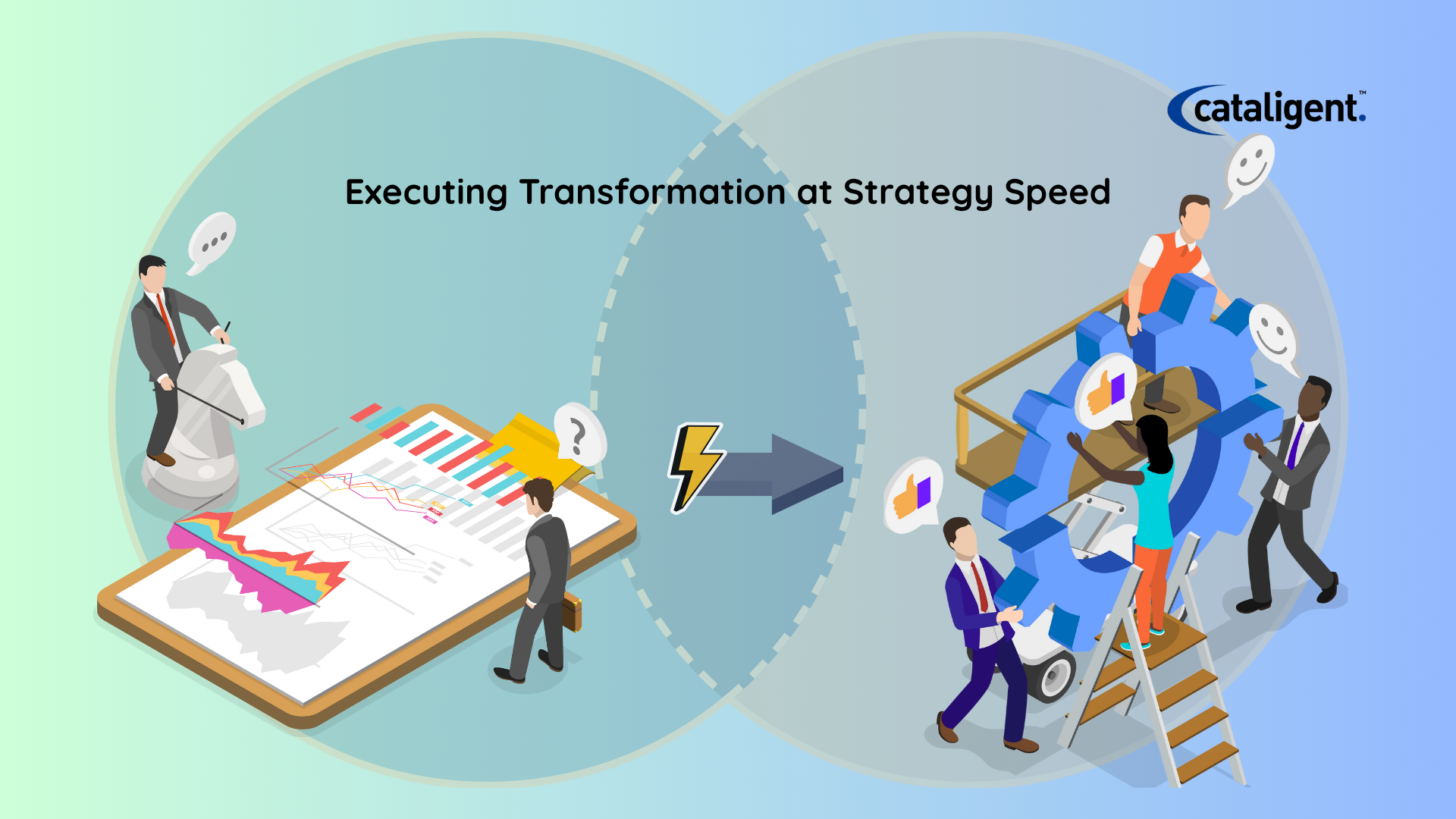
Execution at the Speed of Strategy: Redefining Agility in Transformation
Strategy can change in one leadership meeting, but enterprise execution often changes through weeks of manual updates, unclear decisions, delayed approvals, and inconsistent workstream reporting. That gap is where transformation agility breaks down. Execution at the speed of strategy does not mean moving without control. It means the organization can translate strategic shifts into governed initiatives, accountable owners, updated milestones, visible dependencies, fast decisions, and current executive reporting before the opportunity or risk has passed.
This matters for CEOs, CFOs, COOs, strategy leaders, transformation offices, PMOs, consulting firms, and business unit heads because agility without governance can create confusion. A transformation strategy creates direction, an initiative creates potential, and governed execution turns transformation intent into measurable progress. True agility is the ability to adjust the transformation portfolio while preserving ownership, value tracking, stage gate control, and evidence based closure.
What Does Execution at the Speed of Strategy Mean?
Execution at the speed of strategy means connecting strategic decisions to the operating execution layer quickly and visibly. When leaders change priorities, approve a market response, accelerate a cost saving program, or shift resources across workstreams, the transformation office should be able to update initiatives, owners, sponsors, milestones, risks, dependencies, approval workflows, and steering committee reporting without rebuilding the whole governance model.
This is not a call for loose project management. It is a stronger form of transformation governance. Each initiative still needs a description, owner, sponsor, business unit, function, stage gate status, Implementation Status, Potential Status, value logic, and closure condition. Agility comes from having a governed system that can absorb strategic change without losing control.
Why Strategy Speed Matters for Business Transformation
Business transformation programs often fail to keep pace with leadership intent. A board may approve a new strategic objective, but the PMO still needs to chase workstream updates, finance still needs to validate value assumptions, and business units may not know which existing initiatives should continue, pause, or stop. If execution cannot respond, strategy becomes a presentation rather than a management system.
Speed matters most when the transformation portfolio is large. A market expansion workstream may depend on pricing approval, channel readiness, legal entity setup, and resource allocation. A cost saving initiative may depend on supplier renegotiation, process redesign, finance validation, and business unit adoption. A post merger integration workstream may require rapid decision making across functions. Without governed agility, leaders see motion but not controlled progress.
| Strategic shift | Execution risk | Owner requirement | Reporting need |
|---|---|---|---|
| New growth priority | Teams launch initiatives without portfolio tradeoffs | Named sponsor and initiative owner | Priority status, resources, dependencies, milestones |
| Cost pressure | Savings are announced before validation | Finance owner and business unit sponsor | Baseline, target value, forecast value, actual value |
| Operating model change | Roles change faster than decision rights | Process owner and accountable business head | Role adoption, approval workflow, closure evidence |
| Risk event | Escalations stay in email and local trackers | Risk owner and steering committee path | Risk age, mitigation action, decision needed |
| Portfolio reprioritization | Old initiatives stay active without review | Transformation office and sponsor review | Continue, on hold, cancel, or close decision |
How to Build a Strategy to Initiative Control Loop
A fast strategy execution model needs a control loop from leadership decision to initiative update. The loop begins with a strategic objective, translates it into initiatives or measures, assigns an owner and sponsor, defines stage gate requirements, confirms value logic, and updates portfolio reporting. The loop should also work in reverse. When execution data shows a blocked dependency, risk escalation, or weakening Potential Status, leadership should receive a clear decision request.
Consulting firms can help clients design this loop as part of transformation governance. Enterprise transformation offices can run it as a recurring management discipline. The important point is that strategy and execution should not live in separate reporting cycles.
How to Separate Fast Decisions from Loose Governance
Many organizations confuse agility with lighter control. In business transformation, the better approach is faster governance. Decision rights should be explicit. Approval workflows should be clear. Escalation routes should be visible. Workstream owners should know what evidence is required to move an initiative through the next stage gate.
For example, a steering committee may allow a measure to move forward when entry criteria are met, place it on hold when a dependency changes, or cancel it when the business case is no longer valid. This lets leaders act quickly while keeping a traceable record of why the decision was made.
How to Use Stage Gates Without Slowing Decisions
Stage gates are often criticized because they are seen as slow. In a well governed transformation program, stage gates should make decisions faster by clarifying what evidence is needed. Degree of Implementation stages can separate a defined idea from an identified measure, a detailed plan, a decided initiative, an implemented change, and a closed measure with confirmed evidence.
This approach prevents two common problems. First, it stops immature ideas from being reported as execution progress. Second, it stops implemented work from being closed before adoption, financial validation, or business evidence is ready.
How to Keep Steering Committee Reporting Current
Execution at strategy speed requires leadership reports that reflect current reality. If every report depends on manual consolidation from spreadsheets and slides, the reporting cycle becomes slower than the strategy cycle. Steering committee reporting should show workstream progress, achievements, issues, decisions needed, next steps, Implementation Status, Potential Status, risks, dependencies, approvals, and closure evidence.
Current reporting also changes meeting quality. Leaders can spend less time asking for status explanations and more time resolving resource tradeoffs, approving next steps, clearing dependencies, and deciding which initiatives should continue, pause, or stop.
Metrics That Matter
Agility in transformation should be measured through speed with control. Relevant metrics include time from strategy decision to initiative creation, initiative completion, milestone completion, approval ageing, client decision ageing where relevant, dependency blockage, risk escalation, Implementation Status, Potential Status, decision delay, resource allocation, budget versus actual, forecast value, actual value, closure evidence, steering committee reporting cadence, manual reporting effort, and status accuracy.
| Metric | Why it matters | How to validate it |
|---|---|---|
| Strategy to initiative cycle time | Shows how quickly leadership decisions become owned work | Track decision date, initiative creation date, owner assignment, and first milestone |
| Decision delay | Shows whether governance is supporting or slowing execution | Measure days open for approvals, escalations, and steering committee decisions |
| Dependency blockage | Shows where strategy speed is being lost between workstreams | Review dependency owner, due date, ageing, and escalation status |
| Implementation Status | Shows execution progress against plan | Validate milestones, stage gate movement, and owner evidence |
| Potential Status | Shows whether expected business value remains credible | Compare baseline, target value, forecast value, actual value, and finance review |
Common Mistakes to Avoid
Confusing agility with constant reprioritization. Changing priorities every week without portfolio governance creates noise and weakens owner accountability.
Reporting speed without evidence. A fast launch does not prove execution unless milestones, adoption, risks, dependencies, approvals, and closure evidence are tracked.
Letting strategy and PMO reporting run separately. If strategic decisions do not update initiative tracking quickly, leaders lose visibility into what changed and why.
Removing stage gates to move faster. Stage gates should clarify evidence and speed decisions, not disappear when the organization feels pressure.
Ignoring Potential Status. A workstream can appear green on tasks while expected value, financial impact, or business adoption is slipping.
How Cataligent Helps Through CAT4
Cataligent helps enterprises and consulting firms connect strategy shifts to governed business transformation execution through CAT4, its no code strategy execution platform. The governance problem is that many organizations can change strategy faster than they can update initiatives, owners, approvals, risks, value tracking, and steering committee reporting.
Through CAT4, Cataligent supports transformation workstreams, strategic objectives, initiative portfolios, owners, sponsors, milestones, risks, dependencies, approval workflows, Degree of Implementation, DoI stage gates, Implementation Status, Potential Status, value tracking, and closure evidence. CAT4 can support multi project management when transformation portfolios include many projects, internal organization governance when decision rights need clarity, and cost saving programs when strategy speed is linked to financial impact.
Cataligent helps leaders move faster without losing control. Instead of relying on fragmented spreadsheets, PowerPoint decks, email approvals, and separate trackers, CAT4 gives the transformation office a governed execution layer for current reporting and decision making.
What Cataligent Does Not Claim
Cataligent does not claim that CAT4 creates transformation strategy automatically. CAT4 does not replace consulting expertise, leadership judgment, finance systems, ERP systems, BI platforms, project management tools, or every planning tool.
CAT4 does not guarantee ROI, compliance, transformation success, savings, EBITDA improvement, user adoption, or business outcomes. CAT4 supports governed execution, value tracking, approvals, reporting, and controller backed closure where financial value is involved.
Conclusion
Execution at the speed of strategy is not about rushing transformation work. It is about giving leaders a governed system that can translate strategic decisions into owned initiatives, stage gate progress, value tracking, approval workflows, risk escalation, and current executive reporting. Talk to Cataligent about connecting business transformation strategy to governed execution through CAT4.
FAQs
What does execution at the speed of strategy mean in transformation?
It means strategic decisions can be translated quickly into governed initiatives with owners, sponsors, milestones, risks, dependencies, approvals, and reporting. It does not mean skipping stage gates or removing accountability.
How can leaders make transformation more agile without losing control?
Leaders should define decision rights, approval workflows, escalation routes, stage gate evidence, and portfolio review rules before speed is required. This allows fast decisions while preserving auditability, ownership, and value tracking.
How does CAT4 help with faster strategy execution?
CAT4 supports initiative tracking, DoI stage gates, approvals, risks, dependencies, Implementation Status, Potential Status, value tracking, and executive reporting. Cataligent uses CAT4 to help enterprises and consulting firms keep execution aligned with changing strategy.