
The 7 Phases of Business Transformation: A Complete Guide for Modern Enterprises
Many enterprise transformation programs begin with a strong case for change but weaken when the phases are treated as a presentation sequence instead of a governed execution model. Leaders approve ambition, teams create roadmaps, consultants build workstreams, and the PMO starts reporting. Then decisions age, owners change, dependencies grow, forecast value moves, and the steering committee sees activity without clear evidence of progress. The 7 phases of business transformation matter because they help leaders move from intent to accountable execution.
For CEOs, CFOs, COOs, strategy leaders, transformation offices, consulting firms, PMO leaders, and finance teams, a phase model is useful only when it defines what must be owned, approved, tracked, adopted, measured, and closed. A transformation strategy creates direction. An initiative creates potential. Governed execution turns transformation intent into measurable progress.
What Are the 7 Phases of Business Transformation?
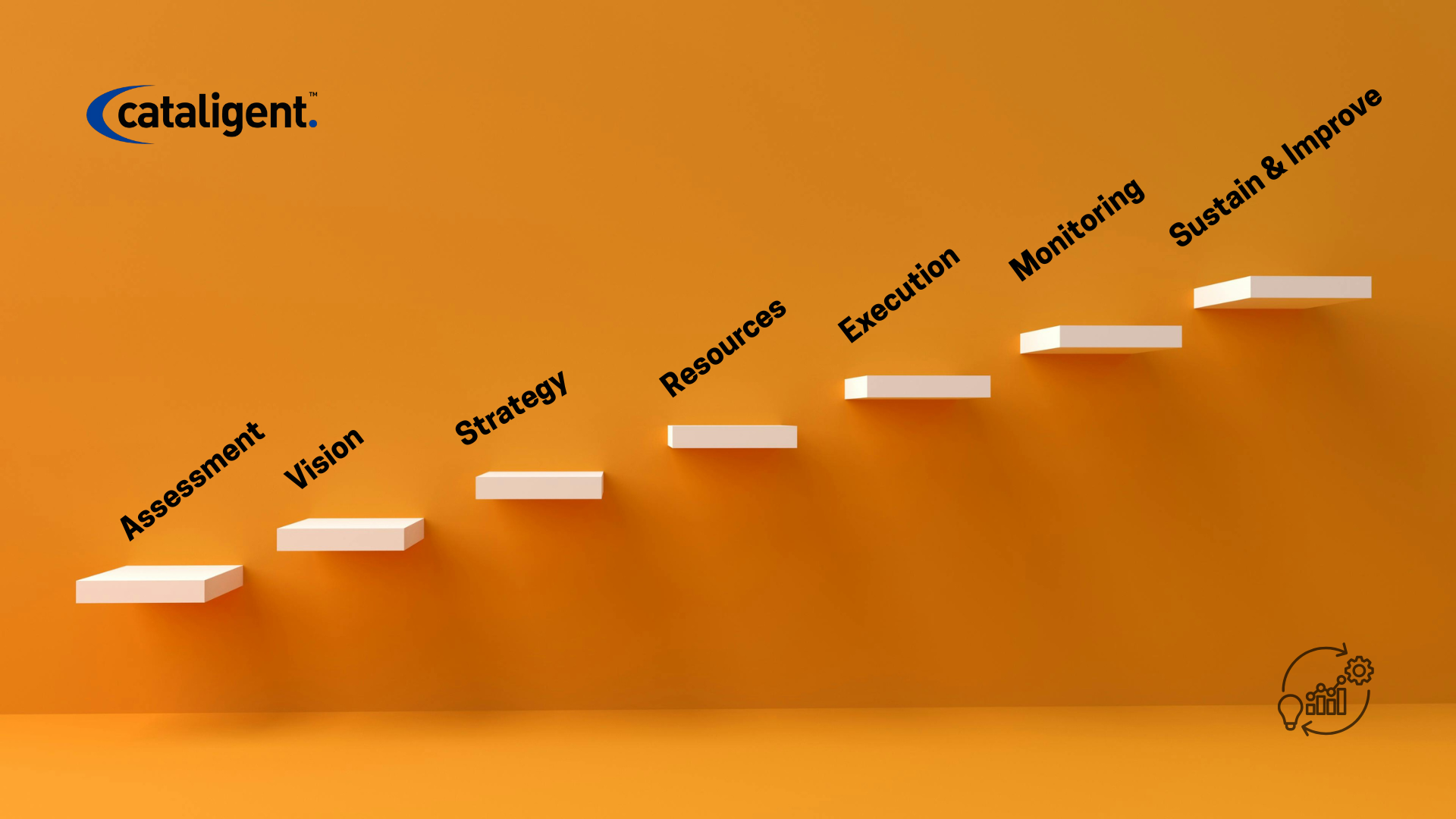
The 7 phases of business transformation are a practical way to structure enterprise change from strategy through closure. The phases can be described as diagnose, design, prioritize, mobilize, execute, adopt, and confirm. The exact labels may vary by organization or consulting methodology, but the governance logic should remain consistent. Each phase should define the decision to be made, the owner accountable for progress, the evidence needed, and the reporting view required by leadership.
Business transformation is not a one time project plan. It is a controlled portfolio of workstreams, initiatives, measures, milestones, risks, dependencies, approvals, and value assumptions. A modern enterprise may use the same phase model for operating model change, cost saving programs, post merger integration, customer experience redesign, process improvement, quality improvement, service improvement, or market expansion.
Why the 7 Phases Matter for Business Transformation
The 7 phases matter because weak transformation execution usually fails at the handoffs. Diagnosis is not converted into owned initiatives. Design is not connected to decision rights. Priorities are approved without a baseline. Execution begins before dependencies are clear. Adoption is assumed because a milestone closed. Value is reported before finance has confirmed actual impact. Closure happens in a status deck without evidence.
A good phase model prevents these failure points. It gives the transformation office, PMO, consulting partner, business unit sponsor, initiative owner, and finance team a shared execution language. It also helps leadership separate Implementation Status from Potential Status. A workstream may be green on delivery while the forecast value is slipping, or a cost saving initiative may have completed actions while actual value still needs controller validation.
| Phase | Common failure | Governance requirement | What to track |
|---|---|---|---|
| Diagnose | Problem is described but not baselined | Confirm business pain, baseline, owner, and affected units | Baseline, risk, process gap, cost of problem |
| Design | Future model lacks decision rights | Define target operating model, sponsors, and approvals | Design decision, sponsor approval, dependency map |
| Prioritize | Too many initiatives compete for attention | Score initiatives by value, urgency, risk, and capacity | Target value, resource need, business impact |
| Mobilize | Teams start without accountable owners | Assign owner, sponsor, controller, milestones, and reporting cadence | Owner accountability, readiness approval, workstream plan |
| Execute | Progress is tracked as activity only | Use stage gates, risk escalation, and dependency control | Implementation Status, milestone evidence, approval ageing |
| Adopt | Business units do not change behavior | Track training, process use, adoption evidence, and exceptions | Adoption rate, process compliance, issue volume |
| Confirm | Closure is claimed before value is validated | Require closure evidence and controller validation where financial value is involved | Actual value, Potential Status, closure approval |
Phase 1: Diagnose the Real Transformation Problem
The first phase should identify the business problem that creates cost, delay, customer friction, quality risk, capacity pressure, or lost growth. A weak diagnosis creates vague initiatives. A strong diagnosis names the process, business unit, legal entity, function, customer segment, system dependency, and measurable baseline. For example, a finance transformation may diagnose slow month end close, duplicate manual controls, weak account ownership, and inconsistent reporting periods.
Consulting firms should use this phase to connect client interviews, data review, and operating model analysis into clear measures. Enterprise teams should avoid starting with solution ideas before the problem is baselined. Good diagnosis creates a traceable line from problem to potential value.
Phase 2: Design the Future Operating Model
Design is where transformation often becomes too conceptual. A future operating model should define roles, decision rights, governance forums, process changes, system touchpoints, and approval workflows. It should also state what will not change. A sales transformation design might define new account ownership, pricing approval rules, lead qualification steps, CRM data responsibilities, and regional escalation paths.
This phase needs sponsor accountability because design decisions affect business units. The transformation office should track open decisions, ageing approvals, and dependencies. Without this control, design remains attractive but difficult to implement.
Phase 3: Prioritize Initiatives Before Capacity Is Consumed
Most modern enterprises have more transformation ideas than capacity. Prioritization should not be a political ranking exercise. It should compare strategic objective, target value, risk, readiness, dependency load, resource demand, and adoption complexity. The outcome should be a controlled initiative portfolio, not a long wish list.
For cost saving programs, this is where baseline, target value, forecast value, and finance ownership become important. For customer or operating model programs, this is where KPI tracking and OKR tracking help connect initiatives to measurable progress. Prioritization should also define what gets stopped, put on hold, or combined.
Phase 4: Mobilize Workstreams with Owners and Sponsors
Mobilization turns approved priorities into accountable execution. Each workstream should have a sponsor, initiative owner, business unit owner, milestones, risks, dependencies, approval workflow, and reporting cadence. A transformation roadmap without owners is a communication document, not an execution system.
Examples of governed workstreams include procurement savings, shared services redesign, post merger integration, quality improvement, product portfolio simplification, and service request improvement. Each should have a clear owner and evidence requirement. The PMO or transformation office should confirm readiness before execution begins.
Phase 5: Execute Through Stage Gates and Current Reporting
Execution is where transformation value is either protected or lost. Stage gates help leaders confirm that each initiative has moved from defined to identified, detailed, decided, implemented, and closed. The point is not to slow work. The point is to make sure decisions, risks, dependencies, and evidence are reviewed at the right time.
Steering committee reporting should show achievements, issues, decisions needed, next steps, Implementation Status, Potential Status, and value movement. This is especially important when a program is green on milestones but red on forecast value, adoption, or dependency risk.
Phase 6 and 7: Drive Adoption and Confirm Outcomes
Adoption is the phase that converts implementation into business change. It should track whether people use the new process, whether exceptions decline, whether decision rights work, whether training is complete, and whether business units accept the new operating model. Closing a project before adoption evidence is available creates false confidence.
Confirmation is the final governance step. Where financial value is involved, controller backed closure helps verify actual value against baseline, target value, and forecast value. Where the outcome is non financial, leaders should still require evidence such as KPI movement, process compliance, service improvement, quality records, or approved closure documentation.
Metrics That Matter
The 7 phases need metrics that show movement across the full transformation journey. Early phases should track baseline, design decisions, owner assignment, prioritization score, and readiness. Middle phases should track milestone completion, dependency blockage, risk escalation, approval ageing, and resource allocation. Late phases should track business adoption, Potential Status, actual value, status accuracy, closure evidence, and manual reporting effort.
| Metric | Why it matters | How to validate it |
|---|---|---|
| Baseline quality | Weak baselines make value claims unreliable | Review source data, finance input, and agreed measurement logic |
| Owner assignment | Transformation stalls when accountability is unclear | Confirm owner, sponsor, controller, and business unit for each measure |
| Approval ageing | Delayed decisions slow the phase movement | Track open approvals by age, owner, and affected workstream |
| Implementation Status | Shows execution progress against plan | Review milestone evidence, DoI stage, and blocker status |
| Potential Status | Shows whether expected value is still credible | Compare target value, forecast value, actual value, and closure evidence |
| Adoption evidence | Confirms business change beyond implementation | Use process data, training completion, usage records, and exception trends |
Common Mistakes to Avoid
Treating phases as presentation headings. Each phase should create a decision, an owner, evidence, and a reporting requirement, not just a slide in a roadmap.
Starting execution before the baseline is agreed. Without baseline clarity, teams cannot prove whether an improvement created confirmed value.
Prioritizing every idea as urgent. A transformation portfolio needs choices because capacity, sponsor attention, and finance validation are limited.
Closing implementation without adoption evidence. A new process, system, or operating model is not complete until the business uses it and exceptions are understood.
Reporting financial value without controller validation. Forecast savings and actual savings should not be treated as the same thing when leadership decisions depend on them.
How Cataligent Helps Through CAT4
Cataligent helps enterprises and consulting firms turn the 7 phases of business transformation into governed execution through CAT4, its no code strategy execution platform. The governance problem Cataligent helps solve is the loss of control between phase based planning and measurable implementation. CAT4 gives leaders one governed place to structure objectives, portfolios, programs, projects, measure packages, measures, owners, sponsors, approvals, risks, dependencies, milestones, Implementation Status, Potential Status, and closure evidence.
For business transformation, CAT4 can connect diagnosis, design, prioritization, mobilization, execution, adoption, and confirmation into a controlled operating rhythm. For PMO leaders and consulting teams, it supports multi project management and portfolio governance across complex programs. For organization design and operating model change, Cataligent can connect roles, decision rights, and ownership through internal organization structures. Where transformation includes savings or EBIT impact, CAT4 can support cost saving programs with baseline, forecast, actual value, and controller backed closure.
Cataligent has 25 years in continuous operation since 2000 and supports enterprise execution through CAT4 across large scale settings. The next step is to talk to Cataligent about converting your transformation phase model into governed execution and current leadership reporting.
What Cataligent Does Not Claim
Cataligent does not claim that CAT4 creates transformation strategy automatically. CAT4 does not replace consulting expertise, leadership judgment, finance systems, ERP systems, BI platforms, project management tools, or every planning tool. CAT4 does not guarantee ROI, compliance, transformation success, savings, EBITDA improvement, user adoption, or business outcomes. CAT4 supports governed execution, value tracking, approvals, reporting, and controller backed closure where financial value is involved.
Conclusion
The 7 phases of business transformation are valuable only when they control how strategy moves into accountable execution. Diagnose the real problem, design the operating model, prioritize the portfolio, mobilize owners, execute through stage gates, drive adoption, and confirm outcomes with evidence. That is how a phase model becomes a governance model.
Explore how Cataligent supports business transformation governance through CAT4, so your transformation phases connect to owners, approvals, value tracking, executive reporting, and evidence based closure.
FAQs
What are the most important phases of business transformation?
All phases matter, but diagnosis, prioritization, execution, adoption, and confirmation are often where programs lose control. These phases determine whether transformation intent becomes measurable progress rather than activity.
Why is a transformation roadmap not enough?
A roadmap shows planned movement but does not prove ownership, approval, risk control, dependency closure, adoption, or value confirmation. Leaders need governed execution and evidence at each phase.
How does CAT4 support the 7 phases of business transformation?
CAT4 helps Cataligent connect phases to portfolios, programs, projects, measures, owners, sponsors, approvals, DoI stage gates, Implementation Status, Potential Status, and closure evidence. It supports execution control without claiming to replace strategy, consulting expertise, or leadership judgment.