Month: September 2025

  • Performance Management: Driving Organizational Success Through Metrics and Accountability

    Performance Management: Driving Organizational Success Through Metrics and Accountability

    What is Performance Management in Business Consulting?

    Performance management is a structured, continuous process for monitoring, evaluating, and enhancing individual, team, and organizational performance. It ensures that activities and outputs are aligned with corporate objectives and that accountability and development are maintained across all levels. Rather than being a one-time evaluation, performance management fosters a culture where data-driven decision-making, continuous feedback, and proactive improvement are embedded into daily operations.

    Cataligent utilizes a holistic methodology supported by the CAT4 platform to capture, analyze, and report performance data. This approach ensures that performance management is objective, actionable, and tied directly to strategic goals, enabling leaders to make informed decisions that drive measurable results.

    Why Performance Management is Critical

    Performance management is essential for organizations aiming to enhance productivity, maintain competitiveness, and achieve strategic objectives. Its importance is highlighted through:

    • Alignment with Goals: Cataligent ensures individual, team, and departmental objectives are directly linked to corporate strategy, creating clear focus and direction. For example, aligning sales targets with strategic market expansion ensures each effort contributes to broader organizational success.
    • Enhanced Accountability: Metrics and reporting structures cultivate a culture of responsibility. Teams and employees understand expectations and can track their contributions against defined objectives.
    • Informed Decision-Making: By analyzing KPIs and trends, leaders can identify areas requiring attention, reallocate resources effectively, and optimize processes for better outcomes.
    • Employee Engagement and Development: Regular feedback, coaching, and performance reviews help employees grow, build skills, and remain motivated, resulting in higher productivity and retention.
    • Continuous Improvement: Performance data reveals trends, strengths, and gaps, enabling iterative improvements to processes, strategy execution, and overall organizational effectiveness.

    Without structured performance management, organizations risk misalignment, reduced productivity, and underperformance, limiting their strategic impact and competitive edge.

    How Performance Management Shapes Consulting Impact

    Performance management transforms consulting recommendations into measurable organizational improvements. Cataligent’s approach includes:

    1. Setting Clear Objectives:
      Cataligent collaborates with leadership to define SMART objectives for teams and individuals, ensuring every goal supports the broader organizational strategy. Clear objectives create accountability and provide a reference for evaluating performance effectively.
    2. Defining KPIs and Metrics:
      KPIs are selected to quantify performance in key areas, including efficiency, quality, output, and customer impact. Cataligent ensures metrics are actionable and balanced, providing a comprehensive view of organizational health.
    3. Monitoring and Reporting:
      Using CAT4, real-time performance data is captured and visualized through dashboards and reports. This enables leaders to quickly identify trends, gaps, or deviations and take corrective actions proactively.
    4. Feedback and Coaching:
      Structured feedback loops ensure employees and teams understand their performance and development opportunities. Cataligent supports coaching programs that enhance skills, correct underperformance, and reinforce high-performance behaviors.
    5. Continuous Optimization:
      Data-driven insights allow organizations to refine strategies, adjust processes, and improve performance frameworks iteratively. Cataligent ensures that improvements are sustainable and continuously aligned with evolving business goals.

    How Cataligent Can Help

    Cataligent combines expertise, technology, and practical frameworks to maximize performance management impact:

    • CAT4 Integration: Real-time tracking, analytics, and reporting provide transparent and actionable insights into organizational performance.
    • Customized KPI Frameworks: Metrics are tailored to align with organizational objectives, industry benchmarks, and departmental goals.
    • Leadership Support: Cataligent coaches leaders to interpret performance data, provide effective feedback, and foster a high-performance culture.
    • Employee Development Programs: Structured coaching and review processes ensure employees grow and contribute effectively to strategic goals.
    • Sustainable Performance Improvements: Continuous monitoring and iterative adjustments embed long-term performance enhancements across the organization.

    Embedded Value for Consulting

    • Aligned Performance: Ensures all activities support strategic objectives.
    • Increased Accountability: Clear responsibilities and measurable outcomes enhance ownership and reliability.
    • Data-Driven Insights: Real-time analytics enable proactive, informed decision-making.
    • Enhanced Engagement: Feedback and coaching improve employee motivation and productivity.
    • Continuous Improvement: Performance data drives ongoing optimization of processes, strategies, and results.

    Performance management converts strategy into measurable action. By setting clear objectives, defining actionable KPIs, providing continuous feedback, and leveraging data-driven insights, Cataligent ensures organizations achieve sustainable success and measurable impact.


  • Operational Excellence: Streamlining Business Processes for Maximum Efficiency

    Operational Excellence: Streamlining Business Processes for Maximum Efficiency

    What is Operational Excellence in Business Consulting?

    Operational excellence is a structured and continuous approach to improving processes, workflows, and operations to achieve optimal efficiency, effectiveness, and quality. It is not just about fixing processes—it is about fostering a culture where continuous improvement, proactive problem-solving, and streamlined operations are embedded into daily practices. In consulting, operational excellence ensures organizations optimize current operations and build frameworks that sustain long-term performance improvements.

    Cataligent leverages a structured methodology to assess, redesign, and enhance operations. Using the CAT4 platform, operational data, KPIs, and workflow analytics are utilized to identify bottlenecks, inefficiencies, and automation opportunities, ensuring interventions lead to measurable performance gains.

    Why Operational Excellence is Critical

    Achieving operational excellence is essential for organizations seeking competitiveness, agility, and profitability. Its significance lies in:

    • Process Efficiency: Streamlined workflows reduce redundant steps, minimize delays, and eliminate waste, leading to faster delivery, reduced costs, and improved resource utilization.
    • Consistent Quality: Optimized operations ensure outputs meet consistent standards, improving customer satisfaction, loyalty, and organizational reputation.
    • Employee Productivity: Simplifying workflows reduces frustration and manual errors, enabling employees to focus on higher-value tasks that contribute to strategic goals.
    • Agility: Efficient processes allow organizations to adapt quickly to market shifts, emerging trends, or operational challenges without significant disruption.
    • Sustainable Growth: Continuous improvement becomes part of the culture, ensuring organizations maintain competitiveness and long-term operational success.

    Without operational excellence, businesses face inefficiency, inconsistency, and missed growth opportunities, limiting their market advantage.

    How Operational Excellence Shapes Consulting Impact

    Operational excellence transforms consulting from theoretical recommendations to tangible business results. Cataligent employs a comprehensive, step-by-step approach:

    1. Process Mapping and Analysis:
      Cataligent begins by documenting existing workflows across functions, using data and visual representations to identify inefficiencies, redundancies, bottlenecks, and pain points. This analysis provides a clear understanding of where interventions will have the highest impact.
    2. Process Reengineering:
      Based on insights from mapping, Cataligent redesigns workflows to maximize efficiency and effectiveness. This may include consolidating steps, automating repetitive tasks, simplifying approvals, or introducing new tools, ensuring processes are faster, leaner, and less error-prone.
    3. Implementation of Best Practices:
      Cataligent benchmarks internal processes against industry standards and best practices to optimize operations. Applying proven frameworks ensures that operations are not only efficient internally but also competitive externally.
    4. Performance Measurement & KPIs:
      Improvement initiatives are measured through relevant KPIs such as cycle time reduction, cost savings, error rate reduction, and throughput improvements. This data-driven approach ensures that gains are quantifiable and trackable over time.
    5. Continuous Improvement & Feedback Loops:
      Operational excellence is ongoing. Cataligent embeds mechanisms for continuous feedback, monitoring, and iterative enhancements, creating a culture where improvement is part of daily operations, rather than a one-off project.

    How Cataligent Can Help

    Cataligent combines technology, consulting expertise, and practical frameworks to deliver operational excellence:

    • CAT4 Integration: Real-time process monitoring and analytics provide visibility into operational performance, enabling timely interventions and informed decision-making.
    • Tailored Process Solutions: Cataligent customizes process improvements to suit the organization’s structure, industry, and objectives, ensuring practical, high-impact results.
    • Expert Advisory: Cataligent consultants guide process redesign, automation implementation, and change management to secure sustainable adoption.
    • Benchmarking & Best Practices: Industry standards and benchmarks are used to validate improvements, enhancing competitiveness and efficiency.
    • Culture of Continuous Improvement: Training, engagement, and feedback mechanisms help embed a mindset of ongoing enhancement, making operational excellence a core organizational value.

    Embedded Value for Consulting

    • Enhanced Efficiency: Streamlined operations reduce costs and maximize resource utilization.
    • Higher Quality: Consistent, reliable processes enhance customer trust and satisfaction.
    • Employee Empowerment: Simplified workflows reduce frustration and enable employees to focus on strategic, value-adding tasks.
    • Agile Operations: Efficient processes allow for quick adaptation to changing market or operational conditions.
    • Sustainable Performance: Continuous improvement mechanisms ensure long-term operational effectiveness and growth.

    Operational excellence transforms organizations into high-performing, efficient, and adaptable enterprises. By streamlining processes, embedding best practices, and fostering a culture of continuous improvement, Cataligent ensures that consulting initiatives deliver tangible and lasting results.

  • Data-Driven Transformation: Using Analytics to Drive Real Change

    Data-Driven Transformation: Using Analytics to Drive Real Change

    What is Data-Driven Transformation?

    Data-driven transformation refers to reshaping business strategies, processes, and operations by leveraging analytics, insights, and measurable intelligence. It shifts decision-making from assumptions and instincts to facts and predictive models. By embedding analytics into the transformation journey, organizations unlock hidden opportunities, identify inefficiencies, and drive meaningful change that is both measurable and scalable.

    Cataligent’s CAT4 platform integrates analytics directly into program, project, and portfolio management. This ensures that transformation initiatives are guided by evidence, not guesswork, and that results are continuously measured and optimized.

    Why is Data-Driven Transformation Critical?

    Modern businesses generate vast amounts of data, but only those who transform it into actionable insights can achieve real advantage. Data-driven transformation is critical because:

    • Informed Decision-Making: Leaders can rely on data to make smarter, evidence-based decisions. For example, product development teams can use analytics to forecast demand and avoid failed launches. This minimizes risks and maximizes business outcomes.
    • Agility: With access to real-time analytics, organizations can react instantly to changes. If customer demand shifts or a competitor launches a disruptive product, businesses can pivot strategies without delay. This responsiveness ensures long-term competitiveness.
    • Customer-Centricity: Analytics provide deep insights into customer behaviors, preferences, and pain points. This enables organizations to personalize offerings—whether through tailored marketing campaigns or improved product design—boosting loyalty and retention.
    • Efficiency: Data uncovers inefficiencies in workflows, supply chains, and resource allocation. By acting on these insights, businesses save costs, improve productivity, and enhance service delivery, ensuring better ROI.
    • Measurable Outcomes: With data tied to KPIs, leaders gain visibility into whether transformation efforts are delivering on their promises. This clarity prevents wasted investments and ensures accountability at every level.

    Without embedding analytics, transformations risk being speculative rather than evidence-driven, reducing their effectiveness.

    How Data-Driven Approaches Reshape Transformation

    Embedding analytics across transformation programs reshapes how organizations operate and compete. Cataligent’s approach includes:

    1. Strategic Analytics Integration:
      Transformation begins by aligning business goals with analytics. Cataligent helps organizations define KPIs that directly link to strategic objectives. This ensures that every initiative has a clear purpose, measurable benchmarks, and accountability.
    2. Real-Time Dashboards:
      Instead of waiting for periodic reports, CAT4 dashboards deliver live updates. Leaders see project health, risks, and progress in real time. For instance, if a project overshoots its budget or timeline, leaders can step in immediately to correct course.
    3. Predictive Modeling:
      Predictive analytics anticipate risks and opportunities before they arise. For example, supply chain analytics can forecast potential disruptions, while HR analytics can highlight future talent shortages. This foresight allows organizations to plan ahead rather than firefight.
    4. Customer & Market Insights:
      Transformation succeeds when it aligns with evolving customer needs. CAT4’s analytics uncover patterns such as customer churn risks or emerging demand for new services. This allows organizations to craft proactive strategies that resonate with market realities.
    5. Performance Measurement & Optimization:
      Transformation is an ongoing process. CAT4 tracks performance against KPIs continuously and flags underperforming areas. Organizations can then adjust strategies, reallocate resources, or refine processes. This creates a culture of continuous improvement and ensures sustained growth.

    How Cataligent Can Help

    Cataligentempowers organizations to make analytics the backbone of transformation:

    • Integrated Analytics in CAT4: Analytics modules are embedded into transformation workflows, offering organizations consistent visibility and control.
    • Consulting Expertise: Cataligent’s experts help define effective data strategies, select meaningful KPIs, and translate analytics into practical actions.
    • Customized Reporting: Every industry has unique metrics. Cataligent ensures reporting is tailored, delivering the most relevant insights to leaders.
    • Customer-Centric Insights: Beyond operations, Cataligent emphasizes customer-focused analytics, ensuring transformations align with customer journeys.
    • Continuous Optimization: Transformation doesn’t stop after implementation—Cataligent ensures organizations keep evolving as new data insights emerge.

    Embedded Value for Transformation

    • Evidence-Based Strategies: Leaders act on facts, reducing uncertainty and risk.
    • Agility in Execution: Real-time insights support rapid adjustments, ensuring transformation remains on track.
    • Enhanced Customer Loyalty: Personalized, insight-driven strategies strengthen relationships and customer trust.
    • Higher ROI: By optimizing resources, businesses achieve better outcomes for every dollar invested.
    • Sustainable Competitive Advantage: Continuous analytics-driven innovation keeps organizations ahead of competitors and market changes.

    Transformation becomes real when it is measurable, strategic, and customer-focused. With Cataligent’s data-driven approach, organizations don’t just change—they evolve intelligently, turning analytics into the engine of sustainable growth.

  • Change Management as the Catalyst: Driving Cultural Shifts that Last

    Change Management as the Catalyst: Driving Cultural Shifts that Last

    What is Change Management in Transformation?

    Change management is not just about new tools or revised workflows; it is the structured discipline of guiding individuals, teams, and organizations through the shift from the current state to a desired future state. Successful change management ensures that transformation goes beyond processes and technology, embedding cultural shifts that sustain progress over time. Without it, even the most well-designed strategies risk falling flat.

    Cataligent views change management as the human side of transformation. Using its CAT4 platform, it integrates communication, engagement, training, and adoption frameworks to ensure that changes become ingrained in organizational culture rather than temporary fixes.

    Why is Change Management Critical to Transformation?

    Transformation isn’t purely technical—it is fundamentally human. Employees, leaders, and stakeholders need to buy into new ways of working for transformation to succeed. Change management becomes the catalyst because:

    • Adoption Over Resistance: Employees often resist transformation due to uncertainty or fear. Change management reduces resistance by involving people in the process and addressing concerns early.
    • Cultural Continuity: Without cultural alignment, transformation risks becoming a short-term initiative. Change management fosters cultural ownership, ensuring the new direction feels natural and sustainable.
    • Engagement: People must feel part of the transformation, not like bystanders. Structured engagement drives higher morale, stronger commitment, and improved productivity.
    • Sustainability: Change must last beyond launch day. A focus on change management ensures that new practices become habits, creating sustainable outcomes.

    Without this human-centered approach, transformation is reduced to isolated technology rollouts or policy changes that fail to deliver impact.

    How Change Management Shapes Cultural Shifts

    Change management ensures that transformation reshapes culture in meaningful, lasting ways. Cataligent approaches this with:

    1. Communication Frameworks:
      Effective change begins with transparent, consistent, and tailored communication. Cataligent ensures messaging reaches every stakeholder, clarifying what changes mean for them individually and collectively. Communication channels are built to inform, inspire, and remove ambiguity.
    2. Training & Upskilling:
      Culture thrives when employees are equipped to embrace change. Cataligent develops training programs that focus not only on new tools but also on new mindsets and behaviors. Upskilling empowers employees to take ownership of transformation.
    3. Engagement & Involvement:
      Transformation cannot be imposed top-down. Cataligent’s approach involves employees through workshops, feedback loops, and collaborative design. This creates shared ownership of change, making cultural shifts more authentic and deeply rooted.
    4. Leadership Alignment:
      Leaders must model the change they expect. Cataligent helps align leadership behaviors and communication with transformation goals. This alignment ensures credibility and reinforces the cultural shift across all levels of the organization.
    5. Reinforcement & Measurement:
      Change must be reinforced over time. Cataligent uses metrics and dashboards within CAT4 to measure adoption levels, track progress, and identify areas where reinforcement is needed. Celebrating successes builds momentum and sustains transformation.

    How Cataligent Can Help

    Cataligent positions change management as an integrated pillar of business transformation:

    • End-to-End Change Frameworks: From planning to reinforcement, Cataligent ensures every stage of transformation considers the human element.
    • CAT4 Adoption Dashboards: Real-time visibility into adoption and engagement provides organizations with actionable insights to keep cultural shifts on track.
    • Custom Training Programs: Tailored training ensures employees develop both the skills and mindsets required for transformation success.
    • Leadership Coaching: Cataligent works with executives to ensure they embody change and influence culture effectively.
    • Cultural Integration: Beyond processes, Cataligent ensures that change is embedded into values, behaviors, and daily operations.

    Embedded Value for Transformation

    • Higher Adoption Rates: Employees embrace changes faster and more effectively.
    • Sustainable Cultural Shifts: Transformation becomes part of organizational DNA, not a temporary initiative.
    • Stronger Leadership Alignment: Leaders actively drive and embody cultural change.
    • Improved Employee Morale: Engagement and involvement reduce resistance and improve productivity.
    • Resilient Transformation: With culture aligned, organizations can adapt more smoothly to future changes.

    Transformation does not succeed because of strategy alone—it endures because culture evolves with it. By placing change management at the heart of transformation, Cataligent ensures that cultural shifts are authentic, resilient, and lasting.

  • Embedding Risk & Compliance as the Backbone of True Transformation

    Embedding Risk & Compliance as the Backbone of True Transformation

    What is Risk & Compliance in Business Transformation?

    Risk and compliance are not side activities within transformation—they are the backbone that holds transformation efforts together. Business transformation often involves structural changes, technology adoption, new processes, and cultural shifts. Each of these areas comes with inherent risks: financial, operational, regulatory, and reputational. Compliance ensures organizations stay aligned with industry standards, laws, and internal governance, while risk management proactively identifies, assesses, and mitigates threats.

    Cataligent’s CAT4 platform integrates Quality Management Systems (QMS), audit trails, document management, and risk management tools, ensuring risk and compliance are embedded directly into transformation initiatives rather than treated as afterthoughts.

    Why Are Risk & Compliance Critical to Transformation?

    Ignoring risk and compliance can derail even the most promising transformation programs. Their importance lies in:

    • Sustainability: Transformation programs must be built to last, not just deliver short-term gains. Risk and compliance frameworks ensure organizations remain strong in the face of audits, regulatory scrutiny, or unforeseen disruptions. By embedding compliance, organizations create transformations that withstand external and internal pressures.
    • Trust: Business transformation often requires buy-in from multiple stakeholders—investors, employees, regulators, and customers. Demonstrating accountability through compliance practices and proactive risk management fosters trust. Trust accelerates adoption, reduces resistance, and improves stakeholder confidence in the transformation journey.
    • Efficiency: Spotting risks early saves both time and money. Addressing potential problems at the planning stage avoids rework, delays, or financial penalties. Compliance ensures that organizations avoid costly missteps, while risk management provides a roadmap to navigate uncertainties with minimal disruption.
    • Adaptability: Regulatory landscapes change frequently. Compliance frameworks offer guidance on how to adapt without halting or slowing transformation initiatives. By proactively building adaptability into governance, organizations can pivot quickly without losing momentum.

    Without embedded risk and compliance, transformation remains fragile—vulnerable to breakdowns, penalties, or reputational harm.

    How Do Risk & Compliance Shape Transformation?

    Integrating risk and compliance into transformation ensures that initiatives move forward safely, strategically, and sustainably. Here’s how CAT4 enables this:

    1. Quality Management Systems (QMS):
      Transformation success depends on consistent quality across all initiatives. QMS modules in CAT4 include audits, non-conformance management, corrective actions, and document controls. These systems ensure processes meet both internal standards and external regulations. By embedding quality checks into the transformation lifecycle, organizations reduce the chances of failure and enhance credibility.
    2. Audit & Document Management:
      A lack of documentation can cripple compliance efforts. CAT4 automates audit trails and document management, ensuring every decision, change, and approval is recorded. This transparency creates accountability across teams and simplifies compliance reviews. When regulators or internal auditors examine transformation efforts, organizations are prepared with clear, defensible records.
    3. Risk Management Tools:
      Transformation initiatives involve financial, operational, and technological risks. CAT4 identifies, categorizes, and tracks these risks at both project and enterprise levels. Leaders gain visibility into potential threats, evaluate their impact, and develop mitigation strategies. By treating risks as part of planning rather than crises, organizations protect themselves from unnecessary setbacks.
    4. Policy & Access Control:
      Transformations often bring new systems, processes, and structures. If access rights are poorly managed, the risk of misuse or error increases. CAT4’s access management ensures only authorized individuals can make critical changes. This governance prevents unauthorized decisions, data leaks, or system misconfigurations that could undermine transformation success.
    5. Continuous Monitoring:
      Risks and compliance obligations evolve throughout a transformation. CAT4’s dashboards provide ongoing visibility, flagging risks in real-time and ensuring compliance measures remain effective. Continuous monitoring transforms compliance from a one-time checklist into a living process that adapts alongside the organization.

    How Cataligent Can Help

    Cataligent ensures that risk and compliance become enablers, not obstacles, to transformation:

    • Integrated Compliance Modules: CAT4 includes QMS, audit, and document management systems designed for seamless adoption. These modules are embedded into transformation programs to ensure compliance is not an afterthought but a foundation.
    • Risk-Centric Transformation: Cataligent helps organizations identify risk factors early and incorporate them into strategic and project planning. This proactive approach reduces surprises and strengthens resilience.
    • Governance Frameworks: Consulting services align transformation programs with industry regulations, global standards, and internal governance structures, ensuring transformations meet compliance expectations from the start.
    • Culture of Accountability: Beyond tools, Cataligent supports organizations in embedding accountability into their culture. This ensures employees at all levels view risk and compliance as integral parts of transformation, not barriers.

    Embedded Value for Transformation

    • Audit-Ready Operations: Transformation initiatives remain regulator-proof and fully defensible under scrutiny.
    • Proactive Risk Management: Risks are identified early, reducing disruptions, financial loss, and reputational harm.
    • Stakeholder Trust: Transparency and accountability build confidence with customers, investors, and regulators.
    • Resilient Transformation: Efforts are not only ambitious but sustainable, ensuring long-term success.

    True transformation is not just about speed and ambition—it is about stability and trust. By embedding risk and compliance as a backbone, Cataligent enables organizations to pursue bold changes with confidence and resilience.

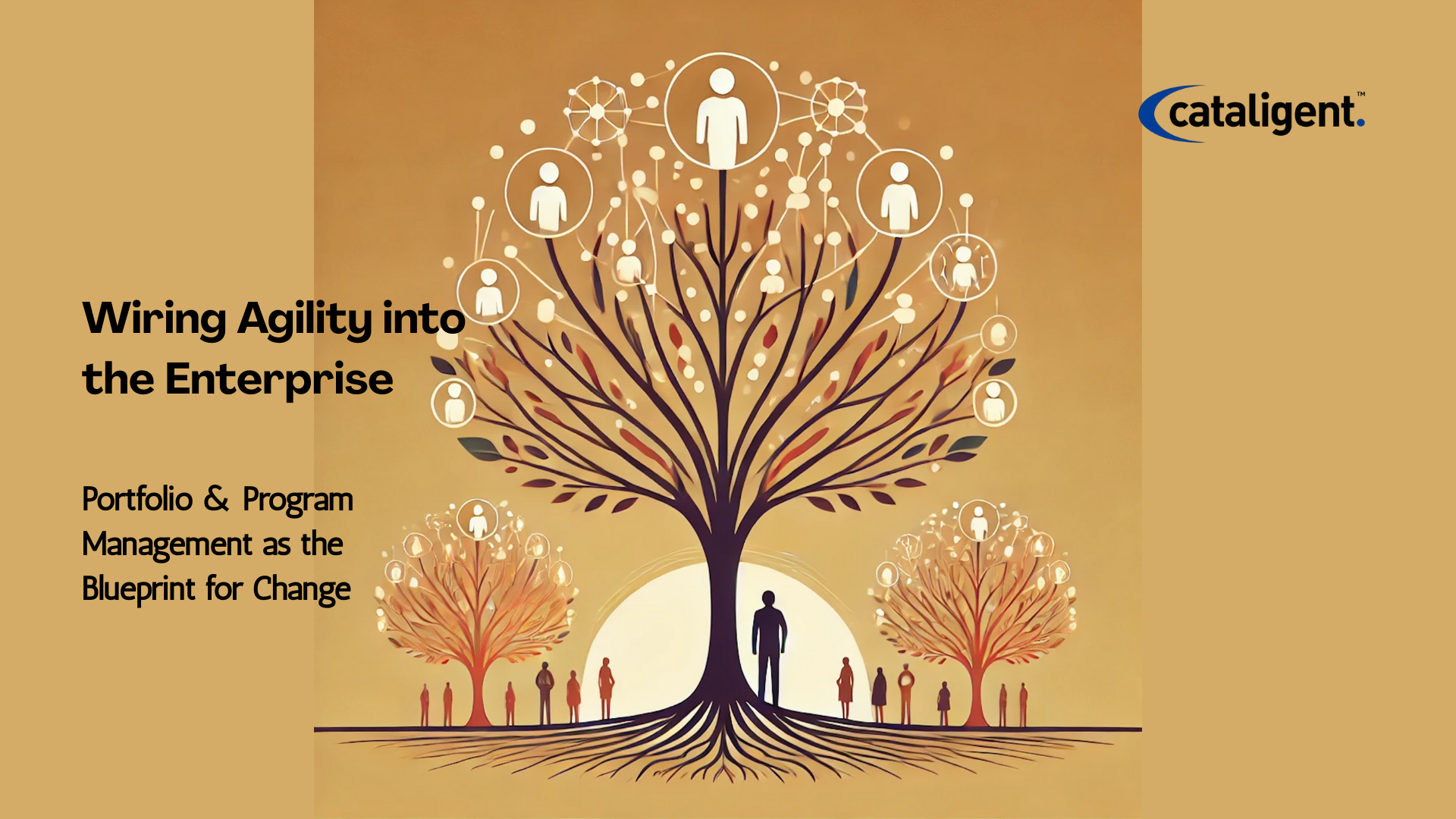
  • Agility at Scale: How Portfolio & Program Management Reshapes Transformation Journeys

    Agility at Scale: How Portfolio & Program Management Reshapes Transformation Journeys

    What is Agility at Scale?

    Agility at scale is the ability of organizations to adapt rapidly, continuously, and efficiently while managing multiple programs and portfolios simultaneously. Unlike traditional project delivery, where agility is often limited to small teams, scaled agility ensures that flexibility extends across the entire enterprise. This means that even as organizations grow in complexity, they retain the ability to pivot quickly and confidently.

    Cataligent’s CAT4 platform provides the backbone for scaling agility through integrated portfolio planning, project phasing, resource allocation, and program oversight. Instead of scattered tools and disconnected reporting, CAT4 centralizes everything, allowing businesses to navigate complex transformation journeys with precision and coherence.

    Why Does Agility at Scale Matter?

    Organizations are under constant pressure to evolve, but speed without structure leads to chaos. Portfolio and program management transform agility into a repeatable business capability by:

    • Maintaining Strategic Alignment: Every initiative within the portfolio is directly tied to long-term organizational goals. Without alignment, efforts risk becoming fragmented and wasted. With CAT4, executives can easily see how projects link back to the core mission, preventing misaligned investments.
    • Prioritizing Investments: Resources are finite. Portfolio management ensures funding and people are allocated to initiatives with the greatest impact. By ranking projects on feasibility, value, and risk, organizations can cut back on low-return activities and double down on those with the potential to transform the business.
    • Creating Transparency: Blind spots are the enemy of agility. Real-time dashboards in CAT4 provide leadership with a clear view of progress, financial utilization, and risks. This transparency ensures that decisions are made with accurate, up-to-date data rather than delayed reports.
    • Reducing Waste: Not all projects deliver value. Phasing and gating methods within CAT4 ensure initiatives that do not meet performance thresholds are paused or stopped early, saving both time and money. This reduces sunk costs and increases overall portfolio efficiency.

    In industries where disruption is constant, agility at scale is no longer optional. It is a survival necessity, ensuring that organizations can continuously respond to shifts in customer demand, regulation, and competitive pressure.

    How Does Portfolio & Program Management Enable Agility?

    Scaling agility requires balancing flexibility with governance. Portfolio and program management within CAT4 deliver this balance through four key enablers:

    1. Portfolio Planning and Prioritization
      Transformation begins with clarity. Portfolio planning ensures leadership has a clear map of all potential initiatives, ranked by value and impact. Instead of spreading resources thinly across dozens of projects, organizations can concentrate on the few that matter most. CAT4 provides structured frameworks to evaluate initiatives objectively, balancing strategic fit, financial return, and execution risk.
    2. Program Oversight and Phased Delivery
      Large transformation programs can easily spiral out of control. By breaking them into phases and gates, leaders can assess progress at each stage before committing additional resources. This oversight prevents runaway projects and builds accountability at every step. CAT4 supports structured review points, ensuring initiatives deliver results incrementally rather than waiting for one large payoff.
    3. Real-Time Dashboards and Analytics
      Agility thrives on insight. CAT4’s dashboards offer live views of project status, risks, and financials. Leaders no longer need to wait for monthly reports; they can spot deviations instantly and act decisively. Analytics features highlight trends, capacity bottlenecks, and cost variances, turning raw data into actionable intelligence that fuels agility.
    4. Resource and Capacity Management
      Agile transformation requires the right talent at the right time. Without resource optimization, agility collapses under the weight of burnout or underutilization. CAT4 matches resources to demand, helping leaders balance workloads across multiple initiatives. This prevents bottlenecks, ensures skills are used effectively, and avoids costly idle time.

    How Cataligent Can Help

    Cataligent  empowers organizations to scale agility with practical, technology-enabled methods:

    • CAT4 as a Control Tower: It acts as a central hub where leaders can oversee transformation initiatives, eliminating silos and providing one version of the truth.
    • Proven Methodologies: With structured phasing, gating, and portfolio planning frameworks, organizations can avoid trial-and-error approaches and instead follow tested best practices.
    • Transparency & Governance: Leaders gain confidence knowing that every initiative is tracked, measured, and aligned with corporate priorities.
    • Consulting Expertise: Cataligent’s team provides tailored guidance, embedding change management, risk controls, and capacity optimization into the DNA of transformation.

    Embedded Value for Transformation

    • Enterprise-Wide Agility: Businesses move beyond isolated agile teams to organization-wide flexibility supported by governance.
    • Faster Decision-Making: Real-time insights enable quick pivots without waiting for delayed reports.
    • Smarter Investment Choices: Portfolios are continuously aligned to strategic objectives, ensuring resources are used where they matter most.
    • Higher Success Rates: Structured oversight improves the odds of transformation programs achieving measurable impact.

    Agility at scale is not about moving faster—it’s about moving smarter. With portfolio and program management powered by Cataligent, transformation journeys become structured, resilient, and capable of delivering lasting value.