Month: September 2025

  • Redesigning Operating Models Through Consulting: From Inefficiency to Scalable Growth

    Redesigning Operating Models Through Consulting: From Inefficiency to Scalable Growth

    Growth ambitions often clash with outdated structures, siloed processes, and rigid operating models. Businesses striving to expand or adapt to new market realities often find that inefficiency in their current models holds them back. This is where business consulting for operating model redesign becomes indispensable. By rethinking how people, processes, and technology interact, consulting unlocks pathways from stagnation to scalable growth.


    What Is Operating Model Redesign in Consulting?

    An operating model defines how an organization delivers value to its customers and stakeholders. It is the blueprint of how strategy translates into execution. Redesigning an operating model means re-architecting this blueprint to improve alignment, agility, and efficiency.

    Consulting-led operating model redesign involves:

    • Assessing Current State: Identifying inefficiencies, redundancies, and misalignments between strategy and operations.
    • Defining Future State: Establishing the desired end-to-end model that supports scalability and growth.
    • Reconfiguring Structures: Realigning processes, roles, governance, and technologies to achieve future goals.
    • Embedding Agility: Ensuring the model adapts seamlessly to market shifts and emerging opportunities.

    It is not just about cutting costs or automating workflows. It’s about creating a dynamic system where every part of the organization works in harmony toward shared objectives.


    Why Operating Model Redesign Matters

    Most businesses experience friction between their strategic intent and their execution reality. Common challenges include:

    1. Siloed Operations
      Teams often work in isolation, creating bottlenecks and inefficiencies that slow down decision-making.
    2. Scaling Limitations
      As organizations grow, outdated structures cannot handle increased complexity, leading to inefficiency and lost opportunities.
    3. Customer Expectations
      Rigid models make it difficult to respond to rapidly evolving customer needs and digital experiences.
    4. Cost Pressures
      Duplicated processes, fragmented tools, and ineffective governance drive up operating costs without adding value.
    5. Lack of Agility
      Legacy systems and structures prevent businesses from adapting to market disruptions or regulatory changes.

    Consulting-driven operating model redesign addresses these obstacles by building flexible, streamlined, and growth-ready frameworks.


    How Consulting Enables Operating Model Transformation

    Consulting provides a structured, expert-driven pathway to operating model redesign. Key stages include:

    1. Diagnosis and Discovery
      Consultants begin by analyzing the organization’s current model, identifying inefficiencies, gaps, and areas of misalignment.
    2. Strategic Alignment
      Ensuring the redesigned model directly supports long-term business objectives and market positioning.
    3. Process Reengineering
      Streamlining workflows, reducing redundancies, and leveraging automation to drive efficiency.
    4. Technology Integration
      Incorporating modern platforms, AI, and digital tools to enable scalability and real-time visibility.
    5. Governance and Role Clarity
      Redefining decision rights, accountability frameworks, and performance metrics to improve agility and execution.
    6. Change Management and Adoption
      Supporting cultural transformation so employees embrace new ways of working and sustain the redesigned model.

    This structured approach ensures that operating model redesign is not just a theoretical exercise but a tangible, value-driving transformation.


    Practical Applications Across Industries

    Operating model redesign is not limited to one sector. Consulting firms apply it across industries to solve context-specific challenges:

    • Financial Services: Streamlining compliance processes while enabling digital customer experiences.
    • Manufacturing: Integrating smart technologies for supply chain optimization and predictive maintenance.
    • Retail & E-Commerce: Aligning logistics and digital operations to handle omnichannel growth.
    • Healthcare: Redesigning patient care pathways and administrative processes to improve outcomes.
    • Technology & SaaS: Scaling operations without sacrificing innovation or customer satisfaction.

    Outcomes of Operating Model Redesign

    Organizations that invest in consulting-led operating model redesign realize transformational benefits:

    • Efficiency Gains: Reduced waste, duplication, and operating costs.
    • Scalability: Ability to handle growth without compromising quality or agility.
    • Customer-Centricity: Faster response times and more tailored services.
    • Resilience: Stronger adaptability to external shocks such as regulatory changes or supply chain disruptions.
    • Strategic Alignment: Clearer link between high-level strategy and day-to-day execution.

    The Role of Technology in Scalable Operating Models

    Modern operating models depend heavily on digital enablement. Consulting helps businesses:

    • Deploy integrated platforms for unified data visibility.
    • Use automation and AI to optimize repetitive processes.
    • Build real-time dashboards for performance tracking.
    • Enable cloud-driven scalability that reduces dependency on legacy systems.

    Technology is the enabler, but consulting ensures it is implemented in a way that creates measurable business value.


    Why Businesses Need Consulting Support

    Redesigning an operating model internally often fails because organizations are too close to existing structures and biases. Consulting provides:

    • External Perspective: Unbiased insights to identify inefficiencies leaders may overlook.
    • Proven Frameworks: Structured methodologies for transformation.
    • Change Expertise: Ensuring adoption across cultural and operational dimensions.
    • Governance: Establishing accountability mechanisms for execution.

    Without expert consulting, operating model initiatives risk stagnation, resistance, or misalignment with strategic goals.


    How Cataligent Enables Operating Model Redesign

    Cataligent specializes in guiding organizations through operating model transformations using its CAT4 platform and consulting expertise.

    • Holistic Diagnosis: Cataligent assesses inefficiencies and misalignments across structures, processes, and systems.
    • Integrated Dashboards: CAT4 provides real-time transparency into workflows, KPIs, and bottlenecks.
    • Process Optimization: Leveraging AI and automation to streamline end-to-end operations.
    • Scalable Frameworks: Designing operating models that support sustainable growth.
    • Governance Structures: Embedding accountability to ensure that strategy execution remains on track.

    Cataligent does more than recommend changes—it enables organizations to operationalize transformation and achieve measurable outcomes.


    The Future of Operating Models in Business Consulting

    As businesses face increasing volatility and competition, operating model redesign will remain central to consulting. Organizations that re-architect now will gain agility, scalability, and resilience, while those that delay risk stagnation.

    Future-ready operating models will integrate human creativity, digital intelligence, and adaptive governance into one cohesive system. Consulting is the bridge that makes this possible.


    Call to Action

    If inefficiencies and outdated structures are holding your business back, it’s time to act. Cataligent can help you reimagine your operating model, eliminate friction, and build a scalable framework for sustainable growth.

    Partner with Cataligent to transform inefficiency into opportunity and unlock the next phase of your business growth.

  • Decision Intelligence in Consulting: Turning Complex Data into Clear Business Strategy

    Decision Intelligence in Consulting: Turning Complex Data into Clear Business Strategy

    Businesses today are inundated with data—from customer interactions, supply chains, operations, and digital footprints. Yet, data alone does not drive growth. What organizations need is the ability to turn complex, fragmented information into clear, actionable strategy. This is where decision intelligence in consulting becomes a critical differentiator. It enables leaders to move from guesswork to precision, from reactive decision-making to proactive strategy.


    What Is Decision Intelligence in Consulting?

    Decision intelligence combines data science, business strategy, and behavioral insights to help organizations make better decisions. It moves beyond traditional analytics by incorporating context, predictive modeling, and scenario planning to ensure decisions are not only data-driven but also strategically aligned.

    In the consulting space, decision intelligence means:

    • Translating raw data into business narratives that leaders can act on.
    • Applying AI, machine learning, and advanced analytics to uncover hidden opportunities and risks.
    • Using scenario simulations to assess potential outcomes before making high-stakes moves.
    • Embedding decision frameworks into daily operations to ensure consistency and accountability.

    At its core, decision intelligence is about empowering leaders to make choices that balance risk, reward, and long-term sustainability.


    Why Decision Intelligence Matters for Businesses

    While most organizations collect data, very few manage to derive real value from it. Consulting with decision intelligence at its core bridges this gap by answering fundamental challenges:

    1. Information Overload
      Executives face mountains of data without clarity on what truly matters. Decision intelligence filters the noise and prioritizes insights that impact strategy.
    2. Slow, Reactive Decision-Making
      Traditional decision cycles often lag behind market dynamics. Decision intelligence accelerates the process by providing real-time, forward-looking insights.
    3. High-Risk Environments
      In uncertain markets, wrong decisions can be costly. Predictive modeling and scenario analysis reduce risks by highlighting likely outcomes and trade-offs.
    4. Strategy-Execution Divide
      Even when strategies are well-defined, execution often falters due to misaligned decisions at the operational level. Decision intelligence ensures alignment across leadership, management, and frontline teams.

    By addressing these pain points, decision intelligence transforms consulting from advisory support into a catalyst for measurable business impact.


    How Decision Intelligence Works in Consulting Engagements

    Effective consulting engagements leverage decision intelligence through a structured, multi-layered approach:

    1. Data Integration and Cleansing
      Consolidating data from diverse sources (finance, operations, customer, supply chain) and ensuring it is accurate, relevant, and usable.
    2. Insight Generation
      Applying advanced analytics, AI models, and visualization tools to identify trends, correlations, and anomalies that traditional methods miss.
    3. Scenario Planning and Simulation
      Running simulations to model potential business outcomes across different market, regulatory, or competitive scenarios.
    4. Decision Framework Design
      Creating standardized decision-making frameworks that align with the company’s goals, governance structures, and risk appetite.
    5. Operational Embedding
      Integrating decision tools and dashboards into daily workflows so leaders and teams act consistently on insights.
    6. Feedback Loops and Continuous Improvement
      Monitoring outcomes, learning from results, and refining models to make future decisions sharper.

    This systematic use of decision intelligence allows consulting engagements to deliver immediate clarity and long-term strategic alignment.


    The Role of Technology in Decision Intelligence

    Technology is the backbone of decision intelligence. Key enablers include:

    • AI & Machine Learning Models: For predictive insights and pattern detection.
    • Business Intelligence Dashboards: Providing real-time visibility into KPIs and performance metrics.
    • Automation Tools: Accelerating reporting and ensuring accuracy.
    • Scenario Modeling Platforms: Allowing leaders to test strategies against multiple possible futures.

    But technology alone is not enough—it must be paired with consulting expertise to contextualize insights and translate them into actionable strategies.


    Practical Applications of Decision Intelligence in Consulting

    Decision intelligence consulting can be applied across industries and functions:

    • Strategic Planning: Aligning corporate strategies with market realities using predictive insights.
    • Financial Optimization: Identifying cost-saving opportunities while balancing investment for growth.
    • Customer Experience: Using behavioral analytics to tailor services and improve retention.
    • Supply Chain Resilience: Anticipating disruptions and optimizing logistics in real-time.
    • Regulatory Compliance: Proactively managing compliance risks through predictive monitoring.
    • Workforce Planning: Anticipating talent needs and aligning workforce strategies with business goals.

    Why Businesses Need Consulting Support for Decision Intelligence

    While organizations may invest in analytics tools, they often struggle to translate insights into action. Consulting adds value by:

    • Designing frameworks tailored to business context.
    • Bridging the gap between technical insights and executive decision-making.
    • Providing governance and accountability structures.
    • Ensuring cultural adoption so decision intelligence becomes part of the organizational DNA.

    Without consulting support, decision intelligence risks becoming another underutilized technology investment.


    Outcomes of Decision Intelligence-Driven Consulting

    Businesses that adopt decision intelligence in consulting engagements achieve:

    • Faster Decisions: Reduced time from insight to action.
    • Greater Precision: Strategies based on evidence rather than intuition.
    • Higher ROI: Optimized resource allocation and improved financial outcomes.
    • Increased Agility: Ability to pivot quickly in uncertain environments.
    • Sustainable Advantage: Continuous improvement driven by feedback loops.

    How Cataligent Helps Businesses Harness Decision Intelligence

    Cataligent brings together consulting expertise and its CAT4 platform to deliver decision intelligence that drives measurable transformation.

    • Unified Data Frameworks: Cataligent integrates and cleanses data across functions to build a single source of truth.
    • Real-Time Dashboards: CAT4 provides leaders with instant visibility into performance, risks, and opportunities.
    • Predictive Modeling: Advanced analytics highlight trends, risks, and opportunities before they materialize.
    • Scenario Simulations: Cataligent helps organizations stress-test strategies against multiple future conditions.
    • Execution Governance: Ensures decisions translate into aligned, accountable actions across teams.

    With Cataligent, decision intelligence is not just about insights—it becomes the foundation of smarter, faster, and more resilient strategies.


    The Future of Decision Intelligence in Business Consulting

    As data volumes continue to grow and market uncertainties intensify, decision intelligence will become central to consulting. Organizations that harness it will gain a decisive edge by transforming complexity into clarity, and uncertainty into opportunity.

    Consulting is no longer about presenting reports—it’s about empowering businesses to act with precision. Decision intelligence ensures that every move counts, every risk is calculated, and every opportunity is seized.


    Call to Action

    If your organization is ready to transform decision-making from guesswork to intelligence, Cataligent can help. With deep consulting expertise and the CAT4 platform, we partner with businesses to turn complex data into clear, actionable strategies.

    Make your next decision the smartest one. Connect with Cataligent and drive transformation with confidence.

  • Resilient Transformation: Embedding Risk Intelligence into Business Transformation Programs

    Resilient Transformation: Embedding Risk Intelligence into Business Transformation Programs

    Business transformation is often celebrated for driving growth, innovation, and efficiency, but without resilience, even the boldest initiatives risk collapse under pressure. Disruptions are no longer rare exceptions—they are a constant reality shaped by technological shifts, cybersecurity threats, regulatory complexity, and global uncertainties. To succeed in this environment, transformation programs must embed risk intelligence at their core. This is what turns ambitious change into sustainable impact.


    What Is Resilient Transformation?

    Resilient transformation is the integration of risk intelligence into every stage of business transformation, from strategy to execution. It ensures that change initiatives are designed not only to achieve growth but also to withstand shocks, adapt to emerging challenges, and protect the organization’s reputation.

    Unlike traditional approaches where risk is treated as a compliance checkbox, resilient transformation makes it a strategic enabler. It ensures:

    • Risk Awareness: Identifying vulnerabilities linked to transformation initiatives before they escalate.
    • Proactive Mitigation: Embedding safeguards into execution frameworks.
    • Compliance by Design: Aligning every initiative with evolving regulatory requirements.
    • Resilience as a Capability: Building organizations that can pivot and recover without derailing progress.

    Why Risk Intelligence Is Essential in Transformation

    Transformations today happen in an unpredictable world. Failing to integrate risk intelligence can undermine even the most well-planned initiatives. Key reasons include:

    1. Cybersecurity Threats
      With rapid digital adoption, enterprises face growing exposure to cyberattacks, data breaches, and privacy violations. A single incident can erode trust and stall transformation.
    2. Regulatory Complexity
      Global markets demand adherence to increasingly complex regulations. A misstep in compliance can result in fines, reputational harm, or failed initiatives.
    3. Operational Vulnerabilities
      Supply chain disruptions, process inefficiencies, or resource shortages can derail transformation timelines and outcomes.
    4. Market Volatility
      Economic fluctuations, geopolitical instability, and competitive shifts demand constant recalibration of transformation priorities.

    Without risk intelligence, transformation becomes fragile—prone to delays, failures, and wasted investments.


    The Value of Embedding Risk Intelligence

    Integrating risk intelligence into transformation delivers significant benefits:

    • Stronger Continuity: Businesses can maintain progress despite external shocks.
    • Smarter Decisions: Leaders act with foresight, supported by real-time insights.
    • Greater Accountability: Risks are owned, tracked, and mitigated at every level.
    • Sustainable Outcomes: Initiatives deliver value long after initial implementation.
    • Stakeholder Trust: Customers, partners, and regulators see the organization as reliable and future-ready.

    How to Embed Risk Intelligence into Transformation Programs

    Successful integration of risk intelligence requires a structured yet adaptable approach. The process typically involves:

    1. Integrate Risk into Strategy Development
      Transformation planning must evaluate risks alongside opportunities. This ensures goals are ambitious but realistic.
    2. Continuous Risk Monitoring
      Real-time tracking tools replace outdated periodic reviews, enabling instant detection of threats.
    3. Governance with Accountability
      Clear ownership for risk management must be established across all initiatives.
    4. Compliance Integration
      Compliance is not an afterthought—it becomes an embedded layer in every process and decision.
    5. Scenario Planning
      Organizations prepare for multiple futures, building contingency strategies that allow agility.
    6. Risk Analytics & Automation
      Technology platforms deliver predictive insights and automate reporting, reducing human error and reaction time.

    How Cataligent Enables Resilient Transformation

    Cataligent empowers organizations to build resilience directly into their transformation programs through the CAT4 platform and expert advisory services.

    • Real-Time Risk Dashboards: Leadership gains immediate visibility into emerging threats, compliance gaps, and exposure levels.
    • Planned vs. Actual Tracking with Risk Overlays: Ensures deviations are measured both in performance and in risk.
    • Compliance-Embedded Frameworks: Programs are aligned with current and evolving regulatory requirements.
    • Scenario Modeling: Organizations simulate different outcomes to prepare for disruptions before they occur.
    • Integrated Governance Structures: Cataligent helps embed accountability into governance, ensuring risk management is shared across stakeholders.

    This integrated approach allows transformation programs to move boldly without leaving resilience behind.


    Practical Applications of Resilient Transformation

    1. Digital Transformation
      Secure cloud migration, data privacy compliance, and cybersecurity resilience are built into digital adoption initiatives.
    2. Supply Chain Modernization
      Adaptive supply chain structures, backed by risk intelligence, prepare organizations for global disruptions.
    3. Operational Restructuring
      Efficiency programs are balanced with workforce stability and compliance safeguards to prevent unintended risks.
    4. Mergers & Acquisitions
      Integration strategies account for financial, cultural, and operational risks, ensuring smoother transitions.
    5. Customer-Centric Programs
      Transformation initiatives that prioritize customer experience also address risks related to trust, loyalty, and service continuity.

    Outcomes of Risk-Embedded Transformation

    Organizations adopting resilient transformation approaches experience measurable improvements:

    • Enhanced Resilience: The ability to withstand and recover from crises without stalling progress.
    • Improved Agility: Faster pivots and adjustments when disruptions occur.
    • Optimized Resource Allocation: Proactive risk mitigation saves costs tied to crisis management.
    • Future Readiness: Structures and processes evolve to handle uncertainties proactively.
    • Sustainable Transformation: Initiatives deliver long-term, measurable value instead of short-lived results.

    The Future of Business Transformation

    Transformation is no longer just about speed or scale—it is about resilience. Businesses that embed risk intelligence into every stage of transformation will not only survive disruptions but also thrive in them. Resilient transformation ensures innovation is secure, governance is adaptive, and success is sustainable.

    With Cataligent’s CAT4 platform and advisory expertise, organizations gain the confidence to pursue ambitious transformation agendas while managing risks effectively. By combining execution discipline with risk intelligence, Cataligent helps enterprises build transformations that are bold, secure, and built to last.

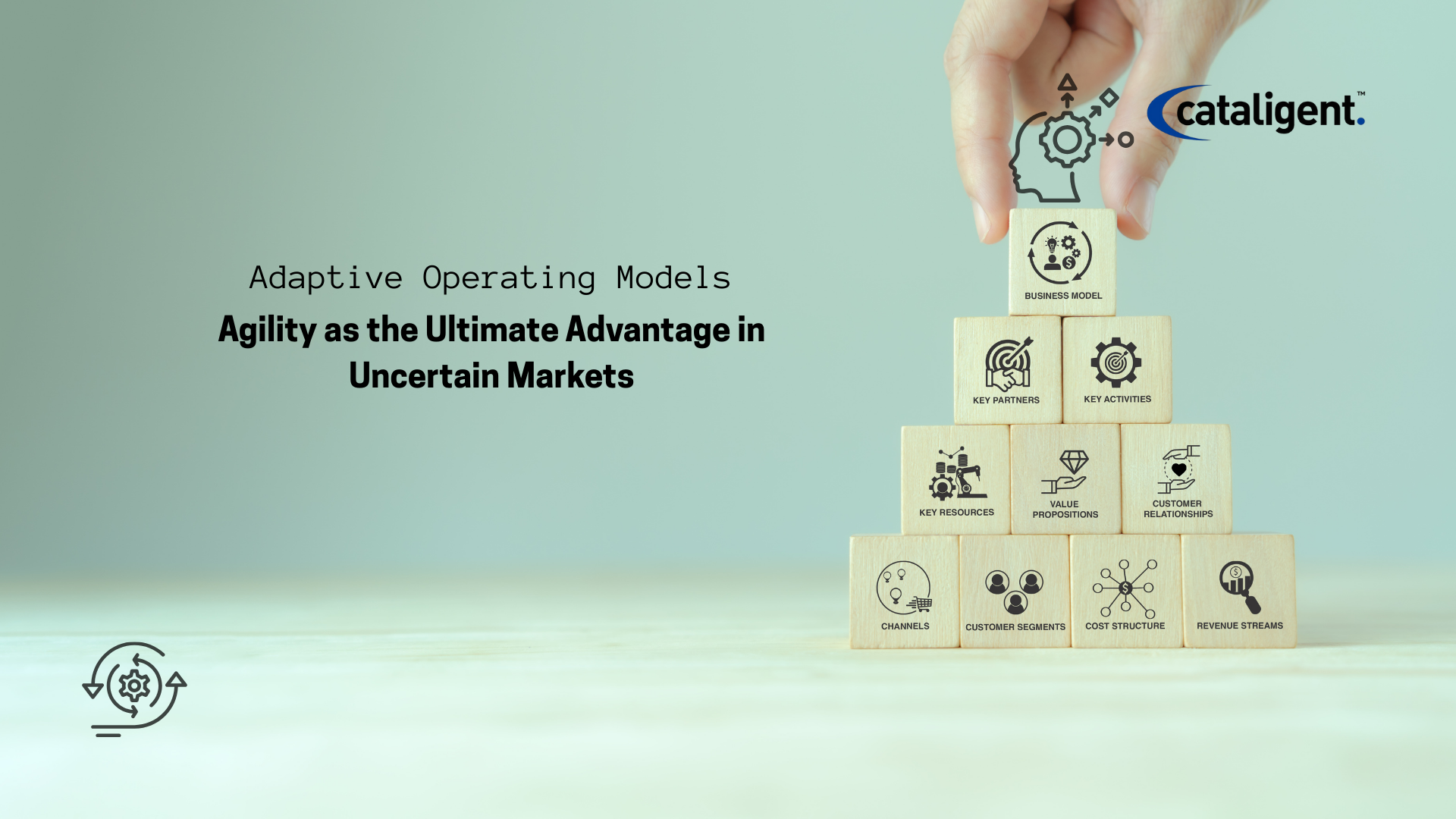
  • Transforming Enterprises with Adaptive Operating Models: Building Agility for Uncertain Markets

    Transforming Enterprises with Adaptive Operating Models: Building Agility for Uncertain Markets

    Business landscapes no longer reward static structures. Market volatility, technological disruption, shifting regulations, and evolving customer expectations are forcing organizations to rethink how they operate. Companies that cling to rigid models struggle to adapt, while those that embrace adaptability find themselves positioned for growth even in uncertain conditions. This is why building adaptive operating models is not just a trend—it is a business necessity.

    What Are Adaptive Operating Models?

    An adaptive operating model is the structural and strategic blueprint that enables a business to rapidly reconfigure itself in response to change while staying aligned with long-term goals. Unlike traditional models, which emphasize stability and predictability, adaptive models focus on flexibility, resilience, and agility.

    Key attributes include:

    • Agility in Governance: Decision-making structures that allow quick pivots without bureaucratic delays.
    • Cross-Functional Integration: Teams that collaborate beyond silos to address opportunities and challenges holistically.
    • Technology-Enabled Transparency: Digital systems that provide real-time insights into performance and risk.
    • Continuous Learning Loops: Mechanisms for feedback, improvement, and innovation at every level.

    Why Adaptive Models Matter Today

    Global uncertainty has become the norm rather than the exception. Adaptive models allow businesses to:

    • Respond Faster to Disruption: Whether due to supply chain breakdowns, regulatory changes, or competitive moves, response time becomes a competitive advantage.
    • Enhance Resilience: Adaptive structures absorb shocks without destabilizing core operations.
    • Empower Employees: Teams closer to the ground are enabled to act without waiting for hierarchical approvals.
    • Stay Customer-Centric: Flexibility ensures businesses can pivot quickly to meet emerging customer needs.

    Without adaptive models, organizations risk inefficiency, missed opportunities, and erosion of market relevance.

    How Adaptive Transformation Works

    Transforming into an adaptive enterprise involves rethinking multiple layers of the organization:

    1. Strategy Alignment: Ensuring strategic goals are broad enough to allow flexibility but precise enough to provide direction.
    2. Structural Redesign: Moving away from rigid hierarchies toward networked, empowered teams.
    3. Technology Integration: Using platforms that provide transparency, automation, and real-time decision support.
    4. Governance Evolution: Creating frameworks that balance accountability with speed.
    5. Cultural Shift: Building a mindset of experimentation, learning, and resilience across the workforce.

    How Cataligent Helps Build Adaptive Operating Models

    Cataligent’s expertise and CAT4 platform provide organizations with the tools and frameworks to redesign their operating models for agility and resilience.

    • Scenario-Based Planning: Enables organizations to prepare for multiple future possibilities, reducing risk of disruption.
    • Real-Time Data Utilization: CAT4’s dashboards provide leaders with actionable insights to make quick, informed decisions.
    • Governance Transformation: Cataligent helps businesses implement agile governance that drives both accountability and responsiveness.
    • Execution Discipline: Ensures that even while adapting, initiatives are tracked and aligned with business outcomes.
    • Scalability: Solutions that can be deployed across units, regions, or enterprise-wide initiatives.

    Practical Applications

    • Supply Chain Resilience: Adaptive models make it easier to reroute logistics, shift suppliers, and manage disruptions without halting operations.
    • Digital Transformation: Ensures new technologies are integrated seamlessly, with the flexibility to scale or pivot based on adoption and results.
    • Workforce Agility: Supports hybrid working models, decentralized teams, and employee empowerment.
    • Customer-Centric Innovations: Enables organizations to adjust product and service offerings quickly in response to market demand.

    The Benefits of Adaptive Operating Models

    Enterprises that adopt adaptive models experience:

    • Resilient Growth: Consistent performance even during crises.
    • Operational Agility: Resources redirected quickly toward high-priority initiatives.
    • Faster Time-to-Market: Ability to innovate and deliver solutions rapidly.
    • Employee Engagement: Empowered teams that drive ownership and creativity.
    • Long-Term Sustainability: A culture and framework that evolve continuously with the business environment.

    The Future with Adaptive Transformation

    Adaptive operating models are no longer optional; they are the foundation of sustainable success in uncertain markets. By embedding flexibility, resilience, and speed into operations, businesses can stay relevant, competitive, and future-ready.

    With Cataligent’s advisory services and CAT4 platform, enterprises can transform not just their structures but their capabilities, ensuring they thrive regardless of what the future brings.

  • From Strategy to Execution: Real-Time Business Transformation with Intelligent Orchestration

    From Strategy to Execution: Real-Time Business Transformation with Intelligent Orchestration

    Business transformation is no longer a distant concept reserved for large-scale restructuring; it is now a continuous necessity for organizations navigating competitive markets, evolving technologies, and customer expectations that shift rapidly. The challenge for leaders is not about designing strategies—it’s about executing them with precision, agility, and real-time insight. Without seamless execution, even the most innovative strategies remain as documents instead of results. This is where intelligent orchestration becomes the differentiator.

    What is Real-Time Business Transformation?

    Real-time business transformation is the process of aligning strategic objectives with day-to-day execution, supported by systems that provide instant visibility, accountability, and adaptability. Unlike traditional models that rely on quarterly reviews and retrospective reports, real-time transformation enables decision-makers to act on insights the moment deviations occur. It ensures that organizations are not only setting ambitious targets but also consistently meeting or exceeding them through data-backed execution.

    At its core, this approach is about:

    • Connecting strategic intent with operational activities.
    • Breaking silos between departments and initiatives.
    • Leveraging technology for proactive decision-making.
    • Embedding agility into governance and monitoring.

    Why Businesses Struggle with Transformation

    Organizations often fail to achieve transformation outcomes because of disjointed execution. Common barriers include:

    • Strategy-Execution Gap: Leaders define bold strategies, but frontline teams lack visibility or alignment with them.
    • Delayed Insights: Reports that arrive weeks or months later hinder timely intervention.
    • Siloed Initiatives: Different units pursue overlapping or conflicting initiatives without unified oversight.
    • Inflexible Processes: Legacy governance models fail to adapt to rapidly shifting market dynamics.

    The cost of these barriers is steep: lost opportunities, wasted resources, employee frustration, and eroded competitive advantage.

    Why Real-Time Execution Matters

    The pace of business demands continuous adaptation. Markets shift overnight, disruptions occur without warning, and customer demands evolve faster than traditional planning cycles. Real-time execution helps organizations:

    • React to market shifts instantly.
    • Track planned vs. actual progress without waiting for end-of-cycle reports.
    • Identify risks and bottlenecks before they become critical.
    • Ensure accountability across teams and initiatives.
    • Deliver consistent, measurable results.

    Real-time execution transforms leadership decision-making from reactive to proactive, enabling organizations to shape outcomes instead of chasing them.

    How Intelligent Orchestration Powers Transformation

    Intelligent orchestration integrates technology, governance, and data to synchronize transformation initiatives across the enterprise. It connects the dots between multiple projects, programs, and portfolios while ensuring leaders have complete visibility.

    Key components include:

    1. Centralized Dashboards: Unified visibility across business functions and initiatives.
    2. Planned vs. Actual Tracking: Clear measurement of performance against set goals.
    3. Initiative Aggregation: Consolidation of efforts to reduce duplication and align with enterprise objectives.
    4. Risk Mitigation Tools: Early detection of issues with actionable recommendations.
    5. Automated Reporting: Reducing manual effort and enabling faster decision-making.

    This orchestration ensures that transformation is not fragmented but coordinated, efficient, and results-driven.

    How Cataligent Enables Real-Time Business Transformation

    Cataligent’s CAT4 platform and advisory services are designed to eliminate the strategy-execution gap. By combining structured transformation frameworks with advanced analytics, Cataligent helps enterprises manage complexity with clarity.

    Key Ways Cataligent Supports Transformation:

    • Unified Transformation Framework: CAT4 provides organizations with a structured approach to govern and track all transformation initiatives.
    • Real-Time Monitoring: Dashboards give leadership immediate visibility into progress, risks, and outcomes.
    • Data-Driven Decision Making: By analyzing deviations and performance trends, leaders can act with precision.
    • Risk & Compliance Integration: Transformation efforts are safeguarded with proactive risk identification and compliance monitoring.
    • Scalable Solutions: Whether for a single business unit or enterprise-wide change, Cataligent’s tools adapt to the scope and scale required.

    Practical Applications

    • Digital Transformation Programs: Ensure technology adoption projects stay aligned with business goals.
    • Operational Efficiency Initiatives: Track cost reduction and process optimization with real-time performance metrics.
    • Mergers & Acquisitions: Orchestrate integration plans across multiple functions without losing momentum.
    • Customer-Centric Transformations: Align initiatives to deliver measurable improvements in customer experience.

    The Outcomes of Intelligent Orchestration

    Organizations that embrace real-time business transformation with Cataligent gain:

    • Greater Agility: Ability to pivot quickly in response to external disruptions.
    • Improved Efficiency: Reduced duplication of efforts and optimal resource allocation.
    • Higher Accountability: Clear ownership and responsibility at all levels.
    • Sustainable Growth: Transformation efforts tied to measurable financial and operational outcomes.
    • Future-Readiness: Governance models that adapt to emerging challenges and opportunities.

    Transforming Enterprises with Adaptive Operating Models: Building Agility for Uncertain Markets

    While intelligent orchestration ensures strategies are executed effectively, enterprises must also design operating models capable of thriving in volatile environments. Adaptive operating models go beyond efficiency—they embed resilience and agility into the very structure of the organization.

    What Are Adaptive Operating Models?

    Adaptive operating models are frameworks that allow businesses to reconfigure processes, resources, and governance rapidly in response to market changes. Instead of rigid structures that struggle to evolve, adaptive models promote flexibility while maintaining alignment with long-term strategy.

    These models are built on:

    • Agile Governance: Flexible structures that support quick decision-making.
    • Cross-Functional Collaboration: Teams empowered to work beyond silos.
    • Technology Enablement: Digital tools that provide transparency and automation.
    • Continuous Learning: Feedback loops that drive improvement and innovation.

    Why Adaptive Models Are Essential

    Businesses that rely on rigid operating models face higher risks during disruptions—whether due to global crises, technological shifts, or competitive pressures. Adaptive models ensure:

    • Faster Response to Change: Reducing time-to-market for products and services.
    • Resilience in Crisis: Ability to absorb shocks without derailing operations.
    • Employee Empowerment: Teams enabled to make decisions closer to the point of action.
    • Sustained Competitiveness: Continuous alignment with evolving customer and market needs.

    How Cataligent Enables Adaptive Transformation

    Cataligent equips organizations with the frameworks and tools to embed adaptability at the core of their operations.

    • Scenario-Based Planning: Helps leaders anticipate multiple possible futures and design flexible strategies.
    • Real-Time Data Utilization: Ensures decisions are grounded in current, actionable insights.
    • Governance Redesign: Implements structures that support both accountability and agility.
    • Execution Discipline: Balances flexibility with rigorous tracking of outcomes.

    Tangible Benefits for Enterprises

    Organizations adopting adaptive operating models through Cataligent achieve:

    • Resilient Growth: Strong performance even in volatile markets.
    • Operational Agility: Rapid reallocation of resources to high-priority areas.
    • Improved Customer Alignment: Ability to pivot quickly to meet emerging demands.
    • Sustainable Transformation: Models designed to evolve continuously, not collapse under pressure.

    The Future of Business Transformation

    Business transformation is not a one-time event but an ongoing discipline. Intelligent orchestration ensures strategies are executed with precision, while adaptive operating models prepare enterprises to thrive amid uncertainty. Together, these approaches redefine transformation from a project to a culture of agility, accountability, and innovation.

    With Cataligent’s CAT4 platform and advisory expertise, organizations can confidently navigate disruption, drive measurable outcomes, and build a foundation for sustainable success.

  • Measuring the True Business Value of ITSM: Beyond SLA Metrics

    Measuring the True Business Value of ITSM: Beyond SLA Metrics

    What It Is

    Service Level Agreements (SLAs) have long been used to benchmark IT service performance, defining expected uptime, response times, and resolution speeds. However, SLAs only measure operational compliance—they fail to capture how ITSM contributes to broader business goals. Measuring the true business value of ITSM goes beyond SLAs, focusing on how IT services impact productivity, revenue growth, innovation, and customer satisfaction.

    True ITSM measurement shifts the perspective from outputs to outcomes. Instead of asking, “Did the ticket get resolved in four hours?” organizations ask, “Did ITSM improve employee efficiency, reduce customer churn, or accelerate time-to-market?” This approach emphasizes ITSM as a driver of tangible business benefits rather than just a process for managing incidents.


    Why It Matters

    Relying solely on SLAs offers a limited view. While IT may appear compliant, it might still fail to deliver real value. Here’s why a business-focused measurement framework is essential:

    • Business Alignment: SLA compliance alone cannot guarantee that ITSM is supporting strategic objectives. Metrics tied to outcomes ensure IT services are aligned with organizational priorities such as revenue growth or market expansion.
    • User Satisfaction: Quick ticket resolution does not necessarily equate to a positive user experience. By tracking long-term impact and satisfaction, organizations understand whether ITSM truly enhances workflows.
    • Innovation Enablement: ITSM’s potential extends beyond maintenance; it should foster an environment where digital initiatives and innovations thrive.
    • Stakeholder Confidence: Executives and boards are more interested in IT’s impact on business results than adherence to technical service commitments. Business-value metrics provide the transparency and justification for strategic investment.

    Focusing on true business value transforms ITSM from a back-office function into a strategic contributor that supports growth, efficiency, and competitiveness.


    How to Implement

    Shifting ITSM measurement from SLA compliance to business value involves a structured, multi-step approach:

    1. Define Business-Centric KPIs
      Develop metrics that reflect organizational outcomes. This could include improved employee productivity, minimized downtime costs, accelerated product releases, or higher customer satisfaction scores. The goal is to tie ITSM performance directly to the results that matter most.
    2. Link ITSM Outcomes to Business Goals
      Map IT services to strategic objectives. For example, improving system uptime should be linked to revenue continuity, customer experience, or operational efficiency. Every service should have a clear line of sight to its business impact.
    3. Measure User Experience
      Incorporate metrics that reflect real user experiences, such as Net Promoter Score (NPS) or employee satisfaction surveys. This demonstrates how ITSM affects daily operations and overall morale, providing a human-centered dimension to performance evaluation.
    4. Track Innovation and Agility
      Evaluate how ITSM practices enable faster adoption of new technologies, smoother digital transformation, and organizational agility. Track initiatives supported by ITSM that contribute to innovation, from quicker deployments to seamless integrations.
    5. Use Data-Driven Insights
      Implement dashboards and analytics tools that combine ITSM data with financial, operational, and user experience metrics. This holistic approach ensures leaders can see the direct correlation between ITSM performance and business outcomes, facilitating informed decision-making.

    Benefits

    When ITSM is measured through the lens of business value, organizations experience tangible and strategic advantages:

    • Clarity of Impact: IT’s contribution to achieving business objectives becomes transparent and measurable.
    • Better Decision-Making: Data-driven insights guide investment and prioritization of IT initiatives based on demonstrated value.
    • Enhanced User Trust: Employees and customers view IT as a facilitator of their success, not just a support function.
    • Innovation Acceleration: Freed from narrow SLA-focused metrics, IT can focus on enabling digital transformation and introducing new capabilities.
    • Executive Buy-In: Demonstrating measurable business impact strengthens support and funding for ITSM initiatives, making it easier to scale and improve services.

    Real-World Scenarios

    • Scenario 1: Banking
      A bank shifted its focus from SLA adherence to analyzing downtime costs. By linking ITSM outcomes to revenue impact, it reduced system outages and demonstrated multi-million-dollar savings, reinforcing ITSM’s strategic value.
    • Scenario 2: Healthcare
      A hospital measured delays in patient care caused by IT system disruptions. By aligning ITSM metrics with patient outcomes, IT became recognized as a critical enabler of high-quality healthcare services.
    • Scenario 3: Retail
      A retailer tracked the impact of ITSM on checkout efficiency and customer satisfaction. By correlating IT service improvements with sales metrics, the company highlighted the direct value of ITSM in driving revenue and customer loyalty.

    How Cataligent Can Help

    Cataligent’s IT Service Management solutions enable organizations to measure ITSM performance through a business-value lens. The firm:

    • Maps ITSM outcomes to organizational objectives to demonstrate tangible impact.
    • Builds integrated dashboards connecting IT metrics with financial and operational KPIs.
    • Incorporates user experience data to provide a holistic view of ITSM effectiveness.
    • Creates a culture where ITSM is recognized as a driver of business growth and innovation.

    With Cataligent, ITSM evolves from a compliance-focused process into a measurable force for business transformation and competitive advantage.