Month: March 2025

  • Selecting the Right BPO Partner

    Selecting the Right BPO Partner

    Introduction

    In an increasingly competitive business environment, outsourcing non-core activities to a Business Process Outsourcing (BPO) partner can help organizations streamline operations and reduce costs. However, selecting the right BPO provider is crucial to ensure high-quality service delivery, operational efficiency, and long-term success. This document outlines the key considerations for choosing the right BPO partner, the benefits of outsourcing, and the implementation steps for a successful partnership.

    What It Involves

    Choosing the right BPO partner requires a strategic approach to align the provider’s capabilities with the company’s operational needs, budget, and long-term goals. The process involves evaluating potential vendors based on their expertise, scalability, cost structure, and track record.

    Benefits of Choosing the Right BPO Partner

    1. Ensures High-Quality Service Delivery

    Selecting a reliable outsourcing partner helps maintain service excellence, ensuring that business functions are handled efficiently and professionally.

    2. Cost Efficiency and Budget Optimization

    A well-chosen BPO partner provides cost-effective solutions, reducing labor and infrastructure expenses while maintaining high service standards.

    3. Access to Specialized Expertise

    Outsourcing to an experienced provider grants businesses access to skilled professionals, advanced technology, and industry best practices.

    4. Scalability and Flexibility

    A good BPO partner can scale operations up or down based on business needs, offering greater agility in responding to market changes.

    5. Reduced Risk of Vendor Mismatch

    A thorough selection process minimizes the risk of operational disruptions, poor service quality, and hidden costs associated with an ill-suited provider.

    Implementation Steps for Selecting a BPO Partner

    Step 1: Define Business Requirements

    • Identify the specific processes to be outsourced.
    • Establish service level expectations and key performance indicators (KPIs).
    • Determine budget constraints and cost expectations.

    Step 2: Evaluate Potential Providers

    • Assess vendor expertise in the required service area.
    • Check company reputation, client reviews, and case studies.
    • Ensure compliance with industry regulations and data security standards.
    • Examine technological capabilities and infrastructure reliability.

    Step 3: Conduct a Cost-Benefit Analysis

    • Compare service costs against in-house operations.
    • Evaluate the return on investment (ROI) by analyzing cost savings and efficiency gains.
    • Factor in hidden costs such as training, transition, and management oversight.

    Step 4: Prioritize Vendors with a Proven Track Record

    • Shortlist vendors with a history of successful outsourcing partnerships.
    • Request client references and case studies to verify performance credibility.
    • Conduct pilot projects or trial periods before committing to a long-term contract.

    Step 5: Establish a Clear Contract and Service-Level Agreement (SLA)

    • Define clear terms, including scope of work, deliverables, timelines, and performance metrics.
    • Outline dispute resolution mechanisms and penalty clauses for non-compliance.
    • Include provisions for periodic performance reviews and contract renewals.

    Step 6: Implement and Monitor Outsourcing Partnership

    • Develop a transition plan to ensure a smooth onboarding process.
    • Maintain open communication channels between the company and the BPO provider.
    • Continuously track performance using KPIs and make necessary adjustments.

    Conclusion

    Selecting the right BPO partner is a critical decision that impacts business efficiency, cost-effectiveness, and service quality. By following a structured approach to vendor evaluation, cost analysis, and contract management, businesses can establish successful outsourcing relationships that drive long-term growth and operational success. Regular performance assessments and strategic adjustments will further enhance the effectiveness of the outsourcing partnership, ensuring sustained business value.

  • Assess and Define Core vs. Non-Core Activities

    Assess and Define Core vs. Non-Core Activities

    Introduction

    In today’s dynamic business environment, organizations must streamline operations to stay competitive. One of the most effective strategies for improving efficiency and maximizing resources is distinguishing between core and non-core business activities. By clearly defining these functions, businesses can allocate their internal resources more effectively while leveraging outsourcing opportunities for non-core tasks. This approach not only enhances productivity but also ensures that a company remains focused on its strategic goals.

    This document explores the process of assessing and defining core versus non-core activities, outlining the benefits of this strategy, and providing a practical implementation guide for organizations looking to optimize their operations.

    Need a structured way to evaluate core and non-core activities?
    Classifying activities is only the first step. The real value comes from connecting each process to cost impact, ownership, strategic importance, outsourcing potential, risk, SLA expectations, and measurable savings.

    Cataligent helps organizations assess, prioritize, and manage operational improvement initiatives through structured workflows, cost-saving tracking, vendor governance, and executive reporting.

    Explore Cataligent Cost Saving Program →

    Assess Cost-Saving Opportunities with Cataligent

    What It Involves

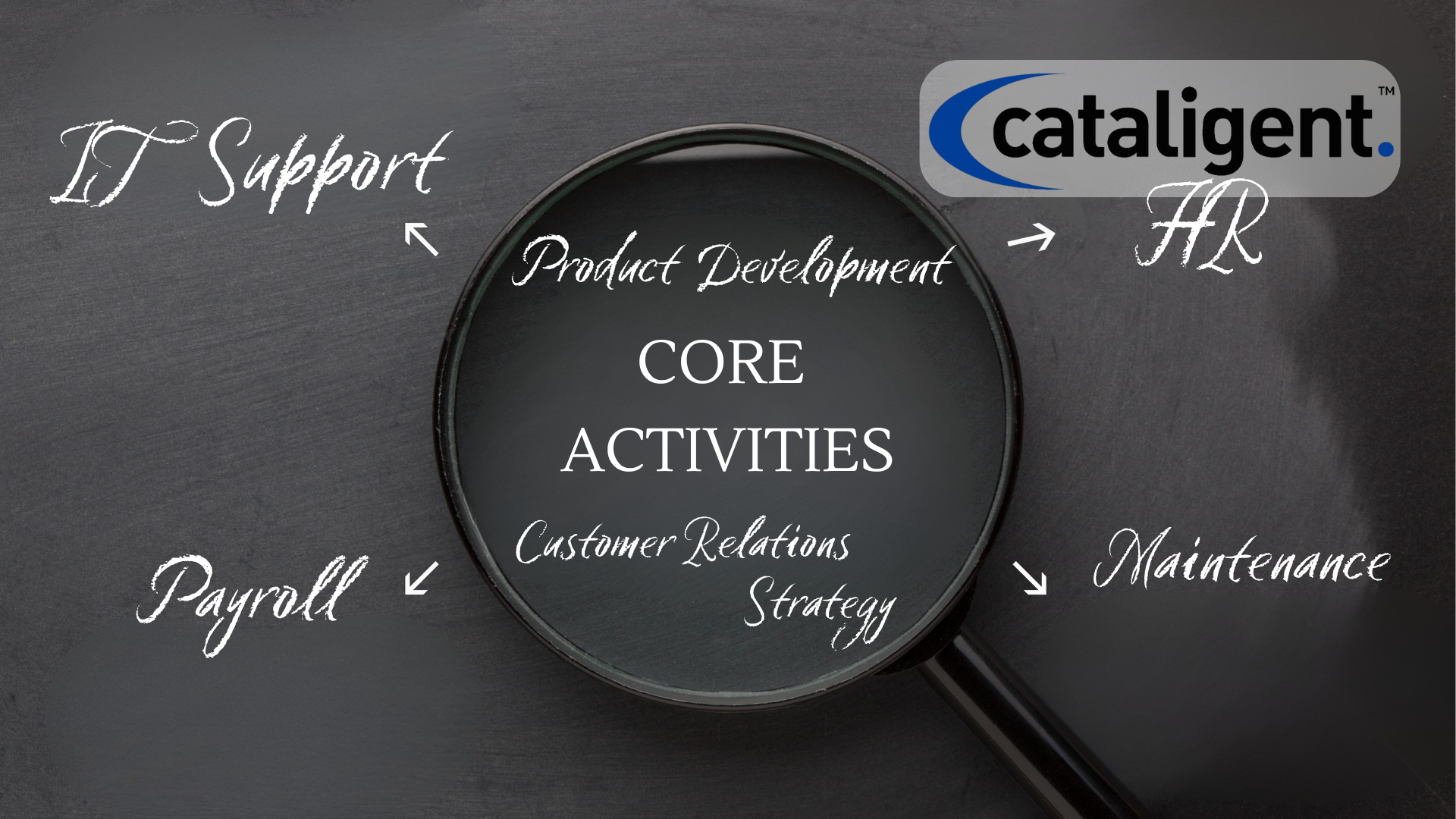
    The distinction between core and non-core activities is fundamental to strategic decision-making. Core activities are those that directly contribute to a company’s mission, competitive advantage, and revenue generation. These functions are unique to the organization’s value proposition and require in-house expertise to maintain control and quality. In contrast, non-core activities, while necessary for smooth business operations, do not directly impact a company’s primary objectives and can often be outsourced to third-party providers.

    Identifying Core Activities

    Core activities are essential functions that define a company’s existence and distinguish it from competitors. These typically include:

    • Product Development and Innovation – Activities related to designing, engineering, and refining products or services that set a company apart in the market.
    • Strategic Management – Decision-making processes involving business expansion, competitive positioning, and long-term growth.
    • Customer Relationship Management – Building and maintaining strong relationships with customers to enhance brand loyalty and engagement.
    • Sales and Marketing – Efforts aimed at driving revenue growth through market research, branding, advertising, and promotional campaigns.
    • Quality Control and Compliance – Ensuring products and services meet industry standards and regulations, protecting brand reputation and consumer trust.

    Identifying Non-Core Activities

    Non-core activities are necessary but do not contribute directly to the company’s primary objectives. These tasks can often be delegated to external service providers without compromising quality or efficiency. Common non-core activities include:

    • Administrative Support – Routine clerical work, document management, and data entry.
    • Payroll Processing and Human Resources (HR) Functions – Managing employee salaries, benefits, and compliance with labor laws.
    • IT Support and Maintenance – Software updates, cybersecurity management, and technical troubleshooting.
    • Customer Service and Call Center Operations – Handling customer inquiries, complaints, and support requests.
    • Supply Chain and Logistics – Inventory management, procurement, and transportation coordination.
    • Facilities Management – Cleaning, security, and maintenance of physical premises.

    From Activity Classification to Cost-Saving Execution

    Defining activities as core or non-core gives leadership a clearer view of where internal resources should be focused. However, many organizations stop at classification and fail to convert the insight into measurable action.

    To make core vs. non-core analysis useful, each activity should be assessed against:

    • Strategic relevance
    • Cost baseline
    • Internal effort and resource consumption
    • Outsourcing feasibility
    • Vendor availability
    • Risk and compliance impact
    • Service-level requirements
    • Potential savings
    • Implementation timeline
    • Responsible owner

    Cataligent helps organizations convert this assessment into a structured transformation or cost-saving program, where opportunities can be prioritized, approved, implemented, monitored, and reported.

    Benefits of Defining Core and Non-Core Activities

    1. Improved Focus on Strategic Priorities

    By outsourcing non-core activities, businesses can redirect internal resources toward core functions that drive growth and innovation. This allows leadership to concentrate on key initiatives rather than being burdened by routine administrative tasks.

    2. Cost Efficiency and Resource Optimization

    Outsourcing non-core functions can lead to significant cost savings by reducing the need for in-house staff, infrastructure, and training. External vendors often offer specialized services at a fraction of the cost, making it a financially viable option.

    3. Access to Specialized Expertise

    Third-party service providers are often experts in their respective fields, ensuring high-quality execution of non-core tasks. Companies can benefit from the latest industry best practices, technology, and innovations without investing in additional training or resources.

    4. Increased Agility and Scalability

    Businesses can scale operations more effectively when non-core activities are outsourced. Whether expanding or downsizing, external partners can adjust services to match the company’s evolving needs, providing greater operational flexibility.

    5. Enhanced Risk Management

    Outsourcing can mitigate risks associated with regulatory compliance, cybersecurity threats, and operational inefficiencies. Professional vendors are well-versed in industry regulations and best practices, reducing the likelihood of legal or financial complications.

    Implementation Guide: How to Assess and Define Core vs. Non-Core Activities

    Step 1: Conduct a Business Process Audit

    A thorough audit of business processes is the first step in classifying activities as core or non-core. This involves:

    • Mapping out all existing business functions and workflows.
    • Identifying key performance indicators (KPIs) for each process.
    • Evaluating the impact of each function on revenue generation, customer satisfaction, and strategic goals.

    Step 2: Classify Activities Based on Strategic Importance

    Once all business functions are identified, categorize them into core and non-core activities using the following criteria:

    • Strategic Importance – Does the activity contribute directly to the company’s mission and long-term success?
    • Competitive Advantage – Does the function differentiate the company from competitors?
    • Operational Necessity – Is the task essential for daily business operations, or can it be outsourced without disrupting workflow?

    Step 3: Identify Outsourcing Opportunities

    For non-core activities, determine which tasks can be outsourced to improve efficiency and reduce costs. Consider:

    • The availability of external vendors with expertise in the specific function.
    • Cost comparisons between in-house execution and outsourcing.
    • Potential risks and challenges associated with third-party service providers.

    How Cataligent Helps Evaluate Outsourcing Opportunities

    Outsourcing decisions should not be based only on cost comparison. A strong decision model should also consider service quality, operational risk, dependency on vendors, data security, compliance, internal capability, and long-term business impact.

    Cataligent helps organizations evaluate outsourcing opportunities using a structured governance approach:

    • Compare in-house vs. external delivery cost
    • Define baseline cost and target savings
    • Assign process owners and decision owners
    • Track risks, dependencies, and compliance requirements
    • Define implementation milestones
    • Monitor vendor performance and SLA adherence
    • Report savings realization to leadership

    This allows organizations to make outsourcing decisions based on both financial value and operational control.

    Step 4: Select Reliable Outsourcing Partners

    When choosing an outsourcing partner, conduct due diligence to ensure credibility, reliability, and quality. Factors to consider include:

    • Reputation and track record in the industry.
    • Compliance with industry standards and regulations.
    • Service level agreements (SLAs) that define performance expectations.
    • Data security measures to protect sensitive business information.

    Step 5: Implement and Monitor Outsourced Functions

    Once outsourcing agreements are in place, establish a robust monitoring system to ensure seamless integration and performance tracking. This involves:

    • Regularly reviewing service provider performance against agreed-upon metrics.
    • Maintaining open communication with vendors to address concerns and improvements.
    • Periodically reassessing the outsourcing strategy to align with evolving business needs.

    How Cataligent Supports Core vs. Non-Core Optimization

    Cataligent supports organizations in moving from activity assessment to measurable execution. Whether the goal is cost reduction, outsourcing, process optimization, resource reallocation, or transformation governance, Cataligent provides the structure needed to manage initiatives from idea to impact.

    Cataligent can support:

    • Business process assessment and classification
    • Cost-saving initiative tracking
    • Baseline, target, forecast, and actual savings monitoring
    • Outsourcing opportunity evaluation
    • Vendor and SLA performance tracking
    • Risk, issue, and dependency management
    • Workflow approvals and ownership mapping
    • Implementation milestone tracking
    • Executive dashboards and management reporting
    • Multi-department transformation program visibility
    Core vs. non-core decision areaCommon business challengeHow Cataligent helps
    Business process auditProcesses are documented in scattered spreadsheets or presentationsCreates structured visibility across activities, owners, costs, and improvement opportunities
    Strategic classificationTeams disagree on what is truly core vs. non-coreSupports transparent evaluation criteria, scoring, ownership, and decision records
    Outsourcing opportunityDecisions are made only on short-term costTracks cost, risk, quality, compliance, vendor dependency, and long-term impact
    Cost-saving potentialSavings estimates are not validated or monitoredTracks baseline cost, target savings, forecast savings, actual savings, and EBIT impact
    Vendor selectionVendor comparisons are informal and difficult to defendSupports evaluation criteria, documentation, approvals, and governance checkpoints
    SLA monitoringOutsourced functions are not measured consistentlyTracks SLA expectations, performance metrics, issues, and improvement actions
    Transformation executionApproved decisions do not become implemented actionsTracks milestones, owners, risks, dependencies, and implementation progress
    Leadership reportingManagement lacks visibility into realized benefitsProvides dashboards, reports, and status updates for decision-makers

    Conclusion

    Defining core and non-core activities is an important step toward operational efficiency, resource optimization, and cost reduction. However, the value of this exercise is realized only when classification leads to measurable decisions, clear ownership, controlled outsourcing, risk visibility, SLA monitoring, and savings tracking.

    Cataligent helps organizations move from activity assessment to execution by connecting business processes, cost-saving opportunities, vendors, risks, implementation milestones, and management reporting in a structured governance model.

    If your organization is reviewing which activities to keep in-house, optimize, or outsource, Cataligent can help create the structure needed to prioritize opportunities, manage implementation, and track measurable business impact.

    Assess Core vs. Non-Core Activities with Cataligent →

  • Workflow Automation in Cost Saving Programs

    Workflow Automation in Cost Saving Programs

    In an increasingly fast-paced business environment, companies are under pressure to find new ways to improve efficiency, reduce operational costs, and maintain a competitive edge. One of the most effective solutions for addressing these challenges is workflow automation. By leveraging software tools and technologies to automate repetitive and time-consuming tasks, organizations can achieve significant cost savings, reduce human error, and increase productivity. This paper explores the concept of workflow automation within the framework of cost-saving programs, examining what it involves, the cost-saving impact it generates, and how businesses can successfully implement automation strategies to optimize their operations.

    What Is Workflow Automation?

    Workflow automation refers to the use of technology, specifically software solutions, to streamline and automate repetitive tasks or processes that would otherwise require manual effort. These tasks can range from simple data entry to more complex processes like document approvals, invoicing, and customer relationship management. By automating these workflows, businesses can eliminate the need for human intervention in routine tasks, enabling employees to focus on more strategic and high-value activities.

    Automated workflows are typically designed using specialized software tools that facilitate the automatic routing of tasks, data processing, and approvals. These tools can integrate with existing systems and applications to trigger actions, send notifications, update databases, and produce reports—all without human involvement. Workflow automation technologies are widely used in various business functions, including finance, HR, IT, sales, and customer service.

    Cost-Saving Impact of Workflow Automation

    The implementation of workflow automation can have a significant impact on an organization’s bottom line. The cost-saving benefits of automation arise from several key factors:

    1. Reduction in Manual Errors and Labor Costs

    One of the primary cost-saving advantages of workflow automation is the reduction of manual errors. Human error is a common issue in many routine tasks, particularly those involving data entry or the processing of large volumes of information. Even small mistakes can lead to costly repercussions, such as delayed payments, incorrect billing, and data inaccuracies. By automating these processes, businesses can reduce the risk of errors, ensuring greater accuracy and consistency in their operations.

    Automation eliminates the need for employees to manually input data, perform repetitive calculations, or track approvals, which significantly reduces the likelihood of mistakes. This, in turn, reduces the time and resources needed to correct errors, leading to cost savings. Moreover, by cutting down on the need for manual intervention, automation reduces labor costs associated with these tasks, allowing employees to be redeployed to higher-value activities that drive business growth.

    2. Speeds Up Task Completion, Increasing Productivity

    In addition to reducing errors, workflow automation can significantly speed up task completion. Tasks that would normally take hours or even days to complete manually can be completed in a fraction of the time with automation. For example, an automated data entry system can process large volumes of data in real time, while an approval workflow automation tool can route documents and requests for approval within seconds.

    By streamlining processes and eliminating bottlenecks, automation allows businesses to complete tasks more quickly, which increases overall productivity. This enhanced efficiency enables companies to achieve more with fewer resources, ultimately reducing costs and improving the speed at which they can respond to customer needs, market changes, and internal demands.

    3. Minimizes Administrative Burden

    Administrative tasks are often a significant source of inefficiency in businesses. These tasks, such as scheduling meetings, sending reminders, managing approvals, and maintaining records, tend to be repetitive and time-consuming. By automating these functions, businesses can reduce the administrative burden on employees and free up valuable time for more important work.

    Automation tools can handle scheduling, sending notifications, filing documents, and tracking approvals, reducing the need for employees to spend time on these low-value activities. This not only improves efficiency but also enhances employee satisfaction by allowing staff to focus on more meaningful and engaging work. By automating administrative tasks, companies can significantly reduce operational costs and improve employee morale.

    4. Increased Compliance and Consistency

    Workflow automation plays a crucial role in ensuring that business processes are carried out consistently and in compliance with regulations. In industries where compliance with laws, standards, or internal policies is critical, automation can help organizations avoid costly violations and legal issues.

    Automated workflows can be designed to follow predefined rules and regulations, ensuring that tasks are performed according to established procedures. For example, an automated invoice approval system can enforce policies regarding spending limits and required documentation, reducing the risk of errors or fraud. By maintaining consistent processes, organizations can improve compliance, reduce legal risks, and avoid penalties or fines, which ultimately contribute to cost savings.

    5. Improved Decision-Making through Data Insights

    Automation tools can collect and analyze data in real-time, providing businesses with valuable insights into their operations. These insights can help organizations make better, data-driven decisions, identify areas for improvement, and optimize their workflows.

    For example, automated systems can generate reports on process performance, highlighting areas where inefficiencies or delays occur. By analyzing these reports, businesses can pinpoint bottlenecks, optimize workflows, and implement corrective actions to improve efficiency. Data-driven decision-making helps organizations continuously refine their processes, reduce costs, and improve performance, creating long-term cost-saving benefits.

    6. Enhanced Customer Experience

    In many cases, workflow automation directly benefits customers by enabling faster response times and more efficient service delivery. For example, in customer service, automated systems can route support tickets, provide instant responses to frequently asked questions, or initiate follow-up actions, ensuring that customer inquiries are addressed promptly.

    By automating routine customer interactions, businesses can improve their customer service efficiency while maintaining a high level of customer satisfaction. A more responsive, efficient customer service experience reduces the likelihood of customer churn and the costs associated with handling complaints, which ultimately drives cost savings for the organization.

    7. Scalability of Operations

    As businesses grow, they need to scale their operations without significantly increasing their costs. Workflow automation provides a scalable solution by enabling businesses to handle larger volumes of work without hiring additional staff or investing in more infrastructure.

    Automated systems can easily accommodate increasing workloads by processing more data, routing more approvals, or handling more customer inquiries without requiring additional resources. This scalability makes it easier for organizations to expand their operations while keeping operational costs under control.

    Steps to Implement Workflow Automation

    Successfully implementing workflow automation requires careful planning and execution. The following steps outline a systematic approach to introducing workflow automation in an organization to achieve maximum cost-saving benefits.

    1. Identify Repetitive and Time-Consuming Tasks

    The first step in implementing workflow automation is identifying the tasks and processes that are repetitive, time-consuming, and prone to human error. These tasks are ideal candidates for automation and should be prioritized for the initial phase of implementation. Examples of tasks that are often automated include data entry, invoice processing, approval workflows, employee onboarding, and customer support ticket management.

    Conducting a thorough assessment of existing workflows will help organizations identify the most suitable areas for automation. Engaging employees and stakeholders in this process is crucial to understand where inefficiencies exist and which processes would benefit the most from automation.

    2. Select the Right Automation Tools

    There is a wide range of software tools available to help businesses automate their workflows. Selecting the right tools is essential to ensure a smooth and effective automation process. Some commonly used automation tools include:

    • Robotic Process Automation (RPA): RPA tools automate repetitive, rule-based tasks, such as data entry, report generation, and form filling.
    • Workflow Management Software: These tools help design, track, and manage workflows, ensuring that tasks are automatically routed and completed according to predefined processes.
    • Document Management Systems: These systems automate document routing, approval, and storage, ensuring compliance and reducing paperwork.
    • Customer Relationship Management (CRM) Systems: CRM tools automate customer interactions, follow-ups, and sales workflows to enhance customer service efficiency.

    It’s important to choose automation tools that integrate well with existing systems and applications. The selected tools should also align with the company’s specific needs and provide a clear return on investment.

    3. Design Automated Workflows

    Once the tools have been selected, businesses need to design the automated workflows. This involves defining the sequence of tasks, the rules for routing tasks, and the conditions under which specific actions should be triggered. For example, an automated approval workflow may involve routing a document to the appropriate manager for review and approval based on predefined criteria, such as the document’s value or department.

    It’s crucial to ensure that automated workflows are designed to be flexible and adaptable to future changes. The design should also account for exceptions, allowing for manual intervention when necessary, without disrupting the overall flow of the process.

    4. Test and Pilot Automation Solutions

    Before fully implementing automation, businesses should test the new workflows with a small group of users or processes. This pilot phase allows businesses to identify any issues, refine the workflows, and assess the effectiveness of the automation tools. Testing helps ensure that the automated processes are functioning as intended and that they meet performance expectations.

    During the pilot phase, businesses should monitor key performance indicators (KPIs) such as task completion times, error rates, and cost savings. Feedback from employees and stakeholders can also provide valuable insights into potential improvements or adjustments that may be required.

    5. Train Employees and Ensure Smooth Adoption

    Training is a critical aspect of implementing workflow automation. Employees need to understand how the automated processes work, how to interact with the new systems, and how to handle exceptions or issues that may arise. Providing adequate training ensures that employees feel confident using the new tools and helps minimize resistance to change.

    In addition to formal training, businesses should offer ongoing support to ensure that employees can effectively use automation tools. This support can take the form of user guides, FAQs, and help desks to assist employees in navigating the new systems.

    6. Monitor and Continuously Improve Automation Efforts

    Once the automation processes are up and running, businesses must continuously monitor their performance and identify opportunities for improvement. This involves reviewing KPIs, gathering feedback from employees, and making adjustments as necessary. Automation should be seen as an ongoing process of refinement rather than a one-time implementation.

    By continuously improving automated workflows, businesses can further optimize their operations, reduce costs, and ensure that automation continues to provide value over time.

    Conclusion

    Workflow automation is a powerful tool for reducing costs, improving efficiency, and driving business growth. By automating repetitive and time-consuming tasks, organizations can eliminate errors, reduce labor costs, speed up task completion, and enhance productivity. The cost-saving impact of automation can be realized across various areas of the business, including administrative functions, compliance, customer service, and decision-making.

    To successfully implement workflow automation, businesses must carefully assess their existing processes, select the right tools, design efficient workflows, and provide adequate training and support to employees. By taking a systematic approach to automation, businesses can unlock significant cost savings and position themselves for long-term success in an increasingly competitive marketplace.

  • Business Consulting and Digital Transformation

    Business Consulting and Digital Transformation

    Introduction

    Digital transformation is reshaping industries, enabling businesses to leverage technology for enhanced efficiency, customer engagement, and competitive advantage. Business consulting plays a crucial role in guiding organizations through digital transformation by assessing technological needs, implementing digital strategies, and ensuring seamless integration of new systems. This document explores the relationship between business consulting and digital transformation, highlighting key areas of impact and strategic benefits.

    Key Aspects of Digital Transformation in Business Consulting

    1. Digital Strategy Development

    • Aligning digital transformation with business objectives and market trends.
    • Identifying key technologies for process automation and efficiency.
    • Creating a roadmap for phased digital implementation.

    2. Technology Integration and Implementation

    • Implementing cloud computing, AI, IoT, and automation solutions.
    • Enhancing data analytics for improved decision-making.
    • Upgrading legacy systems to modern, scalable platforms.

    3. Customer Experience Enhancement

    • Personalizing customer interactions through AI and big data analytics.
    • Implementing CRM solutions for improved customer engagement.
    • Enhancing digital touchpoints, including websites, mobile apps, and e-commerce platforms.

    4. Cybersecurity and Data Protection

    • Implementing robust cybersecurity frameworks to protect sensitive data.
    • Ensuring compliance with data protection regulations (e.g., GDPR, CCPA).
    • Enhancing digital risk management to prevent cyber threats.

    5. Process Automation and Operational Efficiency

    • Utilizing robotic process automation (RPA) to streamline workflows.
    • Reducing manual errors and increasing productivity through AI-driven tools.
    • Enhancing supply chain management with digital tracking and automation.

    6. Workforce Transformation and Digital Training

    • Upskilling employees to adapt to digital tools and technologies.
    • Implementing change management strategies for smooth digital adoption.
    • Encouraging a culture of innovation and continuous learning.

    Industries Benefiting from Digital Transformation Consulting

    Business consulting in digital transformation is critical across various industries, including:

    • Healthcare: Implementing telemedicine, electronic health records (EHRs), and AI-driven diagnostics.
    • Financial Services: Enhancing digital banking, fraud detection, and automated trading systems.
    • Retail and E-commerce: Optimizing online sales platforms, AI-driven marketing, and supply chain automation.
    • Manufacturing: Integrating IoT for smart factories, predictive maintenance, and real-time monitoring.
    • Education: Expanding e-learning platforms, virtual classrooms, and digital assessment tools.

    Conclusion

    Digital transformation is essential for businesses seeking sustainable growth and innovation. Business consulting firms play a pivotal role in guiding organizations through the digital landscape by developing strategies, integrating advanced technologies, and ensuring workforce adaptability. By leveraging digital transformation, businesses can enhance efficiency, improve customer experiences, and stay ahead in an increasingly digital world.

  • How Crucial is Risk Management for Business Consulting?

    How Crucial is Risk Management for Business Consulting?

    Introduction

    Risk management is a critical component of business consulting, ensuring that organizations can identify, assess, and mitigate potential threats to their operations, finances, and reputation. Effective risk management strategies help businesses navigate uncertainties, comply with regulations, and maintain long-term stability. This document explores the importance of risk management in business consulting and how it contributes to sustainable success.

    Key Aspects of Risk Management in Business Consulting

    1. Identifying and Assessing Risks

    • Conducting comprehensive risk assessments to identify potential threats.
    • Analyzing financial, operational, technological, and market-related risks.
    • Prioritizing risks based on their likelihood and potential impact on the business.

    2. Regulatory Compliance and Legal Risk Mitigation

    • Ensuring adherence to industry regulations, legal requirements, and corporate governance standards.
    • Implementing compliance programs to prevent regulatory penalties and lawsuits.
    • Regularly updating policies to align with changing legal frameworks.

    3. Financial Risk Management

    • Developing strategies to mitigate financial instability and market fluctuations.
    • Implementing budgeting and financial planning techniques to reduce exposure.
    • Managing currency exchange risks for international operations.

    4. Operational and Strategic Risk Management

    • Identifying inefficiencies in business processes that could lead to operational failures.
    • Developing contingency plans to ensure business continuity during crises.
    • Aligning risk management with strategic business objectives.

    5. Cybersecurity and Technological Risk Management

    • Protecting sensitive business data from cyber threats and breaches.
    • Implementing robust IT security protocols and disaster recovery plans.
    • Ensuring compliance with data protection laws and best practices.

    6. Reputation and Brand Risk Management

    • Monitoring public perception and addressing potential PR crises.
    • Developing crisis communication strategies to manage reputational damage.
    • Strengthening brand trust through proactive risk management initiatives.

    Industries Benefiting from Risk Management Consulting

    Risk management consulting is vital across various industries, including:

    • Financial Services: Mitigating investment, credit, and fraud risks.
    • Healthcare: Ensuring patient data security and regulatory compliance.
    • Retail and E-commerce: Managing supply chain disruptions and cybersecurity threats.
    • Manufacturing: Preventing operational failures and supply chain inefficiencies.
    • Technology and IT: Safeguarding intellectual property and data privacy.

    Conclusion

    Risk management is crucial for business consulting, enabling organizations to safeguard their assets, ensure compliance, and maintain resilience in an evolving business landscape. By identifying potential risks, implementing proactive strategies, and aligning risk management with business objectives, companies can enhance stability and sustain long-term growth. Consulting firms play a key role in guiding businesses through risk mitigation strategies, ensuring they remain competitive and prepared for unforeseen challenges.

  • Outlining Market Research and Analysis for Business Consulting

    Outlining Market Research and Analysis for Business Consulting

    Introduction

    Market research and analysis are fundamental components of business consulting, helping organizations understand industry trends, customer behavior, and competitive landscapes. Through data-driven insights, businesses can make informed decisions, optimize strategies, and gain a competitive edge. This document explores the key elements of market research and analysis in business consulting.

    Key Aspects of Market Research and Analysis

    1. Understanding Market Research

    • Gathering and analyzing data to identify market trends and opportunities.
    • Assessing customer preferences, demographics, and purchasing behavior.
    • Evaluating competitive positioning and industry benchmarks.

    2. Types of Market Research

    • Primary Research: Direct data collection through surveys, interviews, and focus groups.
    • Secondary Research: Analyzing existing reports, industry publications, and competitor data.
    • Qualitative Research: Understanding consumer motivations and perceptions.
    • Quantitative Research: Statistical analysis of numerical data to validate market trends.

    3. Competitive Analysis

    • Identifying key competitors and analyzing their strengths and weaknesses.
    • Evaluating market share, pricing strategies, and product positioning.
    • Benchmarking against industry leaders to identify growth opportunities.

    4. Consumer Insights and Target Audience Identification

    • Segmenting customers based on demographics, psychographics, and behavior.
    • Identifying unmet needs and pain points to tailor business strategies.
    • Using customer feedback to refine products and services.

    5. Trend Analysis and Forecasting

    • Monitoring emerging market trends and shifts in consumer demand.
    • Predicting future industry developments through data analytics.
    • Identifying technological advancements and innovation opportunities.

    6. Market Entry and Expansion Strategies

    • Assessing market feasibility for new product launches or geographic expansion.
    • Developing go-to-market strategies based on research insights.
    • Identifying potential risks and barriers to market entry.

    Industries Benefiting from Market Research and Analysis

    Market research and analysis play a crucial role across multiple industries, including:

    • Retail and E-commerce: Understanding consumer purchasing patterns and optimizing product offerings.
    • Healthcare and Pharmaceuticals: Identifying patient needs and market demand for new treatments.
    • Technology and IT: Assessing software trends, innovation potential, and competitive positioning.
    • Financial Services: Understanding investment trends and customer preferences for banking products.
    • Manufacturing and Automotive: Evaluating supply chain efficiencies and consumer demand for new products.

    Conclusion

    Market research and analysis are essential for businesses to make data-driven decisions, reduce risks, and seize growth opportunities. By leveraging comprehensive research methodologies, businesses can optimize strategies, enhance customer satisfaction, and maintain a competitive advantage. Business consulting firms play a pivotal role in guiding organizations through effective market research and analysis, ensuring sustainable growth and success.