
The 90-Day Project Acceleration Plan for Consultants
A consulting engagement can lose momentum before the client notices. The first steering committee is positive, the workstreams are named, the board pack looks polished, and the project plan feels active. Then the team starts chasing updates, the client uses local spreadsheets, approvals sit in email, and value tracking becomes a separate finance exercise.
A 90 day project acceleration plan for consultants should do more than increase meeting frequency. It should create the governance, reporting cadence, owner accountability, and value tracking needed for a client programme to move from intent to controlled execution. The goal is not speed for its own sake. The goal is faster clarity, faster decisions, and faster evidence of progress.
Cataligent works with consulting firms and enterprise clients through CAT4, its no code strategy execution platform, to support this kind of acceleration. CAT4 gives the engagement team one governed place for measures, approvals, financial impact, dependencies, status reporting, and controller backed closure.
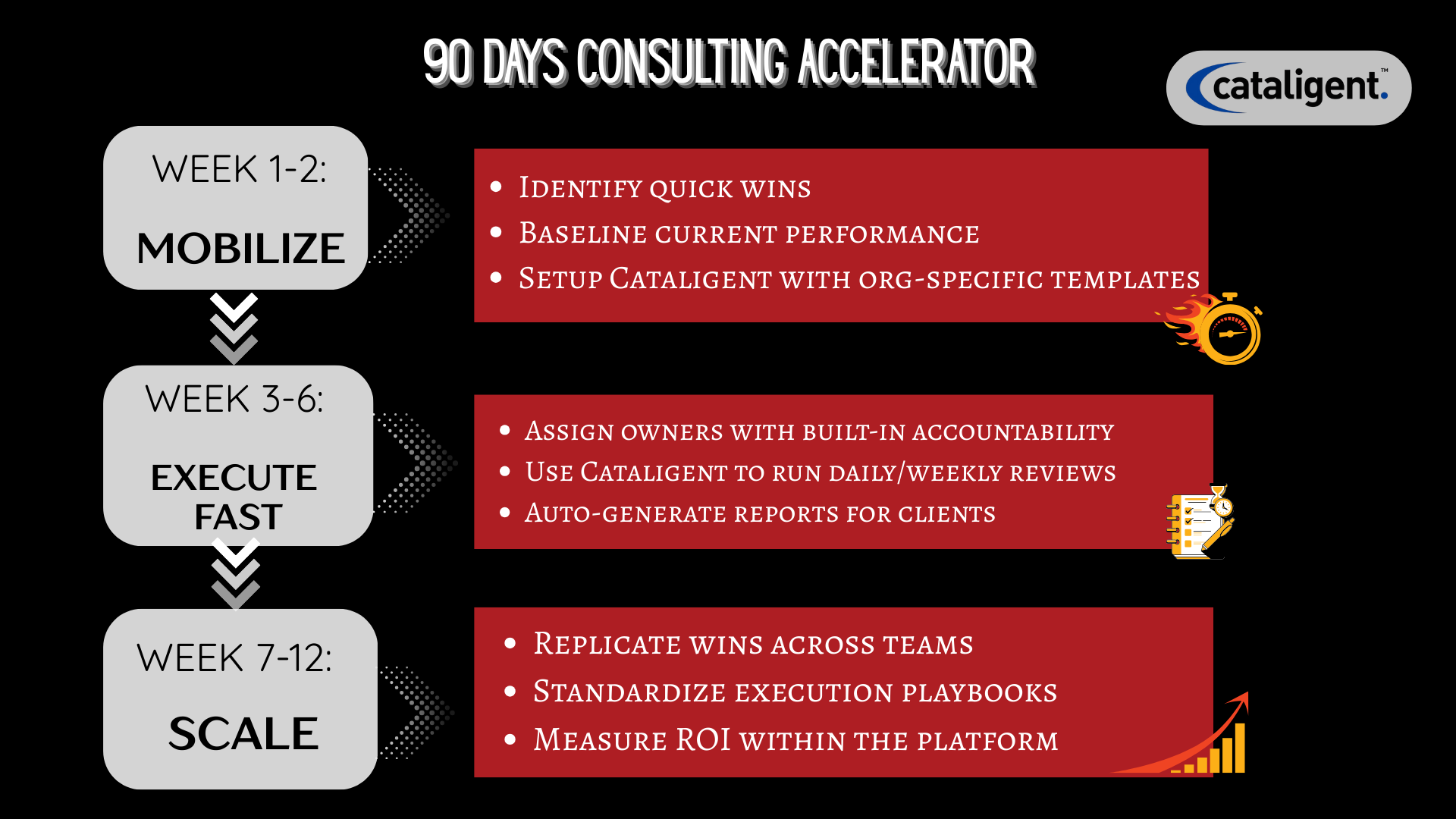
Days 1 to 30: create the execution structure before the work expands
The first 30 days should turn the consulting firm’s methodology into an operating model the client can actually run. This means defining the programme hierarchy, not just a list of tasks. In CAT4 terms, the hierarchy moves from Organization to Portfolio, Program, Project, Measure Package, and Measure. That structure matters because every financial effect, milestone, risk, dependency, and decision must roll up without manual consolidation.
Consultants should start by identifying the transformation office, steering committee, workstream leads, measure owners, sponsors, controllers, and process owners. Each measure should have a description, business unit, function, legal entity, owner, sponsor, controller, and steering context. Without this basic structure, later reporting will become a negotiation over facts.
The second priority is value framing. For a margin improvement programme, this could include savings baseline, target value, forecast value, actual value, one time cost, recurring benefit, cash flow impact, and EBITDA potential. For a project portfolio programme, it could include investment amount, resource load, delivery milestone, dependency exposure, and decision status. For an enterprise business transformation programme, it could include process adoption, operating model change, and financial value tracking.
The third priority is cadence. Consultants should define how often owners update measures, when the PMO locks reporting inputs, when decisions escalate, and when steering committee packs are produced. A vague cadence creates reporting debt. A clear cadence creates momentum.
Days 31 to 60: move from planning to controlled execution
The second 30 days should prove that the governance model can handle real change. This is where many consulting teams discover that client execution is more complex than the initial plan suggested. Dependencies appear between workstreams. Value assumptions change. Approvals take longer than expected. Resource conflicts emerge. Some initiatives need to be placed on hold, and others should be cancelled before they consume more time.
A strong acceleration plan gives the consulting team a way to manage these issues without rebuilding the programme pack every week. CAT4 supports this through approval workflows, change request management, claim management, document storage, status narratives, traffic lights, and DoI stage gates. Measures can advance, hold, or cancel through formal governance instead of disappearing into side conversations.
Consultants should also separate implementation progress from value progress. A measure can be active and still lose financial potential. CAT4’s dual status view helps by tracking Implementation Status and Potential Status separately. This gives the partner, director, PMO lead, and client executive a more honest view of the programme.
For cost saving programs, this separation is critical. A procurement renegotiation, workforce efficiency measure, pricing initiative, or vendor performance improvement project can hit milestones while the forecast benefit changes. The plan should show that movement clearly and early.
Days 61 to 90: make progress visible and repeatable
The final 30 days should turn acceleration into a repeatable delivery model. The consulting team should not simply deliver a better status report. It should leave the client with a governed rhythm for decisions, value tracking, and closure.
By this stage, the programme should have current dashboards, scheduled reports, owner level task views, approval history, dependency registers, risk views, and a clean measure hierarchy. Steering committee materials should come from the governed platform, not from a late night analyst consolidation cycle. Workstream leads should know where to update progress. Finance should know where to validate actuals. Sponsors should know which decisions need attention.
This is also when consultants should identify which parts of their methodology can be reused in the next mandate. If every engagement requires a new set of spreadsheets, templates, macros, slide packs, and approval trackers, the firm is leaving efficiency and consistency on the table. Cataligent helps consulting firms configure CAT4 around their delivery model so the firm’s intellectual property can travel across engagements.
What consultants should measure during the 90 days
The acceleration plan should track more than task completion. Consultants should watch reporting cycle time, overdue owner updates, approval ageing, dependency risk, decision backlog, forecast value movement, actual value confirmation, resource overload, and measure closure quality. These measures tell the engagement leader whether the programme is becoming easier to govern or merely busier.
For example, a steering committee may care less about how many meetings occurred and more about whether the top five decisions have clear owners and due dates. A CFO may care less about the number of initiatives launched and more about whether forecast savings are still credible. A COO may care less about total tasks closed and more about whether operating changes are landing in the business.
A disciplined approach to multi project management gives consultants a stronger way to answer these questions. It connects the project view to the portfolio view and the portfolio view to the business case.
How Cataligent Helps Through CAT4
Cataligent helps consulting firms and enterprise clients turn the 90 day acceleration window into a governed execution model. Through CAT4, Cataligent supports programme setup, hierarchy design, measure definition, approval workflows, reporting cadence, value tracking, and closure governance.
The platform is useful because it connects the parts of the engagement that are usually separated. The business case sits with execution. Approvals sit with the measure. Status narratives sit with dashboards. Documents sit with the relevant task, measure, or hierarchy level. Implementation Status and Potential Status sit side by side so the client sees execution and value together.
This matters for consultants because credibility depends on control. A consulting firm can bring a strong point of view, but the engagement needs a system that can carry that point of view through daily execution, weekly PMO review, monthly steering committee reporting, and final closure.
Cataligent’s experience with CAT4 also gives consulting firms proof of enterprise maturity. For 25 years CAT4 has been trusted, with 250+ large enterprise installations, 40,000+ users, and 50+ CAT4 skilled consultants in the network. Those proof points help when a client asks whether the platform can support a serious transformation mandate.
Turning acceleration into a client capability
The best 90 day plan does not create dependency on the consulting team. It creates a governed way for the client to continue execution after the first wave. That means clear roles, decision rights, reporting cadence, value confirmation, and accountable closure.
Consulting firms should use the first 90 days to establish that discipline. Cataligent can help them do it through CAT4, so the engagement does not become another spreadsheet based programme with a polished front end. The result is faster clarity, stronger client control, and a delivery model the firm can use again.
FAQs
Q: What should a 90 day project acceleration plan include?
It should include programme hierarchy, measure ownership, value tracking, approval cadence, dependency management, reporting rules, and closure criteria. The plan should create governance discipline, not just a faster task list.
Q: How can consultants avoid manual reporting during acceleration?
They should capture updates, approvals, risks, financials, and status narratives in a governed platform from the start. Cataligent supports this through CAT4 so reporting reflects the same data used to run the programme.
Q: Why is value tracking important in the first 90 days?
Early value tracking prevents a programme from looking active while the business case weakens. It helps consultants and client leaders see whether forecast value, actual value, and execution progress are moving together.