
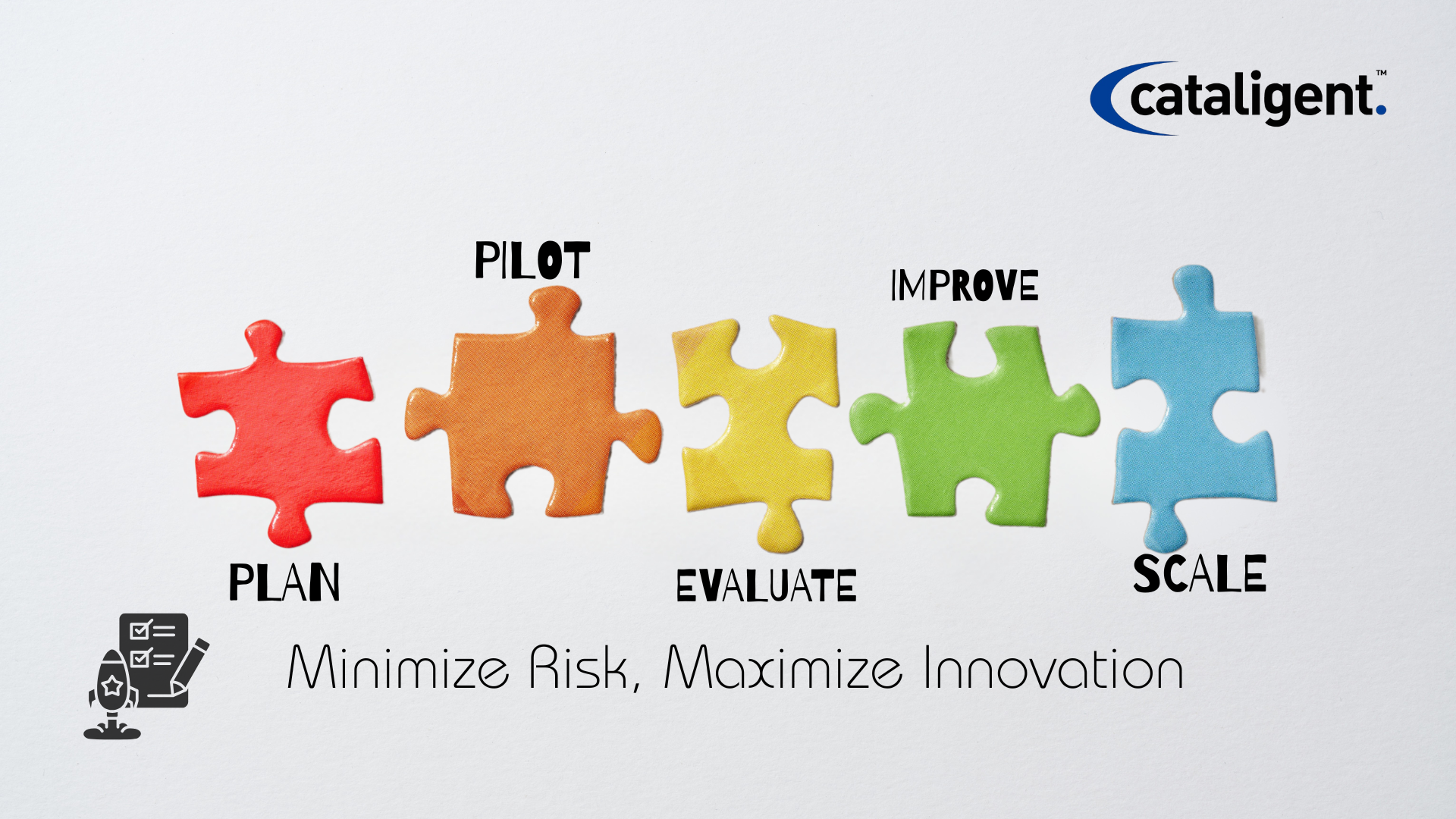
Reduce Innovation Risks with Pilot Testing
Large innovation investments often fail because companies move from idea approval to full rollout before proving demand, operating cost, adoption effort, supplier readiness, and financial impact. Pilot testing reduces innovation risks by creating a controlled environment where leaders can test assumptions before committing wider spend. As a cost saving strategy, the pilot is not a small experiment for its own sake. It is a governance mechanism that connects baseline cost, target savings, forecast savings, actual savings, risk evidence, and finance validation.
For CFOs, transformation leaders, PMOs, operations teams, procurement leaders, and consulting firms, the value of pilot testing is discipline. It helps separate a promising idea from a cost saving initiative that is ready for scaling. A problem creates cost, an improvement creates potential, and governed execution turns potential into confirmed value.
What Is Pilot Testing in Cost Saving Strategy?
Pilot testing is the controlled implementation of an innovation or improvement in a limited scope before wider rollout. The scope may be one business unit, one supplier category, one production line, one customer segment, one shared service process, or one geography. The purpose is to test whether the proposed change reduces cost without creating unacceptable risk, service issues, quality gaps, or hidden work.
In cost saving programs, a pilot should test more than technical feasibility. It should test the savings baseline, target savings assumptions, operating impact, approval workflow, dependency risk, implementation evidence, and closure conditions. A pilot that only proves that the idea works may still fail as a cost reduction strategy if the actual savings are lower than expected or if the cost moves into another function.
Why Pilot Testing Matters for Cost Saving
Innovation risk becomes financial risk when a business scales an unproven change. A new automation tool may reduce manual work but add license cost. A supplier change may lower unit price but increase defect cost. A process redesign may reduce headcount effort in one area but create delays in another. Pilot testing helps leaders find these issues before they become full program losses.
When pilots are tracked in spreadsheets, email threads, and slide decks, the evidence often gets fragmented. Leadership may see a green status update without seeing baseline cost, budget variance, adoption rate, savings risk, or controller review. A governed pilot creates a clear path from test hypothesis to approved scale decision.
| Pilot area | Cost saving hypothesis | Savings risk | Evidence needed before scaling |
|---|---|---|---|
| Automation pilot | Reduce manual processing hours | License and support cost exceed labor saving | Baseline effort, adoption data, actual hours reduced, finance review |
| Supplier pilot | Lower procurement cost through new supplier terms | Quality failures create rework and service cost | Unit cost, defect rate, delivery reliability, controller validation |
| Operating model pilot | Consolidate work into shared services | Local teams rebuild shadow processes | Role mapping, service volume, escalation data, closure evidence |
| Market launch pilot | Test lower cost channel or product offer | Revenue or margin effect is misread | Target segment, cost to serve, margin data, sponsor approval |
Define the Pilot Scope Around the Cost Question
A good pilot starts with a precise cost question. Examples include whether a process change can reduce recurring manual effort by a defined amount, whether a supplier renegotiation can reduce spend without quality loss, whether license rationalization can lower cost without harming productivity, or whether a new service model can reduce travel and support cost.
The scope must be small enough to control but meaningful enough to validate the savings assumption. A pilot that is too narrow may produce false confidence. A pilot that is too broad may become an uncontrolled rollout. Define the business unit, baseline period, cost owner, measure owner, sponsor, controller, decision date, and evidence required for scale approval before the pilot starts.
Separate Test Learning from Confirmed Savings
Pilot teams often confuse positive learning with actual savings. A pilot may show that a tool is accepted by users, but that does not prove EBIT impact. A supplier trial may show a lower price, but that does not prove recurring benefit if volume, quality, logistics, or payment terms change later.
Cost saving governance requires three levels of evidence. First, the pilot must show that the improvement works operationally. Second, it must show that the cost baseline changes. Third, finance or the controller must validate that the reported saving is not double counted, temporary, or offset by new cost elsewhere.
Use Stage Gates Before Wider Rollout
Every pilot should have go or no go stage gates. At the defined stage, the idea is described and the cost problem is clear. At the identified stage, the owner, sponsor, controller, baseline, and target saving are assigned. At the detailed stage, the pilot plan, risks, dependencies, and evidence requirements are documented. At the decided stage, the sponsor approves implementation. At the implemented stage, the pilot is live. At closure, value is confirmed or the initiative is stopped, changed, or held.
This logic helps consulting firms and enterprise teams avoid the common pattern where a pilot is celebrated in a steering committee but never converted into a controlled cost saving initiative. A pilot should end with one of three decisions: scale with governance, redesign and retest, or stop because the financial case is not valid.
Protect Service Quality While Testing Cost Reduction
Cost reduction pilots can create resistance if teams believe the only goal is budget cutting. Strong pilot design protects service quality by tracking customer impact, process stability, risk escalation, compliance requirements, employee workload, and operating continuity. Cost saving strategies should reduce waste, duplication, delay, and avoidable spend, not damage the capability that creates business value.
Examples include testing demand management before reducing capacity, measuring defect cost before switching suppliers, validating request volumes before changing service desk staffing, and tracking rework before removing process steps. Savings should survive real operating conditions, not just the controlled assumptions of a project plan.
Metrics That Matter
Pilot testing needs metrics that connect execution to value. Activity metrics show whether the pilot happened. Governance metrics show whether the pilot is ready to become a reliable cost saving initiative.
| Metric | Why it matters in pilot testing | How to validate it |
|---|---|---|
| Baseline cost | Defines the starting point before the pilot | Use finance records, operational data, supplier invoices, or time evidence |
| Target savings | Shows the expected financial potential | Review the sponsor approved business case and cost owner assumptions |
| Forecast savings | Shows whether the pilot still supports the expected value | Compare pilot results, risks, dependencies, and adoption status |
| Actual savings | Confirms value after implementation | Measure against baseline and require controller validation |
| Approval ageing | Shows delays in moving from pilot to decision | Track time spent waiting for sponsor, controller, or steering committee approval |
| Dependency blockage | Shows whether external factors are stopping value delivery | Track supplier, IT, finance, legal, and operations dependencies |
| Closure evidence | Prevents premature benefit claims | Require operational proof, cost proof, approval history, and finance sign off |
Common Mistakes to Avoid
Running pilots without a baseline. Without baseline cost, the pilot can show activity but cannot prove whether cost has been reduced.
Testing technology but not operating impact. A tool can work technically while creating support cost, adoption issues, data rework, or manual exceptions.
Scaling before finance validation. Forecast savings should not be treated as actual savings until the cost change is measured and validated by the appropriate finance or controller role.
Ignoring negative pilot evidence. A pilot that shows weak adoption, quality risk, or supplier instability is valuable because it protects the business from a larger failed rollout.
Letting pilots become permanent experiments. Every pilot needs a decision date, owner, sponsor, closure criteria, and escalation path so resources are not trapped in unresolved tests.
How Cataligent Helps Through CAT4
Cataligent helps enterprises and consulting firms manage pilot testing as part of governed cost saving strategies. Through CAT4, Cataligent provides one controlled platform for pilot initiatives, baselines, target savings, forecast savings, actual savings, owners, sponsors, controllers, approval workflows, risks, dependencies, reporting, and closure evidence.
CAT4 supports Degree of Implementation, DoI stage gates, Implementation Status, Potential Status, and controller backed closure. This is important for pilot testing because a pilot can be green on delivery while red on value. CAT4 helps leaders see both views before deciding whether to scale, redesign, hold, or cancel the initiative.
Readers planning innovation pilots can connect them to Cataligent cost saving programs, wider business transformation, multi project management, and quality management system governance. The next step is to define the pilot portfolio, assign financial owners, and make scale decisions based on evidence rather than enthusiasm.
What Cataligent Does Not Claim
Cataligent does not claim that CAT4 automatically creates savings. CAT4 does not replace finance systems, ERP systems, accounting systems, procurement systems, BI platforms, or every project management tool.
CAT4 does not guarantee ROI, compliance, savings, EBITDA improvement, or business outcomes. CAT4 supports governed execution, value tracking, approvals, reporting, and controller backed closure around cost saving programs.
Conclusion
Pilot testing reduces innovation risks when it is treated as a financial governance method, not just a learning exercise. It helps leaders test assumptions, protect service quality, control scale decisions, and confirm whether a cost saving strategy can deliver measurable value.
Explore how Cataligent supports pilot based cost saving strategy governance through CAT4, from baseline definition to controller backed closure.
FAQs
How does pilot testing reduce cost saving risk?
It tests the operating and financial assumptions of an improvement before wider rollout. The business can stop, redesign, or scale the initiative based on evidence rather than a broad commitment made too early.
When should pilot savings be counted as actual savings?
Pilot savings should be counted only when the cost reduction is measured against an agreed baseline. The reported value should also be validated by finance or the controller responsible for the relevant cost area.
How does CAT4 support pilot testing governance?
CAT4 tracks pilot owners, sponsors, controllers, baselines, target savings, forecast savings, actual savings, risks, dependencies, approvals, Implementation Status, and Potential Status. Cataligent helps configure this structure so consulting firms and enterprise teams can make scale decisions with stronger evidence.