
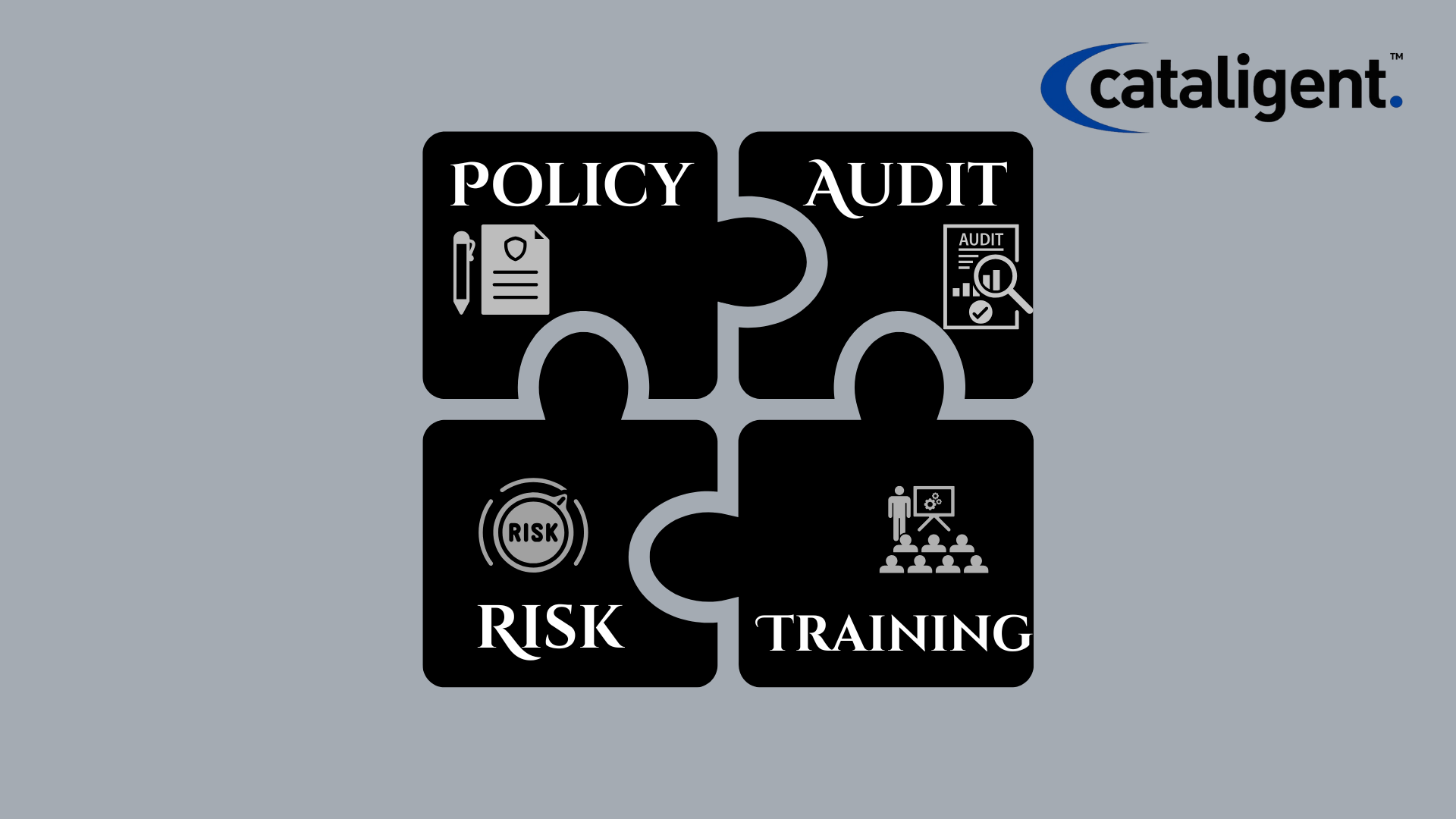
Consolidate Regulatory Compliance Efforts
Compliance cost grows when every regulation, audit request, control review, and evidence file is managed as a separate activity. Legal, finance, operations, IT, quality, and regional teams may all work hard, but duplicated testing, repeated documentation, unclear ownership, and late remediation create avoidable expense. Consolidate regulatory compliance efforts is a cost saving strategy because it turns scattered compliance work into a governed portfolio of obligations, controls, owners, evidence, and financial exposure.
The objective is not to reduce control quality. The objective is to reduce duplicated effort, prevent missed obligations, and confirm which compliance activities actually reduce risk, cost, or financial exposure. For consulting firms and enterprise transformation teams, consolidation also creates a stronger operating model for reporting progress to leadership and regulators.
What Is Regulatory Compliance Consolidation?
Regulatory compliance consolidation means bringing related obligations, policies, controls, evidence requests, remediation tasks, approvals, and reporting cycles into one managed system. Instead of each function maintaining its own tracker, the organization creates a shared view of compliance work across business units, legal entities, geographies, and risk categories.
In cost saving terms, consolidation clarifies the baseline cost of compliance, identifies duplicated work, assigns cost owners and measure owners, and separates planned efficiency from actual savings. A compliance consolidation program may include common control mapping, shared evidence libraries, coordinated audits, standard review calendars, unified policy management, and finance validated reduction of external advisory, manual testing, or rework cost.
Why Consolidating Compliance Efforts Matters for Cost Saving
Compliance teams often spend money because they cannot see the same obligation twice. One regulation may trigger separate work in legal, information security, procurement, quality, and operations. Without a common baseline, leadership may approve a savings target but fail to see whether the saving comes from reduced audit fees, fewer duplicate controls, lower remediation cost, or less manual reporting effort.
A governed cost saving program treats consolidation as a portfolio of savings initiatives. Each initiative needs a baseline cost, target savings, forecast savings, actual savings, sponsor approval, risk review, implementation evidence, and controller validation. This prevents a dangerous mistake: counting lower activity as savings before the organization proves that risk coverage remains acceptable.
| Compliance consolidation area | Where cost appears | Savings risk | Evidence needed |
|---|---|---|---|
| Duplicate control testing | Internal audit hours, external advisor fees, business owner time | Controls are removed without confirming coverage | Control mapping, risk acceptance, test plan approval |
| Scattered evidence requests | Manual document collection and repeated employee effort | Evidence becomes outdated or incomplete | Evidence owner, document version, audit trail |
| Separate policy reviews | Legal review cycles and regional review meetings | Local obligations are missed | Policy inventory, legal entity mapping, approval history |
| Uncoordinated audits | Audit preparation, management response, remediation tracking | Audit fatigue and repeated findings continue | Audit calendar, remediation owner, closure evidence |
Build a Compliance Cost Baseline Before Cutting Activity
The baseline should separate recurring cost from one time cost. Recurring cost may include external assurance fees, audit preparation, regulatory reporting, control testing, system access reviews, policy updates, and management reporting. One time cost may include remediation projects, consultant support, system configuration, or legal review for a specific regulation.
Finance teams should agree how baseline cost will be measured before savings are claimed. For example, reducing three overlapping control tests to one shared test may lower internal hours, but it should not be reported as EBIT impact unless the reduction leads to lower spend, capacity release, or a finance approved productivity benefit. This discipline protects the credibility of strategic cost reduction.
Map Obligations to Controls, Owners, and Savings Initiatives
Consolidation works when obligations are mapped to real ownership. A regulation should connect to policies, controls, process owners, evidence owners, risks, dependencies, and approvals. A savings initiative should then show exactly what will change: one control removed, two evidence requests combined, one audit calendar integrated, or one manual report replaced with governed reporting.
For enterprise teams, this improves accountability. For consulting firms, it creates a repeatable client delivery model that connects regulatory work to measurable execution. The same logic can support quality management system governance when compliance documentation, approval evidence, and audit trails need stronger control.
Use Stage Gates to Protect Risk Coverage
Compliance savings should move through stage gates. At definition, the initiative records the problem and baseline. At scoping, the measure owner, sponsor, controller, affected regulation, and business unit are assigned. At detailed planning, the team defines dependency checks, risk sign off, evidence requirements, and expected financial effect. At decision, leadership approves the change. At implementation, execution evidence is captured. At closure, finance confirms actual value and the controller validates the saving.
This protects the organization from reducing cost in a way that creates future penalties, rework, audit findings, or control weakness. It also gives the steering committee a clear view of implementation status and potential status, rather than a single green status that hides value risk.
Make Compliance Reporting Useful for Leadership
Executives do not need another long compliance activity list. They need a view of cost, risk, ownership, and value. A good report should show which consolidation initiatives are approved, which are blocked by dependencies, which have forecast savings at risk, which require sponsor decisions, and which have reached controller backed closure.
This is where compliance consolidation becomes part of business transformation, not just a legal or audit exercise. It connects obligation management with operating model simplification, process waste removal, supplier cost control, and financial impact tracking.
Metrics That Matter
The right metrics show whether consolidation is reducing cost without weakening control. Track baseline cost, target savings, forecast savings, actual savings, one time savings, recurring savings, EBIT impact, EBITDA impact where relevant, approval ageing, dependency blockage, implementation status, potential status, savings risk, audit finding recurrence, and controller validation. Also track evidence completeness because savings without closure evidence should remain potential value, not confirmed value.
| Metric | Why it matters | How to validate it |
|---|---|---|
| Baseline compliance cost | Prevents vague savings claims | Finance approved cost categories and prior period spend |
| Duplicate control reduction | Shows where work has been consolidated | Control map and risk owner approval |
| Forecast versus actual savings | Separates expected value from confirmed value | Budget variance, invoice reduction, capacity release evidence |
| Approval ageing | Shows governance bottlenecks | Workflow timestamps and sponsor response history |
| Controller validation | Confirms savings can be reported | Closure evidence and finance sign off |
Common Mistakes to Avoid
Removing controls before mapping obligations. Cost reduction becomes dangerous when teams remove testing or documentation without proving that the underlying regulatory requirement is still covered.
Counting reduced workload as financial savings too early. Lower activity is not actual savings until finance can connect it to spend reduction, capacity release, budget variance, or approved benefit realization.
Letting each function keep its own tracker. Separate trackers recreate the duplication that consolidation is meant to remove and make executive reporting unreliable.
Ignoring local legal entity differences. A shared control may work across regions, but local obligations, languages, evidence rules, or retention periods still need clear ownership.
Closing initiatives without evidence. A compliance savings initiative should not close until implementation evidence, risk review, and controller validation are complete.
How Cataligent Helps Through CAT4
Cataligent helps enterprises and consulting firms govern compliance related cost saving strategies through CAT4, its no code strategy execution platform. Through CAT4, teams can manage compliance consolidation as part of formal cost saving programs, with baselines, target savings, forecast savings, actual savings, owners, sponsors, controllers, approvals, risks, dependencies, and reporting in one governed place.
CAT4 supports Degree of Implementation, or DoI, stage gates so each compliance savings measure can move from defined to identified, detailed, decided, implemented, and closed. The platform also separates Implementation Status from Potential Status, which matters when a compliance initiative is on track operationally but the financial value is not yet validated. For larger portfolios, CAT4 can support multi project management views so leadership can see compliance, remediation, policy, and cost saving work together.
Cataligent also helps teams design the governance model around roles, decision rights, and reporting cadence. When ownership is unclear, internal organization design becomes part of the savings program, because a measure without a sponsor, controller, and owner cannot reach credible closure.
What Cataligent Does Not Claim
Cataligent does not claim that CAT4 automatically creates savings. CAT4 does not replace finance systems, ERP systems, accounting systems, procurement systems, BI platforms, or every project management tool. CAT4 does not guarantee ROI, compliance, savings, EBITDA improvement, or business outcomes. CAT4 supports governed execution, value tracking, approvals, reporting, and controller backed closure around cost saving programs.
Conclusion
To consolidate regulatory compliance efforts, leaders need more than a cost reduction target. They need a governed view of obligations, controls, owners, evidence, risks, dependencies, financial baselines, and validated savings. Talk to Cataligent about governing compliance related cost saving strategies through CAT4, so potential savings can move from idea to controller backed closure.
FAQs
How can compliance consolidation create confirmed savings?
Confirmed savings require a finance approved baseline, evidence of the change, and validation that spend, capacity, or budget impact has changed. Until then, the saving should be treated as forecast value.
Why is controller validation important in compliance cost reduction?
Controller validation helps confirm that reported savings are financially credible and not just lower activity counts. It also protects leadership reporting from double counting or unsupported claims.
Can CAT4 replace a compliance management system?
CAT4 supports governed execution, approvals, reporting, and value tracking around compliance initiatives. It should not be positioned as a replacement for every legal, finance, ERP, procurement, or specialist compliance system.