Month: April 2025

  • How to Build an Effective Incident Management Process

    How to Build an Effective Incident Management Process

    Ensuring uninterrupted business operations requires a robust incident management process that swiftly addresses and resolves IT disruptions. By implementing a structured approach, organizations can minimize downtime, enhance service quality, and maintain customer trust. This guide outlines the essential steps to develop an effective incident management process aligned with IT Service Management (ITSM) best practices.​

    Understanding Incident Management in ITSM

    Incident management is a critical component of ITSM focused on restoring normal service operations as quickly as possible after an unplanned interruption. Unlike problem management in ITSM, which seeks to identify and resolve the root causes of incidents, incident management prioritizes immediate resolution to minimize business impact. 

    Synergy Between Incident and Problem Management

    While Incident and Problem Management serve different purposes, their collaboration is vital for comprehensive ITSM. Incident Management deals with immediate symptom relief, ensuring that services are quickly restored to operational status. Once the immediate issue is addressed, Problem Management delves into the incident’s root cause, aiming to implement solutions that prevent future occurrences. This partnership ensures not only rapid recovery from disruptions but also continuous improvement in service stability.

    Key Steps to Develop an Effective Incident Management Process

    1. Incident Identification and Logging

      Prompt detection and accurate documentation of incidents are foundational. Utilize monitoring tools to detect anomalies and ensure all incidents are logged with pertinent details, including timestamps, affected systems, and initial assessments.
    2. Incident Categorization and Prioritization

      Classify incidents based on their nature and impact on business operations. Prioritization ensures that critical issues receive immediate attention, optimizing resource allocation and response efforts.
    3. Incident Response and Resolution

      Develop standardized procedures for addressing various incident types. Assign incidents to appropriate personnel or teams, equip them with necessary resources, and establish clear timelines for resolution. Automation can enhance efficiency and reduce human error during this phase.
    4. Communication and Stakeholder Engagement

      Maintain transparent communication with all stakeholders throughout the incident lifecycle. Regular updates on incident status, expected resolution times, and potential impacts foster trust and manage expectations effectively.
    5. Incident Analysis and Continuous Improvement

      After resolving an incident, conduct a thorough analysis to determine its root cause. Document findings and implement corrective actions to prevent recurrence. Regularly reviewing and refining the incident management process ensures adaptability to evolving business needs and technological landscapes.

    Best Practices for Incident Management

    • Define Clear Roles and Responsibilities: Establish a dedicated incident response team with clearly outlined duties to ensure accountability and efficiency during incident handling.​
    • Implement Automation: Leverage automation tools to detect, log, and even resolve certain types of incidents, thereby reducing response times and operational costs.​
    • Foster a Culture of Continuous Learning: Encourage teams to learn from past incidents by conducting post-incident reviews and sharing insights across the organization.

    How Cataligent Elevates Incident Management in ITSM

    Transitioning to an effective incident management process requires expertise and the right technological support. Cataligent specializes in delivering customized ITSM solutions that empower organizations to manage incidents proactively and efficiently. Our services include:​

    • Comprehensive ITSM Implementation: Deploying ITSM frameworks that integrate seamlessly with your existing operations, enhancing overall service management.​
    • Automation and AI Integration: Incorporating automation and artificial intelligence to reduce manual intervention, accelerate incident resolution, and minimize errors.​
    • Continuous Support and Training: Providing ongoing support and training to ensure your team is equipped with the knowledge and skills to manage incidents effectively.​

    Transform Your Incident Management with Cataligent

    Investing in a robust incident management process is crucial for maintaining business continuity and delivering exceptional service. Partnering with Cataligent ensures access to cutting-edge ITSM solutions tailored to your organization’s unique needs. Our expertise enables you to navigate the complexities of incident management with confidence and efficiency.​

    Ready to enhance your incident management capabilities? Connect with Cataligent today to discover how our ITSM solutions can drive your business forward.
  • Essential ITSM Terms Every IT Professional Must Know

    Essential ITSM Terms Every IT Professional Must Know

    In today’s IT Service Management (ITSM) landscape, understanding key terminologies is essential for IT professionals to optimize service delivery, improve incident resolution, and ensure a seamless customer experience. Whether you’re an IT support specialist, service desk manager, or a CIO strategizing IT operations, mastering these fundamental ITSM terms can enhance your efficiency and effectiveness.

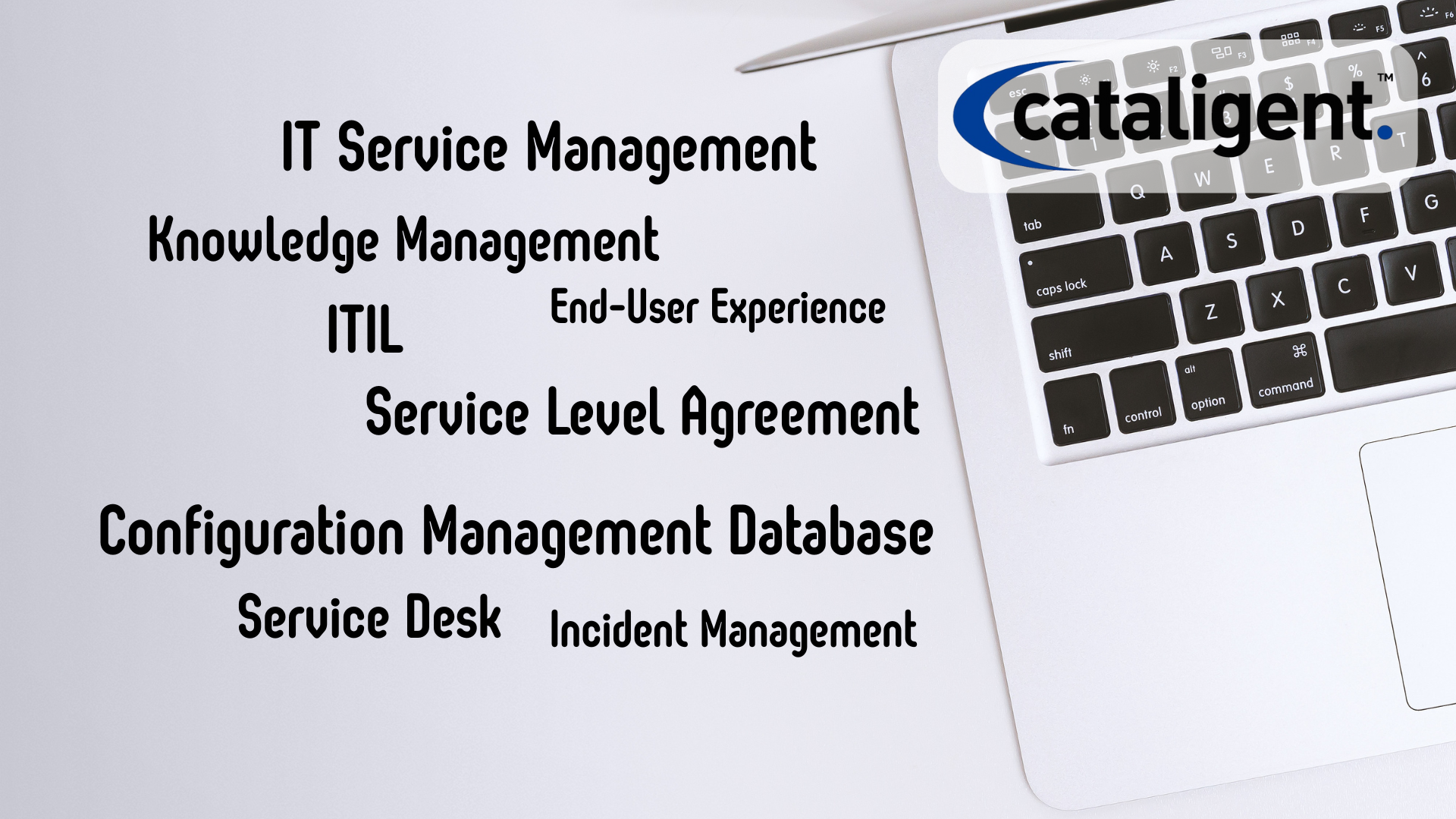
    1. IT Service Management (ITSM)

    ITSM refers to the implementation and management of quality IT services that meet business needs. It involves a structured approach to designing, delivering, managing, and improving IT services within an organization, following ITIL (Information Technology Infrastructure Library) best practices.

    2. Information Technology Infrastructure Library (ITIL)

    ITIL is a globally recognized framework for ITSM that provides guidelines on best practices for delivering IT services. It helps organizations align IT services with business objectives through structured processes like incident management, problem management, and change management.

    3. Incident Management

    Incident management is the process of identifying, analyzing, and resolving incidents to restore services as quickly as possible. Effective incident management minimizes downtime and ensures business continuity.  You can Learn more about Incident Management in ITSM via our previous post.

    4. Service Desk

    A service desk is the central communication point between IT teams and end users. It manages service requests, incident resolution, and user inquiries while following ITIL guidelines. An efficient service desk improves user satisfaction and operational efficiency.

    5. Problem Management

    Problem management focuses on identifying and eliminating the root causes of incidents to prevent future occurrences. It includes both reactive (addressing existing issues) and proactive (preventing potential issues) approaches.

    6. Change Management

    Change management is the structured approach to implementing changes in IT services without disrupting business operations. It ensures that all changes are evaluated, tested, and deployed with minimal risk.

    7. Configuration Management Database (CMDB)

    A CMDB stores information about IT assets, configurations, and their relationships. It helps IT teams maintain accurate records, improve asset management, and ensure compliance.

    8. Service Level Agreement (SLA)

    An SLA is a contractual agreement between an IT service provider and its customers, defining the level of service expected, response times, and responsibilities. Meeting SLA targets is critical for customer satisfaction and compliance.

    9. Operational Level Agreement (OLA)

    An OLA is an internal agreement between IT teams that defines how different service teams support SLAs to ensure seamless IT operations.

    10. Key Performance Indicators (KPIs) in ITSM

    KPIs measure the effectiveness of ITSM processes. Common ITSM KPIs include:

    • Mean Time to Resolution (MTTR) – Average time to resolve an incident.
    • First Call Resolution (FCR) – Percentage of issues resolved in the first interaction.
    • Customer Satisfaction Score (CSAT) – Measures user satisfaction with IT services.

    11. Knowledge Management

    Knowledge management is the process of capturing, organizing, and sharing IT knowledge within an organization. It enables IT teams to document solutions, troubleshoot issues faster, and reduce recurring incidents.

    12. IT Asset Management (ITAM)

    ITAM involves tracking and managing IT assets (hardware, software, licenses, etc.) to optimize costs, ensure compliance, and enhance security.

    13. Service Request Management

    This process handles user requests for standard services, such as password resets, software installations, or access permissions. Service requests differ from incidents as they are pre-defined and do not indicate service disruptions.

    14. IT Governance

    IT governance ensures that IT strategies align with business goals while maintaining compliance, security, and risk management. Frameworks like COBIT (Control Objectives for Information and Related Technologies) help establish IT governance policies.

    15. Root Cause Analysis (RCA)

    RCA is a problem-solving technique that identifies the fundamental cause of an incident to prevent recurrence. RCA is critical in problem management.

    16. Self-Service Portal

    A self-service portal allows end users to access IT services, submit requests, and find solutions to common issues without IT intervention, improving efficiency and reducing workload on the IT support team.

    17. End-User Experience Management (EUEM)

    EUEM focuses on monitoring and optimizing the experience of end users interacting with IT services. It helps businesses understand user satisfaction and enhance IT service delivery.

    18. Service Portfolio Management

    This involves managing the entire lifecycle of IT services, from ideation to retirement, ensuring alignment with business needs and value delivery.

    19. IT Operations Management (ITOM)

    ITOM includes processes and tools that optimize IT infrastructure performance, monitor IT services, and ensure smooth daily operations.

    20. DevOps and ITSM Integration

    Integrating DevOps with ITSM fosters collaboration between development and IT operations teams, streamlining deployments, reducing incidents, and enhancing agility.

    Conclusion

    Cataligent is a trusted provider of ITSM solutions, helping businesses streamline their IT operations with best-in-class frameworks and automation tools. With expertise in incident management, ITIL implementation, and IT governance, Cataligent ensures that IT teams achieve operational excellence while enhancing end-user satisfaction. Whether you need service desk optimization, change management implementation, or IT asset management, Cataligent provides tailored solutions that drive business success.

    To learn more about how Cataligent can transform your ITSM processes, visit their official website today!

  • 10 Myths About ITSM Tools and Software Solutions

    10 Myths About ITSM Tools and Software Solutions

    Businesses today rely heavily on IT Service Management (ITSM) tools to streamline IT operations, improve service delivery, and enhance user experience. However, several myths about ITSM tools prevent organizations from fully embracing their potential. Misconceptions such as “ITSM is only for large enterprises” or “ITSM is too expensive” can deter companies from leveraging these powerful solutions.

    In this article, we debunk 10 common myths about ITSM software solutions, helping businesses make informed decisions and adopt ITSM strategies that drive efficiency and innovation.

    Myth 1: ITSM is Only for Large Enterprises

    Many believe that ITSM solutions are designed solely for large corporations with extensive IT needs. In reality, ITSM frameworks can be tailored to businesses of all sizes. Small and mid-sized enterprises (SMEs) benefit from ITSM by automating workflows, reducing downtime, and improving IT service quality.

    Myth 2: ITSM is Just a Fancy Help Desk

    ITSM is often confused with a simple IT help desk. While help desks focus on resolving user issues, ITSM encompasses a broader spectrum of IT operations, including incident management, change management, asset tracking, and compliance adherence.

    Myth 3: ITSM is Too Expensive

    Another misconception is that ITSM implementation is costly and only justified for large-scale operations. However, modern ITSM solutions come in various pricing models, including cloud-based, subscription-based, and pay-as-you-go models, making them accessible and cost-effective for businesses of all sizes.

    Myth 4: ITSM Implementation is Complex and Time-Consuming

    Some organizations avoid ITSM tools because they fear long deployment times and complex integrations. The truth is that with the right provider, ITSM implementation can be smooth and efficient. User-friendly ITSM software reduces deployment time and ensures faster adoption by IT teams.

    Myth 5: ITSM Only Benefits the IT Department

    ITSM does not solely cater to IT teams; it enhances service delivery across the entire organization. From HR to finance and customer support, ITSM ensures streamlined service management, automation, and improved workflow efficiency.

    Myth 6: ITSM Reduces IT Flexibility

    A common myth is that ITSM enforces rigid structures that limit IT flexibility. However, modern ITSM solutions are highly customizable and can be adapted to business needs, allowing IT teams to maintain agility while following structured workflows.

    Myth 7: ITSM Requires a Large In-House IT Team

    Many assume that managing ITSM software demands a large IT team. However, many ITSM solutions come with intuitive dashboards, automation, and AI-driven capabilities, reducing the need for extensive IT personnel.

    Myth 8: ITSM Tools Are Not User-Friendly

    Early ITSM solutions may have had complex interfaces, but modern ITSM tools prioritize user experience and intuitive design. Adopting a user-centric approach in ITSM has led to solutions that simplify IT operations and enhance accessibility.

    Myth 9: ITSM Only Focuses on IT Issues

    While ITSM does address IT-related issues, it also aligns IT services with business objectives, compliance regulations, and customer service improvements. It provides businesses with structured processes to manage service requests, improve decision-making, and enhance service quality.

    Myth 10: ITSM Adoption Requires a Complete IT Overhaul

    Some believe that adopting ITSM means discarding existing IT infrastructures. However, ITSM tools can be seamlessly integrated with current systems, ensuring a smooth transition without disrupting ongoing operations.

    Why Businesses Should Embrace ITSM Solutions

    Debunking these myths highlights the importance of ITSM tools in modern enterprises. ITSM enhances IT efficiency, automates workflows, improves compliance, and aligns IT operations with business goals. Organizations that implement ITSM experience reduced downtime, improved service delivery, and increased productivity.

    How Cataligent Delivers Best-in-Class ITSM Solutions

    To successfully transition to ITSM, businesses need a reliable ITSM provider. Cataligent offers tailored ITSM solutions that help organizations streamline IT workflows, automate processes, and improve overall IT service management. With a focus on scalability, automation, and AI-driven IT solutions, Cataligent ensures businesses achieve operational excellence and superior end-user satisfaction.

    Transform Your IT Operations with Cataligent

    Cataligent’s ITSM solutions empower businesses with cost-effective, scalable, and intelligent IT service management. Whether you’re looking to adopt ITSM from scratch or optimize existing processes, Cataligent provides cutting-edge solutions to revolutionize your IT operations.

    Get the complete benefits of ITSM—collaborate with Cataligent right now!

  • ITSM vs. Traditional IT Support: What’s the Difference?

    ITSM vs. Traditional IT Support: What’s the Difference?

    In a world where business efficiency and seamless IT operations are crucial for success, companies must choose the right approach for managing IT services. Many organizations still rely on traditional IT support, which operates on a break-fix model, while others have transitioned to IT Service Management (ITSM), a structured approach that aligns IT with business objectives.

    Understanding the differences between ITSM and traditional IT support is essential for businesses looking to improve IT service delivery, reduce downtime, and enhance operational efficiency. This blog explores these key differences and why modern enterprises must adopt ITSM to stay competitive.

    What is Traditional IT Support?

    Traditional IT support, often known as the help desk model, primarily focuses on resolving IT issues as they arise. It is a reactive approach that lacks a structured framework for service management and long-term IT strategy. Businesses that rely on traditional IT support often experience:

    • Longer resolution times due to a lack of automation.
    • Unstructured IT workflows leading to inefficiencies.
    • Higher operational costs due to frequent system failures.
    • Minimal alignment with business objectives.

    While traditional IT support may work for small-scale businesses with minimal IT needs, it fails to meet the demands of enterprise-level organizations requiring a scalable and proactive IT strategy.

    What is IT Service Management (ITSM)?

    IT Service Management (ITSM) is a comprehensive approach to managing IT services, focusing on proactive service delivery, process automation, and business alignment. Unlike traditional IT support, ITSM follows structured frameworks like ITIL (Information Technology Infrastructure Library) to enhance service quality, efficiency, and scalability.

    With ITSM, businesses benefit from:

    • Automated IT workflows that enhance efficiency.
    • Proactive problem management to prevent disruptions.
    • Better IT governance and compliance.
    • Data-driven decision-making through performance analytics.

    Key Differences Between ITSM and Traditional IT Support

    FeatureTraditional IT SupportIT Service Management (ITSM)
    ApproachReactive (fix issues when they occur)Proactive (prevents issues before they occur)
    Process StructureUnstructured, manual workflowsAutomated, standardized processes (ITIL)
    ScalabilityLimited to small IT teamsDesigned for enterprise-level scalability
    Service DeliveryFocused on solving immediate problemsFocused on long-term service improvement
    Business AlignmentMinimal alignment with business goalsStrong alignment with business strategy
    EfficiencyProne to downtime and inefficienciesImproves productivity through workflow automation

    For businesses looking to scale, ITSM is the preferred choice, as it provides a holistic and future-proof IT strategy.

    How ITSM Enhances Business Efficiency

    1. Proactive IT Management – ITSM ensures that businesses anticipate and resolve IT issues before they disrupt operations.
    2. Improved User Experience – Features like self-service portals and AI-driven ticketing enhance IT service accessibility.
    3. Better IT Compliance and Governance – ITSM helps businesses adhere to industry regulations and cybersecurity best practices.
    4. Scalability and Automation – ITSM automates repetitive tasks and allows businesses to scale IT operations seamlessly.

    To dive deeper into the core components of ITSM, explore this resource that outlines essential ITSM principles and best practices.

    Why Businesses Should Transition to ITSM

    Organizations adopting ITSM frameworks experience lower operational costs, enhanced IT service quality, and greater business agility. With leading global enterprises leveraging ITSM, it is clear that structured service management is the future of IT operations.

    Companies that continue relying on traditional IT support risk falling behind due to inefficiencies, high maintenance costs, and poor service delivery. To stay competitive and future-proof IT operations, businesses must make the shift to ITSM-driven service management.

    How Cataligent Delivers Exceptional ITSM Solutions

    Transitioning from traditional IT support to ITSM can be challenging, but Cataligent makes it seamless. As a trusted ITSM solutions provider, Cataligent offers:

    • End-to-end ITSM implementation to enhance business efficiency.
    • Customized IT automation solutions tailored to business needs.
    • AI-driven ITSM tools for proactive issue resolution.
    • ITIL-compliant frameworks ensure best service management practices.

    Drive IT Excellence with Cataligent ITSM Services

    Investing in Cataligent’s ITSM solutions means ensuring business continuity, enhanced service delivery, and long-term operational efficiency. Whether you’re looking to migrate from traditional IT support or optimize existing ITSM processes, Cataligent provides the expertise and technology to transform IT service management for your enterprise.

    Ready to streamline your IT operations?

    Connect with Cataligent today and explore how our world-class ITSM solutions can help your business thrive!

  • How ITSM Enhances End-User Satisfaction and Business Efficiency

    How ITSM Enhances End-User Satisfaction and Business Efficiency

    A business’s success today depends not only on the quality of its products or services but also on the efficiency of its IT operations. Employees and customers expect seamless digital experiences, and any disruption in IT services can significantly impact productivity and satisfaction. This is where IT Service Management (ITSM) plays a crucial role. By implementing structured ITSM frameworks, businesses can ensure smooth IT workflows, faster issue resolution, and enhanced service delivery, leading to higher end-user satisfaction and overall business efficiency.

    This blog explores how ITSM helps organizations elevate end-user satisfaction, reduce downtime, and create a more productive work environment.

    What is ITSM, and Why Does It Matter?

    IT Service Management (ITSM) refers to the strategic approach businesses use to design, deliver, manage, and improve the way IT services are used. Unlike traditional IT support, ITSM follows a structured framework that aligns IT processes with business goals, ensuring efficiency and reliability.

    A well-implemented ITSM system helps businesses achieve:

    • Faster issue resolution through streamlined IT support workflows.
    • Proactive problem management, reducing downtime and business disruptions.
    • Better alignment of IT services with business objectives.
    • Enhanced compliance and security for seamless operations.

    How ITSM Improves End-User Satisfaction

    1. Faster Response and Resolution Times

    With automated ITSM tools, businesses can resolve IT issues faster and minimize disruptions. Features like AI-driven ticketing systems, self-service portals, and automated workflows help employees get back to work without waiting for prolonged resolutions. Faster support translates directly into higher employee productivity and satisfaction.

    2. Self-Service Portals Empower Users

    Modern ITSM solutions offer self-service portals, enabling users to solve minor issues independently. Knowledge bases, automated troubleshooting guides, and AI chatbots reduce dependency on IT teams while ensuring end-users receive instant support.

    3. Proactive Problem Management

    Instead of reacting to IT issues, ITSM enables businesses to adopt a proactive approach. Advanced monitoring and predictive analytics help IT teams identify and address potential problems before they escalate, ensuring a seamless end-user experience.

    4. Improved Communication and Transparency

    A structured ITSM framework ensures better communication between IT teams and employees. Automated notifications, real-time status updates, and SLA tracking keep end-users informed, reducing frustration and increasing trust in IT services.

    5. Continuous Improvement Through Feedback

    ITSM frameworks integrate user feedback loops, allowing businesses to assess IT service performance and make continuous improvements. Regular feedback collection ensures IT teams align services with actual business needs, leading to better end-user experiences.

    6. Standardized IT Processes for Consistency

    Standardizing IT processes through ITSM best practices ensures that every IT request follows a structured workflow, reducing inconsistencies and errors. This leads to a more reliable IT service environment and enhances user confidence.

    Why Businesses Must Adopt ITSM Now

    Businesses that embrace ITSM experience measurable benefits, including cost savings, increased efficiency, and higher end-user satisfaction. To dive deeper into why ITSM is crucial for modern enterprises, read this detailed analysis: Why Is ITSM Important?.

    Cataligent: Your Trusted ITSM Partner

    If you’re looking for a magnificent and reliable ITSM provider, Cataligent offers best-in-class ITSM solutions tailored to optimize business workflows and enhance end-user satisfaction. Our expertise in IT automation, workflow optimization, and incident management ensures that your business operates smoothly with minimal disruptions.

    With Cataligent’s advanced ITSM solutions, businesses can:

    • Automate IT workflows for efficiency.
    • Minimize downtime through proactive issue resolution.
    • Improve IT governance with structured processes.
    • Enhance end-user experiences with faster response times.

    Transform Your Business with Cataligent ITSM Solutions

    In today’s fast-paced digital landscape, businesses must prioritize efficiency, reliability, and user experience. Cataligent provides cutting-edge ITSM solutions that not only streamline IT operations but also enhance overall business performance.

    By leveraging Cataligent’s ITSM expertise, your organization can experience seamless IT service delivery, reduced operational costs, and improved customer and employee satisfaction. Our tailored ITSM frameworks are designed to meet the unique needs of businesses across various industries, ensuring sustainable growth and long-term success.

    Choosing the right ITSM partner can make a significant difference in how smoothly your IT operations run. With Cataligent’s expertise in ITSM implementation, process automation, and service optimization, your business can focus on its core objectives while we handle the complexities of IT service management.

    Don’t let inefficient IT processes hold your business back. Partner with Cataligent today and take the next step toward an optimized IT environment that drives business excellence!Contact us today to explore how Cataligent’s ITSM solutions can revolutionize your IT infrastructure!


  • How Automated and Secure ITSM Promotes Productivity and Financial Growth

    How Automated and Secure ITSM Promotes Productivity and Financial Growth

    In today’s rapidly evolving digital environment, businesses rely heavily on IT Service Management (ITSM) to streamline operations, boost employee productivity, and enhance financial performance. With automation and security playing a pivotal role, ITSM has become more than just a backend support system—it’s now a strategic asset.

    What is Automated and Secure ITSM?

    Automated ITSM involves the use of artificial intelligence (AI), machine learning (ML), and intelligent workflows to automate repetitive tasks like ticketing, incident resolution, change management, and asset tracking. This reduces manual effort, lowers errors, and speeds up IT processes. Secure ITSM ensures that all service operations follow cybersecurity best practices to prevent breaches, data leaks, and compliance violations.

    When automation and security are integrated into ITSM, the results are transformative. Organizations can reduce downtime, increase service efficiency, and protect sensitive information—all of which contribute directly to financial growth and operational excellence.

    The Productivity Advantage

    One of the most immediate benefits of automated ITSM is enhanced productivity. Here’s how:

    • Faster Issue Resolution: Automated ticketing and AI-driven chatbots resolve routine queries instantly, freeing up IT teams for complex tasks.
    • Self-Service Portals: Employees can access self-service knowledge bases and resolve issues independently, reducing dependency on support staff.
    • Proactive Monitoring: Automation tools can detect and resolve potential issues before they escalate, minimizing disruptions.

    Secure ITSM also plays a critical role in productivity. By ensuring that systems are safeguarded against cyber threats, employees can work confidently and without interruptions caused by security breaches or downtime.

    Financial Growth Through Efficient ITSM

    Automated and secure ITSM not only improves day-to-day operations but also contributes significantly to a company’s bottom line:

    • Reduced Operational Costs: Automation cuts down on the need for large IT support teams, lowering labor costs.
    • Minimized Downtime: Secure systems ensure continuous availability of services, reducing revenue losses from outages.
    • Improved Asset Utilization: Automated asset management ensures optimal use and timely maintenance of IT assets.

    Moreover, a streamlined ITSM approach supports digital transformation initiatives, which are critical for modern businesses aiming to stay competitive and agile.

    Interlinking Service-Oriented Architecture with ITSM

    To understand how an automated and secure ITSM system can be made more effective, it’s essential to explore the concept of a service-oriented approach in ITSM. This approach aligns IT services closely with business objectives, ensuring that every function adds measurable value. It fosters transparency, agility, and responsiveness, which are essential for financial sustainability.

    When service orientation is combined with automation and security, ITSM evolves into a business enabler. It breaks silos, allows better collaboration, and drives innovation through flexible and scalable IT service delivery.

    Real-World Examples of Success

    1. Financial Institutions: Banks and insurance companies leverage secure ITSM platforms to handle thousands of customer queries per day while maintaining compliance with strict data regulations.
    2. Healthcare Providers: Hospitals use automated ITSM to manage medical equipment, patient data systems, and administrative tasks efficiently.
    3. E-Commerce Businesses: Online retailers automate their IT support to handle spikes in customer service requests during sales and holidays.

    Building a Resilient ITSM Framework

    To successfully implement automated and secure ITSM, organizations should:

    • Invest in AI and ML: Integrate tools that can learn from data to improve workflows and incident management.
    • Adopt Zero Trust Security Models: Ensure that every user, device, and application is verified before accessing the system.
    • Train Employees: Ensure your staff understands new systems and can use them effectively.
    • Monitor Continuously: Use automated monitoring for real-time insights and quick response.

    Process-Based Management: The Next Level

    Once organizations have adopted automation and security in ITSM, the next logical step is embracing process-based management in ITSM . This ensures that ITSM processes are aligned with organizational goals, standardized across departments, and continuously optimized.

    A process-based approach brings consistency, transparency, and control—crucial for scaling business operations without compromising on quality or security.

    Final Thoughts

    Automated and secure ITSM is no longer a luxury but a necessity for businesses aiming to thrive in a fast-paced, digitally driven world. It boosts productivity, reduces costs, and strengthens security—all leading to sustainable financial growth. By integrating service-oriented and process-based strategies, companies can future-proof their IT infrastructure and turn it into a core driver of success.